Showing posts with label photos. Show all posts

Saturday, October 11, 2014

geometry at the fair

Last month, West Springfield once again hosted the Eastern States Exposition (or “The Big E”), which brings together fair activities from six states: Maine, New Hampshire, Vermont, Massachusetts, Connecticut, and Rhode Island. It’s great fun to attend, and includes displays of the finest crafts to have competed in county and state fairs from all over the northeastern U.S. in the past year. This means, for instance, that there are a bunch of great quilts.

Symmetry naturally plays a large part in the design of these quilts. The interplay between large-scale and small-scale, and between shapes and colors, creates aesthetic interest. This quilt, for instance, presents squares laid out in a basic tiling pattern (a square lattice). Each square contains a star-shaped figure. The star itself has fourfold dihedral symmetry, which matches the symmetry of the lattice, but the choice of colors in the stars breaks the symmetry of the reflections, resulting in cyclic (i.e., pure rotational) symmetry.

This quilt also shows fourfold dihedral symmetry in the shapes, which is broken into cyclic symmetry by the colors. It hints at eightfold (octahedral) symmetry in some places, but this is broken into fourfold symmetry by the colors and by the relationship of these shapes to the surrounding stars.
This pattern shows fourfold cyclic symmetry at the corners, but that’s not what first caught my eye. The basic tile is a rectangle, which has the symmetry of the Klein four-group (no, not that Klein Four Group). For the two quilts above, I first noticed the large-scale symmetry that was broken at the small scale; here I first saw the limited small-scale symmetry that is arranged in such a way as to produce large-scale symmetry. (I think this is because I tend to notice shapes before colors.)
This quilt uses the square lattice on the large scale, but varies the type of small-scale symmetry. Each square contains the same shapes, but they are colored differently so that sometimes the symmetry is dihedral, sometimes cyclic.
This next quilt is geometrically clever in many ways. It has no reflection symmetries, even disregarding the colors, although the basic shapes that comprise it (squares and a shape with four curved edges, two concave and two convex, for which I have no name Edit 10/15: In an amusing exchange on Twitter, I learned that this shape is described among quilters as an “apple core”) do have reflection symmetries. (I am disregarding the straight lines that cut the curved shapes apple cores into smaller, non-symmetric pieces.) The centers of the squares lie on a lattice that matches the orientation of the sides of the quilt, but the sides of the squares are not parallel to the sides of the quilt. The introduction of curved shapes also acts in tension with the rectangular frame provided by the quilt medium.
Some of the quilt designs rejected fourfold symmetry altogether. Here is one based on a hexagonal lattice:
and another based on a triangular lattice:
(These two lattices have the same symmetries.)

Here is a quilt that stands out. It appears to simply be pixellated:

but if you look closely, you’ll see that the “pixels” are not squares, but miniature trapezoids.
It therefore has no points that display fourfold symmetry. All rotational symmetries are of order two.

All of the types of symmetries of the above quilts (except, perhaps, the one that used some tiles with dihedral symmetry, some with merely cyclic) can be described using wallpaper groups, which I leave as an exercise for the reader.

This next design seems more topological than geometric: it is full of knots and links.

This quilt has an underlying square lattice pattern, but the use of circles again evokes links, at least for me.

It was a surprise to come across a quilt with fivefold symmetry, but it makes perfect sense for a tablecloth.

Finally, this quilt was just gorgeous. The underlying pattern is simple—again a square lattice—but the diagonal translations are highlighted by the arrangement of the butterflies.

As you can see, it was decorated as “Best of Show”. We were particularly happy to see it receive this prize, because we had previously seen it in Northampton’s own 3 County Fair!

Tuesday, December 31, 2013

the best “real-life” use of geometry I saw this year

On May 3, 2003, the Old Man of the Mountain—a rock formation that had been known for at least two centuries as one of the natural wonders of New Hampshire—collapsed. No one saw it happen; that morning two park rangers looked up and realized he was gone. It had been expected that this day would arrive. The Old Man’s face was a remnant of ancient glacial movements, and it was not stable, thanks to erosion and freezing; it had already been repaired multiple times since the 1920s. In 2007, a project was begun to memorialize the Old Man, and in 2011 the “Profiler Plaza” was dedicated.

Over fall break this year, my wife and I made a trip to the western edge of the White Mountains, where the Old Man of the Mountain used to reside. We stopped by the memorial to the Old Man that is now located on the edge of “Profile Lake”, where I was astounded by the ingenuity of the project that had been created. Not content with photographs or descriptive plaques, the Old Man of the Mountain Legacy Fund sought to recreate the experience of viewing the famous visage.

This optical illusion is created by looking along any of several different steel structures, called “profilers”.

Each profiler has an array of raised features that, when viewed from an appropriate angle, line up to recreate the face on the mountain from the viewer’s perspective.

The distance from the Profiler Plaza to the Old Man’s former location is about half a mile, but for the profile effect to work requires careful placement of the viewer’s eyes. Thus each steel profiler comes equipped with three spots, marked according to the viewer’s height, so that they will be in the proper alignment. (Below is a picture of my wife looking at one of the profilers.)

I found this application of geometry to a memorial not only ingenious, but also quite stirring. The Old Man of the Mountain inspired several artistic works, including Nathaniel Hawthorne’s short story “The Great Stone Face”. When I was in high school, my mom directed a theatrical adaptation of this story, in which I played the role of the visiting poet who appears near the end of the tale. So I felt a special connection to this place as I visited it for the first time.

It seems this could make a useful cross-disciplinary lesson in school, say between English, geometry, and U.S. history. Students could study the stories of the Great Stone Face and the monument’s demise in 2003. Then they might be asked to choose a location and design the memorial, working out the necessary measurements. For instance, here is a link to a map with the face’s former location marked: 44.1606° N, 71.6834° W. The actual location of the profilers is on the north shore of Profile Lake. If anyone carries this out, I’d love to know how it goes!

Thanks for reading, and Happy New Year!

Wednesday, January 17, 2007

kilts and auld lang syne

The last major event of my trip to the States was the New Year’s Ball of the Chicago branch of the Royal Scottish Country Dance Society. This was my first time to go out Scottish dancing (I’d attended a couple of evenings of practice before), and I was rather pleased with myself by the end of the evening. No, I didn’t get all the dances right, but I did dance all of them (18 in all, plus the waltzes) and I never felt like I was struggling much more than the average dancer. It was a lot of fun. It’s a dance form that’s occasionally demanding intellectually, and it’s not as accessible to the casual dancer as some other styles of social dancing (contradance in particular), but I think I’ve developed a taste for it.

The conventional wisdom, as explained to me by Hannah and Mike (who loaned me the outfit I wore) is that every man looks better in a kilt. So that you can decide for yourself, compare this image with other times you’ve seen me:
(It’s no fair to point out that Hannah still looks better than me, even though conventional wisdom is also supposed to hold that Scottish events belong to that rare category of times in which the men shine and strut while the women accessorize them.) That’s a military jacket I’m wearing. The blue tassles near the tops of the stockings are called “flashes”, and they’re held on by a band that actually functions to hold the stockings up. The pouch in front is called a “sporran”, and it functions as a purse. Quite useful when one wants to inconspicuously carry around the directions for the dances. The kilt’s a bit longer than it should be (not bad for being borrowed, however), because the knees are supposed to be visible.

Despite being nearly a fortnight past December 31, this was a New Year’s event (scheduled as it was to allow other year-turning activities to run their course and not interfere with the dancers’ attendance), and so we sang “Auld Lang Syne” at the end. Also, that’s just appropriate for any time a group is celebrating Scottish culture. They sang two verses, skipping about on the second, which I didn’t know at all (I saw a couple others “loo-looing” with me, as well). The evening ran much later than Hannah and I expected, but was exhilarating the whole time, so I never felt tired. My calf muscles took a couple of days to relax, though; Scottish dance requires you to be on your toes, pointing and bouncing incessantly. The styling is part of the fun.

I heartily encourage all to get out and dance (in whatever style) when the opportunity arises. It’s social, it’s fun, and it’s great exercise.

Tuesday, December 05, 2006

Friday mix

Original post: November 11.
Reposted with photo: December 5. (Cheap way of making it look like I’ve worked on the blog, huh?)

In the academic world, each semester brings its own rhythms, which depend on classes, seminars, who’s around, and numerous other small factors. Sometimes we feel the standard workweek tides, but more often we just get together whenever seems appropriate and settle down to work or socializing. (Contrary to popular stereotypes, most mathematicians really enjoy social activities. It’s possible that in a large fraction of cases they only know how to socialize with other mathematicians, however. It’s difficult to avoid making math jokes through an entire meal or party.)

This fall Friday is the fullest day of the week, normally. It begins at 9:00 in the morning with the course Dr. Hubbard is teaching on Teichmüller theory. This is aimed at a broad graduate student audience. It meets just once a week for two hours. From a review of the definitions of manifolds, differential forms, and cohomology, we have progressed through the proof of the uniformization theorem for Riemann surfaces and are now studying plane hyperbolic geometry (one of my favorite parts of the whole theory), which can be transported to Riemann surfaces (with only a few exceptions) via uniformization (most Riemann surfaces have the unit disk, i.e., the hyperbolic plane, as their universal cover). Most of the students seem to like Hubbard’s teaching overall; he almost certainly teaches in a way they’ve never seen before.

After the class we go to a seminar on Teichmüller theory (loosely speaking; other areas of interest to the participants pop up from time to time). This is where Douady and Roland spoke while visiting Marseille. The audience is quite active. It’s more or less a lecture format, but the peanut gallery is quite happy to interject with questions or points they feel should be clarified. I’ve spoken with some of the organizers, and they claim that they try to encourage an atmosphere where questioning is permitted, because it’s so incredibly frustrating to sit through an entire lecture and have no idea what the speaker said after the first couple of minutes. Apparently at some universities (especially in France, according to their accounts), questioning is actively discouraged. Only the most distinguished attendees may dare to make a remark before the end of the seminar. (In truth, it’s often helpful to younger or less bold audience members if one of the senior members asks a question, because it makes them feel more at ease—you mean there were others for whom that wasn’t totally clear? Oh, that’s a relief.)

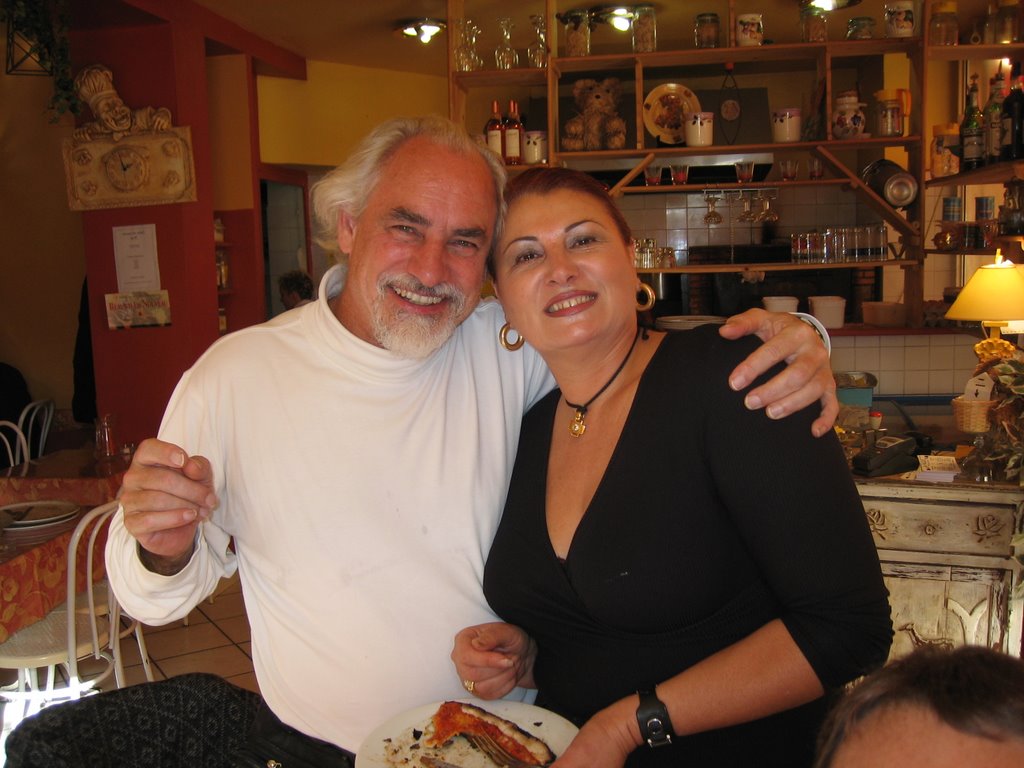
If those morning activities weren’t enough fun, then just wait until lunch. We all hike over to a pizza restaurant called Le Racati. It’s run by a matronly woman who is known simply as “la patronne” (the boss). Various members of the seminar vie for her favor. She takes good care of “les garçons” (as the seminar members are called, since until this year it’s been almost exclusively men). There are usually ten or twelve of us, and we go through four or five pizzas, four or five carafes of wine, a bowl of salad, and whatever other gifts la patronne bestows (sometimes fruit, sometimes desserts). Conversation usually centers around upcoming seminar talks, current mathematical topics of interest, and cultural exchange. This week, following the U.S. elections, politics was a hot subject. Whether any more work gets done by any particular individual the rest of the day depends on how many glasses of wine he or she had. Friday lunch is a highlight of every week. Here’s a photo of la patronne with Prof. Hubbard:


I haven’t quite figured out Friday nights in Marseille. For the first few weeks, we were having dinner with the Hubbards. One week soon after we finally moved into our apartment I took a stroll by myself and treated myself to a nice couscous dinner. There was the party at our place the night before I left for Ithaca a month ago. Twice Sarah and I have gone out to the cinema. There’s nothing consistent, like the choir rehearsal / contradance combination I had in Ithaca. But it hasn’t been bad, for the most part. Movies are relatively inexpensive, fine restaurants are plentiful, and it’s a chance (as always, in any location) to break from the demands of work. I think we should have another party soon. And I should find someplace to dance.

Just to let you know that we do actually work around here, at least for four hours a week on Friday mornings. :-) Now we just need to work on finding folk in the office in the middle of the week, too …

Thursday, November 30, 2006

Remember how things kept changing in "Labyrinth"? It's like that, except without the Jim Henson characters.

Time to give a bit more of a description of Marseille, now that I've had a few afternoons and evenings to walk around.

Whether one travels to Marseille by plane or train, one generally arrives at the Gare Saint Charles, since that's also where the navette (shuttle) from the airport drops you off following the half-hour ride into town. ("Gare" means "station". "Garer" is the verb "to park", whence the word "garage". Yep, it's not just geography, it's etymology! I love languages.) The front of the gare is actually quite beautiful, with lovely statues and ironwork. I don't have pictures facing the gare, but here you can see the view from the top of the stairs leading down from the station into the city:

The main road leading straight out from the escalier is the Boulevard d'Athènes. Just to the right of center you can see Notre Dame de la Garde. Brilliant location, yes? The Vieux Port is just outside of the scope of this picture, off to the right. The golden statue atop the tower is supposed to represent Mary (la bonne mère) watching over the ships in the harbor and at sea. You can read more of the basilica's history (including speculations as to that hill's religious and military use in ancient times) on the website linked above.

Behind the gare is one campus of the Université de Provence, the one where we spend our Friday mornings in Dr. Hubbard's class and the Teichmüller seminar. Describing the path to the campus is how I can begin justifying the title of the essay. If I had turned around from where I was at the top of the stairs and taken a picture in that direction, you would have seen a plastic wall zoning off a construction area. All along the western side of the gare (the stairs face south, by the way) is a hefty amount of construction. The plan, I think, is to add stores and a parking area. Somehow this construction is taking over the entire street along that side. What should be wide pedestrian areas have been transformed by metal fences into a maze of twisty little passages, all alike. On the far side of the street, more construction walls abound, and in recent weeks have begun diverting pedestrians farther and farther away from various intersections, thus necessitating the introduction of more crosswalk signals. I'm convinced that eventually the entire area will be construction, with no room for either walking or driving.

If instead of going around the gare to the campus you begin walking down the Boulevard d'Athènes, you'll reach the Place des Capucines:

This is not far from where we live. There's a patisserie we're fond of just a few meters back up the street from the Place des Capucines. Once you're there, turn left and you'll see the Eglise des Réformés:

(I have to take a picture of it at night sometime, when the rose window is lit up from inside.) Despite what its name might suggest, it is a Catholic church, and was named for a Reformed Augustinian monastery which existed on the site previously.

Here is where my pictures end. I'd like to keep walking down the Boulevard d'Athènes just a bit, however, until we get to La Canebière. This is the major road leading down to the Vieux Port (on the right); to the left, it also leads to Les Réformés (the street I showed you isn't parallel to La Canebière). La Canebière is a mess right now, with massive construction again encroaching on pedestrian areas. "Encroaching" is perhaps not the right word -- "engulfing" might be more accurate. Marseille is in the process of installing a new tramway system. This involves a complete redesign of the sidewalks along with the basic work of laying down the rails. Along this road, the effect has mainly been squeezing the traffic. In other places around town, the construction involves frequent changes in the routes and direction of traffic. As one postdoc who's working here said, "I ride my bike around here a lot, and it's like the topology changes every day."

Enough complaining about construction. (Mostly it makes me glad not to be driving.) I want to describe the Vieux Port, because it's a nice place for evening walks. I wish I had pictures of it right now. I've been down there twice by myself (in very different moods), and a couple of times with friends. It's a popular gathering spot; one finds many couples and groups of friends chatting on benches along the waterfront. During the day lots of fishmongers line the waterfront.

At night a few people fish in between the docked ships. Once I saw a couple struggling to get their fishing line to work, and they asked another man to help them out. By working together, they discovered that the casting mechanism just didn't work well. So they just kept the line in close to the shore. I believe they and the other fisherfolk I saw were using bread as bait. A couple small schools of perhaps twenty or thirty fish moved mysteriously about. The man in the couple watched a small fish dart towards and away from his hook, until he pulled the line out and the hook was stripped clean. His wife/ladyfriend chortled, and they began discussing what kind of bait would be better. Crevettes (shrimp), one proposed. Then the man who was helping walked over to a nearby puddle of standing water, and pointed out that it contained a handful of tiny fish, which could be used as bait for the larger fish. He caught one for them, and they gave it a try. While their new bait bobbled in the water, I walked over to the puddle, as well. The man noticed my somewhat bemused air, and explained that when boats come in and dump fish on the quai, these little fish are left in the puddles after the rest are taken away. The woman came over and pleaded for him to catch another piece of bait, because the one they were using had died and stopped wriggling. He did, and the guy in the couple exclaimed, "Putain! Tu es plus rapide que le poisson!" ("Putain" is the mild vulgarity of choice in Marseille.) The new bait secured, he dropped the line back in the water and started saying, "Viens, viens, grand poisson, mange le petit poisson." ("Come, come, big fish, eat the little fish.") That was enough of that story for me. I sort of wished I had stayed to see if they caught anything, but I wanted to move on and see other things.

One of my favorite sights at the Vieux Port is a massive school of silver-scaled fish swimming about just at the top of the harbor. In sunlight or lamplight, their writhing motions occasionally turn each of them so that they reflect light off their sides to the observer. It's like watching aquatic fireflies. Also at night, Notre Dame de la Garde is brilliantly illuminated and stunning from the harbor. (I tried to get a picture of that one night, but the battery in my camera was worn out.)

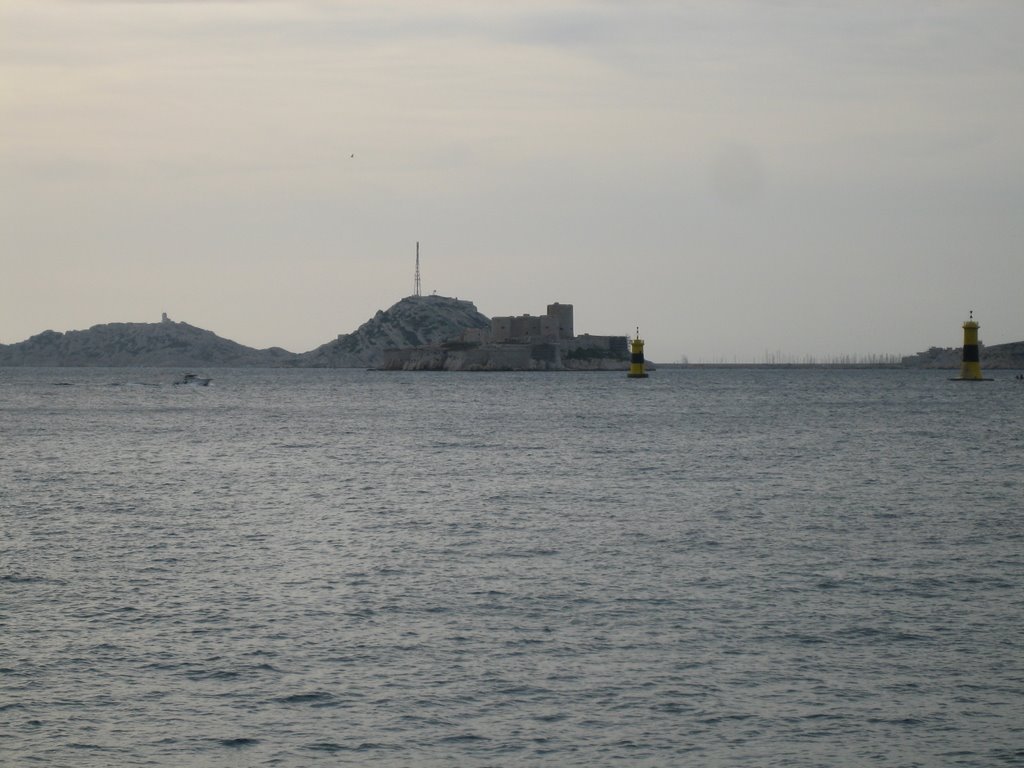
Out past the mouth of the harbor rests the Château d'If, a former island prison made famous by Dumas when he unjustly imprisoned his Count of Monte Cristo there. I do have a picture of this from a distance, taken from a spot where the Hubbards often like to swim:

I certainly plan on making it out to visit the château sometime.

The population of Marseille is dominated, at least in our neighborhood, by North Africans. You're as likely to hear Arabic on the streets as French. Lots of stores had special offers and special hours while Ramadan was happening a couple of months ago. A fortunate side effect of this demographic is the presence of lots of couscous restaurants. In about a four block radius of our house, I've found at least a half-dozen, without really looking hard. The two nicest ones I've been to are Le Femina, on the Rue du Musée, and one down by the Vieux Port whose name I don't know (although inside they have posted a brief story on the 7th century Berber princess Kahena). I've tried a handful of others, and there are two in our neighborhood that I like and are reasonably priced to eat there once a week or so.

The major type of restaurant one encounters on the streets here serves kebab sandwiches. A kebab in this case is an immense amount of lamb skewered, roasted, and left to rotate next to a heating grill in the storefront for who knows how long. It's the sort of thing Americans might find slightly sketchy, but delicious once you try it. My favorite is near the Eglise des Réformés; their sauce and seasonings are the best, and the seating area is spacious and clean.

I've already talked a bit about the open fruits and vegetables market, of which I still highly approve. The metro system is convenient for us (since we live so close to the train station). Lots of little things make this a good place to live. Lots of other little things make it really hard, but I'm not going to share those here right now. This hopefully gives you a picture of what I find fascinating about Marseille.

Friday, November 17, 2006

got it made

This entry is partly by special request. Hannah’s opinion is that I don’t write enough about her. She has a fair point, since any kind of accurate description of my life here must include the fact that I talk with her and write to her every day. Let me begin by quoting a song of the blues artists Paul Rishell and Annie Raines:
When that girl starts tellin’ you
The things that she wants you to do,
Buddy, you've got it made.
In that spirit, I fulfill Hannah’s suggestion.

Actually, I wanted to write this anyway to share with you two pictures I really like.


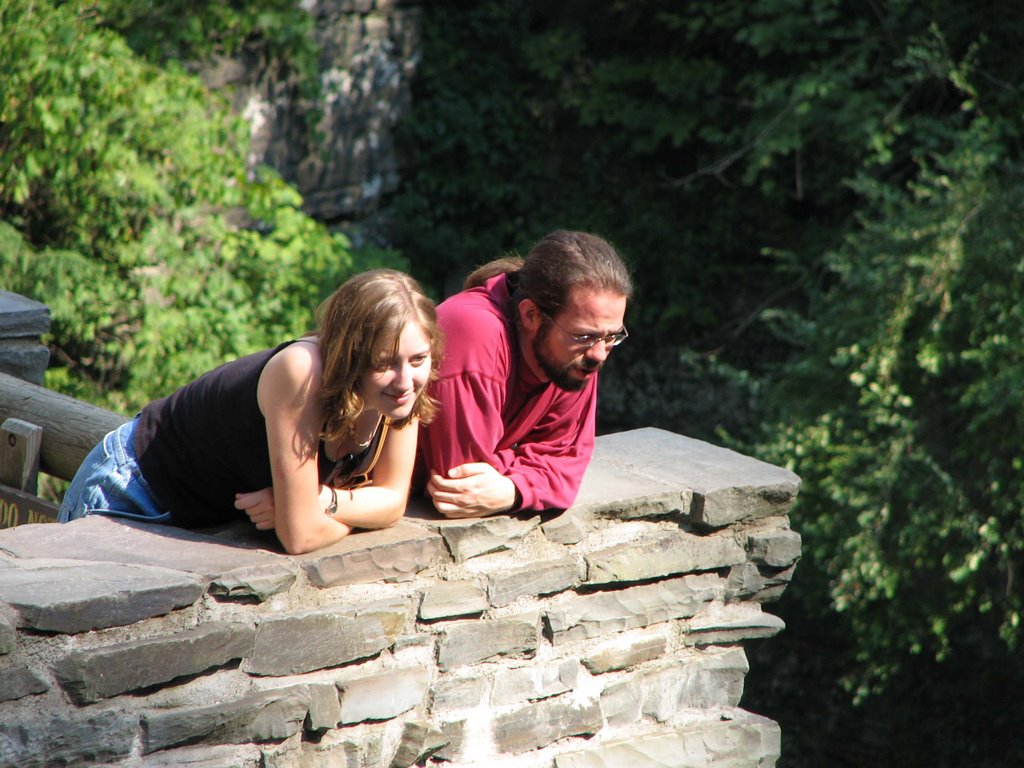
The first is from the gorge at Treman Park outside of Ithaca. It was taken (by Hannah’s mom) the week Hannah was moving back into Cornell at the end of the summer. We were at the time (at the very moment of the picture, I think) discussing how we didn’t think we were going to start dating. So much for that conclusion. I remember distinctly Hannah’s reaction to the falls at the park: coming from a suburban background, she didn’t believe one could actually live so close to such natural beauty.

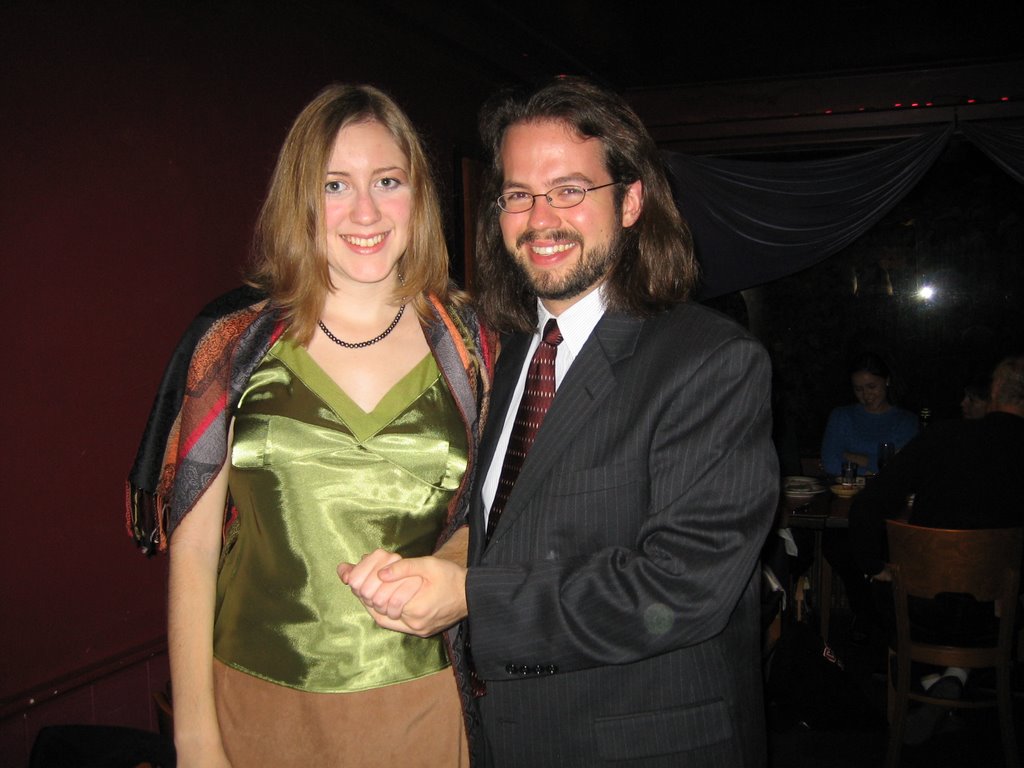
The second photo was taken at Pangea, one of the nicer restaurants in Ithaca, while I was back visiting Hannah this fall. It is now one of about four pictures taken of the two of us since we’ve been a couple. It’s also currently the background for my computer screen.

(In an attempt to echo the title of a previous entry and to tie this title with the above photos, I considered naming this entry “she and he, hanging out at Tre–man…” or “she and he, eating at Pange–a…” Because, y’know, it’s cute and it uses the “e” sound in each of those words. But it turns out that’s not just cute, it’s far too cutesy for my tastes, and besides I could only have used one. In fact, forget I came up with those names.)
One of the wonderful things about our relationship is that we have lots of overlapping interests, but different specializations. I majored in mathematics and music; she’s studying mathematics and English. She adores poetry, which I like but haven’t taken much time to read on my own, and I like 20th century music, some of which she’s begun appreciating. (It’s essentially entirely due to her that I have any interest in learning more about opera, however. That’s one genre that fell outside of my tastes for a long time. But last spring, after we had discussed Der Ring des Nibelungen for several weeks, she basically handed me the disks and said, “Here. Listen to these at home.” I enjoyed them a great deal, much to my surprise. Let this be a lesson that brief selections of four hours works can’t in general give you a notion of what experiencing the whole thing is like.) We’ve filled up substantial portions of our Gmail accounts with poems and mp3s. (Thank goodness for modern communication.) And, of course, we talk about math. I’m a geometer; she’s leaning towards becoming a topologist, which makes for overlapping but not quite identical interests there, too. It’s marvelous to share things you love with people you love.

Hannah was a student in a class for which I was the teaching assistant last fall. So she developed the habit early on of challenging me to explain mathematical ideas well and to her satisfaction. She’s not easily satisfied: she has very high demands on her level of understanding before she’ll admit that she’s mastered a topic. I, naturally, being a teacher (I’ll always be a teacher, even if it doesn’t stay my profession), am happy to explain, to search for new explanations, to examine an idea from several perspectives until we fall on one that she approves of. In the process, of course, she pushes me like no one else to seriously engage with every single detail, and in the end my understanding has grown nearly as much as hers has. I know she’ll be a stupendous researcher.

Hannah is a dancer. She’s been dancing her whole life, mostly folk dances and almost always with her mom. I like to dance. I aspire to learn all that she’s learned. I was never good at sports growing up, but this sort of coordination I have. This sort of movement makes sense to me. And it’s another way to participate in art. Have I mentioned I’m a liberal arts student at heart?

I’ve said before that’s it’s hard to be so far from her for so long. Of course it is. Who would think it should be otherwise? That, indeed, was one of the frustrations I mentioned a couple of weeks ago. Though it hasn’t gotten easier to be apart, recent days have granted us an easier time going about our lives and studies. We look forward to our reunion with great hope and joy. I would never recommend this kind of separation, nor deciding you’re going to start dating someone five days before one of you is about to leave for a long, long time. But I wish this kind of love for everyone. I am completely and totally (and apparently pleonastically, as well) in love with this woman. That’s why we talk for at least an hour per day, and send messages back and forth as often as we can. The above description I’ve given doesn’t begin to explain why I love her, or how wonderful it truly is to have her in my life. These are just the things I imagine you would like to know about her, and special treats we get to enjoy from being together.

And that, I think, is the sappiest essay you’ll get for a while. Unless, of course, Hannah insists I write another one. In any case, I am exceedingly happy.

Monday, November 06, 2006

the end of a good man's life

Adrien Douady, professor of maths at the University of Paris, and friend and advisor to Dr. Hubbard, died on Thursday. Sarah, Roland, and I were with him on an outing to see the region near his vacation home in Les Arcs. It was while swimming near a rocky shoreline at the base of l’Esterel. Roland was in the water with him and brought him into shore; I helped pull him from the water onto the rocks. I don’t feel at liberty here to share more of the details, but I would like to describe the time we spent with him (which I would have written about anyway).

Adrien picked up the three of us at the train station in Les Arcs in the mid-afternoon on Wednesday. He promptly drove us to the Medieval City in town and dropped us off at the bottom. He instructed us to climb the labyrinthine streets and to meet him at the top. Once we rejoined him, he began indicating some of the plants around the area: an olive tree, a rosemary bush, a prickly pear cactus. He indicated a balcony from which the Queen of the Night aria was sung in a performance of The Magic Flute, and persisted in humming that tune for the rest of the afternoon.

Once we arrived at the Douadys’ house, he led us through the surrounding woods, pointing out where boars had rooted in the ground and making us try to guess what a certain plant was (it was thyme). We became convinced we had heard a boar and began tracking it. We eventually came to where we thought it was, and discovered that most of the sounds we’d been hearing were made by trees rubbing against each other in the wind.


We returned to the house, and began cutting wood. Adrien had cut down a tree he thought was too near the house. Roland picked up the chain saw and worked on cutting up the tree. Sarah and I moved the wood over to a pile. It was nice to be outside, enjoying nature and doing some manual labor.

Adrien and his wife Régine invited a few of their neighbors over for dinner. Régine made a marvelous traditional Algerian couscous meal. It was a pleasant repast, with conversation topics varying among house construction, the arriving mistral, wind power, tides in Normandy, and voting in the States.


In the morning, at breakfast, I reminisced about singing “L’amant de Saint Jean” with Adrien in Denmark. (I meant to post the pictures above earlier.) They started teaching me another chanson, “Le vin blanc”. We headed out and saw some of Adrien’s favorite swimming places.


I knew Douady as a brilliant, supportive, fun-loving man. He loved to sing and to swim. He loved doing all sorts of mathematics, and people loved having him in talks for his insight and humor. He was here at the Université de Provence the week before he died to give a talk on the work of two of his students, Buff and Chéritat, of whom he was very proud. We were fortunate to hear his final lecture. He was always full of character, life, and passion. Sarah and Roland knew him better than I, but everyone who met him knew he was a special, wonderful man.

Rest in peace, Adrien.

Friday, August 18, 2006

upcoming conference on splitting the bill...

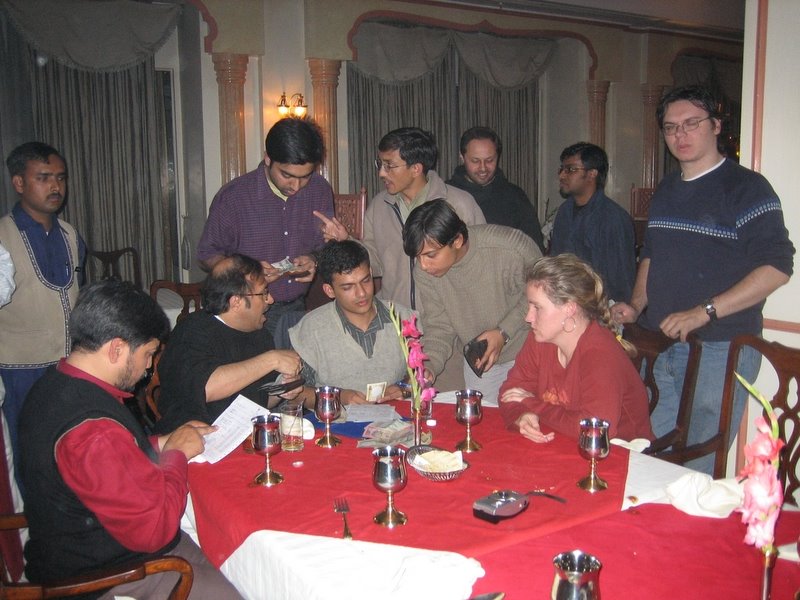
Other mathematicians have the same experience all the time, I’m sure. Going out to dinner with a group of friends, time comes for the check to get divided, someone says, “Hey, Josh is a mathematician. Why don’t we get him to divide the bill?”

This picture (following a nice dinner at a conference I attended) is my answer to that question:


Seriously, my answer is generally, “You do realize that the time it takes to split the bill doubles with each mathematician present?” Some like to say it’s because we haven’t worked with numbers for so long that we’ve forgotten how. I think—although that statement may be true—in this case it’s more due to our proclivity to solve optimization problems. We want to figure out how to take exactly the cash everyone’s contributed to the pile and give everyone the proper change from what’s available. This holds even—perhaps especially—when one person has contributed a $10 and three $1 bills, while everyone else only had $20s. It is invariably the non-mathematician at the table who says, “Why don’t we just ask them to make change from the twenties?” Because that solution is not elegant, we want to reply. Elegance is paramount. Just give us a few more minutes and we’ll work out how to handle this…

Friday, July 28, 2006

Geistliches Lied Part 3b

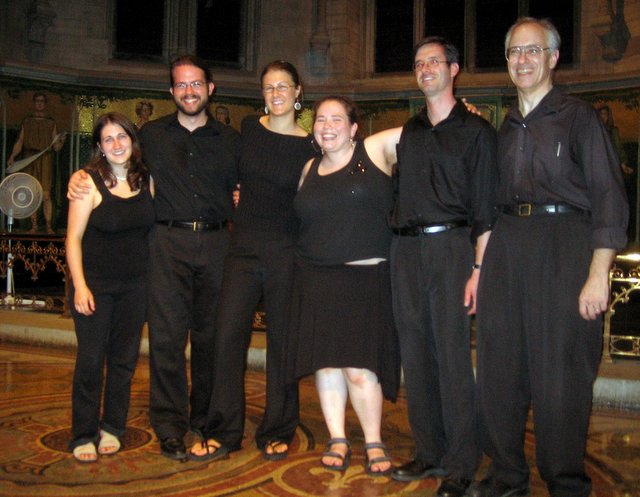
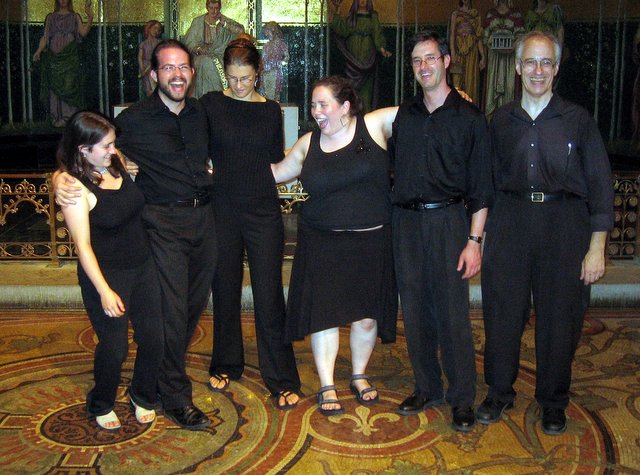
And now for the more traditional pose… What a team of singers! Thanks, everybody, for a great concert and a great summer of rehearsals!

Posted by Picasa

Geistliches Lied Part 3a

Next, the pre-silly picture. (These are getting posted separately because I’m trying to learn Picasa.) This actually looks sillier than the other one, in my opinion, because it totally looks like the women of the choir are checking me out. But I think they’re actually considering whether or not to carry out the suggestion of lifting me up.


Of course, they could be checking me out. One of them said I should tell y’all about how they decided they were tired of women being treated as objects, and started objectifying all the men of the choir. I wasn’t complaining. :-) Posted by Picasa

Geistliches Lied Part 3

I asked the members of the summer choir if I could post pictures, and they all agreed, so here goes…

First, the silly picture. The friend who was taking the pictures suggested the others hoist me up in celebration of the premiere of my song. So that’s me—the one without my feet on the ground.

Posted by Picasa