Yesterday, a week after the “official” start of summer, Hannah and I joined in one of the quintessential summer activities in Ithaca: we went strawberry picking. I feel like we managed to join some kind of club, too, because whenever I have spoken with other friends who go out and pick strawberries, the ones who get the largest amounts almost always come back and say they picked 18 pounds. And so did we, this time. Hooray! We went out with one of Hannah’s friends from church, then went back to the friend’s house and prepared all of the strawberries, cutting off all of the tops and freezing eight quarts’ worth in the large freezer at the house. The rest we brought back and made into a wonderful strawberry-basil soup for a potluck last night. I recommend this dish highly. Take the strawberries, boil them for a bit (don’t add much water, if any, as the strawberries will produce copious amounts of liquid on their own—this is a technique we learned from cooking squash). Then add some heavy cream and chopped basil. Puree the whole thing. We put in sour cream and a small amount of sugar; some recipes we saw also suggested milk. We chilled it for a couple of hours, and served it with fresh (non-sweetened) whipped cream. Yum. It seemed quite successful.
In other exciting news, this year’s Ithaca festival was moved back two weeks to be held last weekend, so I got to attend it for the first time. Melanie was in town, visiting and working, and we went down to the parade on Thursday afternoon. Lots of local organizations participated: schools, housing programs, the Ithachords (barbershop singing), the SPCA (puppies!), and so on. There was an (apparently traditional) Volvo ballet: several Volvos dressed in tutus and dancing around each other in the street. That was bizarre. The commons were in a fair-type atmosphere for the next couple of days, with food stands and performances and boutiques in tents. There was rain at some points, of course; the theme for the year was “I am Ithaca”, and I suspect the rain felt it needed to make an appearance. In fact, the rain arrived on Saturday afternoon just as we were supposed to be folk dancing in Dewitt Park, where there are no shelters of any kind. One dancer/musician pulled out her pipe and played some familiar tunes as we danced very simple steps under our umbrellas. On Sunday, crowds in Stewart Park made an immense human peace sign, in an attempt to set a world record for the largest such sign. We didn’t make it to this event, but you can see videos of it on YouTube. We did go down to the park on Sunday evening to see a circus and walk among the crowds. It was a beautiful day.
Showing posts with label Ithaca. Show all posts
Showing posts with label Ithaca. Show all posts
Sunday, June 29, 2008

Wednesday, October 10, 2007
cum sancto spiritu, part 1
This past weekend was my first stay at a convent (community? ecclesiastical farm? it’s a little hard to describe succinctly). Hannah and I went with a couple of friends to the Community of the Holy Spirit in Brewster, NY, where we spent two very restful days and nights, in part to visit Suzanne, a priest we knew through Cornell. The Melrose Convent is an outgrowth of St. Hilda’s House in NYC and comprises six or eight women who work, farm, pray, and occasionally teach in a lovely, somewhat secluded spot. There is a school, the Melrose School, on the grounds, but no classes were going on, even on Monday because of Columbus Day. We very much enjoyed our time there, and over a few posts I plan to give a relatively thorough account of the weekend.
We set out from Ithaca late Saturday morning. The first couple of hours in the car we spent singing (what delight!), sharing favorite hymns and songs from our youth. Although Hannah didn’t grow up in the church, the rest of us had very varied backgrounds and could cross-pollinate a lot. Jessie teaches Sunday school and looks for good songs to teach kids. I presented my perennial favorite, “The Fruit of the Spirit”:
We stopped twice on the way to the convent. The first was for lunch. There was some debate as to whether we should stop at a familiar fast food outlet or press a little deeper to find a local restaurant. Realize that this was a car full of people who really like eating fresh food and supporting local business, and so the latter option was preferred. We ended up at Last Licks in Liberty (exit 101 off of highway 17). The friendly manager welcomed us and explained that everything was served on sandwiches—subs, hoagies, paninis, and the like. We all had a bottle of one of Boylan’s products (I had my first birch beer, which was a lot like a root beer, but independently very good); I recommend these, when you can’t get hold of Ithaca Sodas. There were quaint posters of olden-days Pepsi advertising (“Worth a dime, costs a nickel!”). The manager told us how he had just flown in from Florida and was just stopping by the store to check how things were going, when he learned that they were understaffed, and so he was working. When we told him we were from Ithaca, he said they had some regular customers from Cornell who would stop by on the way to Yankees games.
The second stop was at a fruit and vegetable stand. Hannah had made the proclamation, “It’s not really fall unless we do something to a pumpkin,” and so we had been watching for pumpkin stands. A hand-written sign on the side of the highway alerted us to the appropriate exit, and we pulled into the driveway of a house with an elderly man sitting under a tarp. He had a piece of corn in his hand, ready for us to sample (I have not been getting nearly enough corn this season), and told us a smattering of dirty jokes. He tried to convince us to buy his book of jokes. We managed to get away with just the pumpkin we were seeking and some corn, carrots, and broccoli (which became dinner the next night).
Once we arrived at the convent, we were promptly greeted with a wealth of treats and an invitation to Vespers. In fact, there wasn’t much time at all before the prayers began. We went into the small round wooden chapel, and we visitors spread ourselves out among the residents who knew what was going on. (We’d all been to evening prayers before, but the peculiarities of the prayer books at the convent required some guidance.) Much of the Vespers service is occupied with reciting psalms on a chant tone. One verse is chanted by the officiant to establish the tone, and thereafter the two sides of the chapel alternate chanting verses. For the first few psalms, I sat quietly, listening and not quite ready to break into the chant myself. There was only one other man there besides myself, and he had decided not to chant along. So my voice would have been the one to break the sound of the women. Now I love the sound of women’s voices (usually in harmony, which chant is not) but that’s not quite what was keeping me from singing. A true unison has a certain kind of purity. Splitting the octaves creates an essentially different sound (and I was not about to try to sing in the women’s range, particular since I’d been sick all week). So just as some people relax by popping in a “Chant” CD to hear the soothing baritone of monks, I was enjoying the piping clarity of women chanting together.
But within a few moments, I developed a strong sense that something was wrong—not just that I was isolating myself from my fellow congregants, or holding back from singing. I’ve studied chant, in the context of music history. I’ve listened to plenty of recordings, made available for the benefit of scholars and consumers. I’ve read about how it tried to strike the balance between emotion (rejoicing, mourning, awe, or penitence as necessary) and removal from the secular realm. About how composers expanded chants to reflect the text (even on the simple word “Alleluia”), then moved them from the meditative to the musical realm. Once I joined in, I realized what had felt wrong. Chant is not meant to be listened to. It has elements of song and elements of speech, but it isn’t either. It’s meditative, certainly, for both those chanting and those “listening”, but it’s nearly meaningless until you participate. It’s deliberate, ancient, immediate (be glad I’m not going off into another Kierkegaard digression here on the immediacy of music), transcendent, spiritual, physical, perplexing, focusing, and holy (in the sense of being set apart from other things in the world).
I’m making this point a bit strongly. There is real musical merit in, and real “outside” appreciation possible for, the hymns, antiphons, and sequences of the liturgy. But a psalm is mostly just intoned; from a melodic standpoint, it’s almost entirely a single repeated note, with a concluding burble up or down. Listening to it may put you in a trance, but I can’t imagine how it would help you worship. I don’t think I can explain more than that how important it is to join in chanting the mass, or service, or whatever, whenever it is possible to do so in place of just listening.
After dinner, we got set up in the guest house, known there as the “longhouse”. We had our own kitchen, stocked with fresh organic goodies (from eggs to raw milk to cookies), a sunny sitting room (directly adjacent to the school; apparently previous residents could hear homeroom or French class going on), and several private rooms to disperse to. Suzanne provided us with her Eddie Izzard DVD collection (which we didn’t manage to watch, however; as a first inkling of what the community was like, if you’ve never met nuns before, the sister who was showing us around the house also declared herself a big fan of Izzard).
We returned to the main house and looked around as dinner was being prepared. Hanging in the hallway was the following prayer. Now, the deliberate vagueness of the authorship, along with the style of writing makes the purported source of this text somewhat suspect. In fact, I searched the internet once I got back and could get no more information; the prayer was always presented in a vacuum (or list of other inspirational texts), except on a couple of occasions when attention was drawn to some anachronisms in the writing. So I include it as an example of how the nuns at the Melrose Convent see themselves and their calling, not any sort of historical document. It’s also still full of useful things for all of us to think about:
Dinner was a veritable feast. Apparently excited about having us as guests, the nuns had prepared several courses, and had sent out specially for hot dogs (they don’t usually eat meat). Hannah and I were, as expected, exceeding happy about the presence of kale. (Over the summer, as we were picking up vegetables from our CSA farm, we would ask with increasing intensity, “Are we getting kale this week? We really hope we are, because we really like having kale.” The first time we did this, the farmers responded in perplexity, “We’ve never actually had a reaction like that from anyone about getting kale.”) And here before us was a new yummy way to prepare it! (They call it “killer kale”.) We also had homemade ketchup, mustard, and tomatillo salsa; “apple leather”, the real version of what Fruit Roll-Ups always dreamed of being; fresh grape juice and grape jelly made from wild grapes in the area; a mix of beans from the garden; and other courses. Apparently when you make all your food fresh from the garden, living with a vow of poverty isn’t so bad.
Lots more I could share about the humor of the sisters and the stories that came out about convent life (such as tales of mass hysteria, or the three nuns who got in a fist-fight), but this is getting a bit long. Moving on to the evening…
Back at the longhouse, we sat around reading for a while. Hannah was reading poetry by Elizabeth Bishop. I was reading hymns (because there was no piano in the house for me to play them on). For some reason, “Lead On, O King Eternal” was going through my head:
We set out from Ithaca late Saturday morning. The first couple of hours in the car we spent singing (what delight!), sharing favorite hymns and songs from our youth. Although Hannah didn’t grow up in the church, the rest of us had very varied backgrounds and could cross-pollinate a lot. Jessie teaches Sunday school and looks for good songs to teach kids. I presented my perennial favorite, “The Fruit of the Spirit”:
The fruit of the spirit’s not a cantaloupe (nope!)Jessie was raised Quaker, and taught us a song about Lucretia Mott to the tune of “The Battle-Hymn of the Republic”. Try it:
The fruit of the spirit’s not a cantaloupe (nope!),
So if you want to be a cantaloupe,
you might as well hear it,
You can‘t be a fruit of the spirit, ’cause the fruit is:
Love, joy, peace, patience, kindness, goodness, faithfulness, gentleness, and self-control.
Thank thee kindly, friend Lucretia, (repeat twice)Did that refrain work O.K. for you? Then try making this scan to the tune of the verse:
Thy light still shines for me!
Throughout the town of Philadelphia she hid the fleeing slaves;We worked on that over and over, marching around the kitchen as we made meals at the convent.
For the freedom of her sisters she did cross the ocean waves,
And she asked Ulysses S. Grant to grant a pardon for the brave.
Her light still shines for me!
We stopped twice on the way to the convent. The first was for lunch. There was some debate as to whether we should stop at a familiar fast food outlet or press a little deeper to find a local restaurant. Realize that this was a car full of people who really like eating fresh food and supporting local business, and so the latter option was preferred. We ended up at Last Licks in Liberty (exit 101 off of highway 17). The friendly manager welcomed us and explained that everything was served on sandwiches—subs, hoagies, paninis, and the like. We all had a bottle of one of Boylan’s products (I had my first birch beer, which was a lot like a root beer, but independently very good); I recommend these, when you can’t get hold of Ithaca Sodas. There were quaint posters of olden-days Pepsi advertising (“Worth a dime, costs a nickel!”). The manager told us how he had just flown in from Florida and was just stopping by the store to check how things were going, when he learned that they were understaffed, and so he was working. When we told him we were from Ithaca, he said they had some regular customers from Cornell who would stop by on the way to Yankees games.
The second stop was at a fruit and vegetable stand. Hannah had made the proclamation, “It’s not really fall unless we do something to a pumpkin,” and so we had been watching for pumpkin stands. A hand-written sign on the side of the highway alerted us to the appropriate exit, and we pulled into the driveway of a house with an elderly man sitting under a tarp. He had a piece of corn in his hand, ready for us to sample (I have not been getting nearly enough corn this season), and told us a smattering of dirty jokes. He tried to convince us to buy his book of jokes. We managed to get away with just the pumpkin we were seeking and some corn, carrots, and broccoli (which became dinner the next night).
Once we arrived at the convent, we were promptly greeted with a wealth of treats and an invitation to Vespers. In fact, there wasn’t much time at all before the prayers began. We went into the small round wooden chapel, and we visitors spread ourselves out among the residents who knew what was going on. (We’d all been to evening prayers before, but the peculiarities of the prayer books at the convent required some guidance.) Much of the Vespers service is occupied with reciting psalms on a chant tone. One verse is chanted by the officiant to establish the tone, and thereafter the two sides of the chapel alternate chanting verses. For the first few psalms, I sat quietly, listening and not quite ready to break into the chant myself. There was only one other man there besides myself, and he had decided not to chant along. So my voice would have been the one to break the sound of the women. Now I love the sound of women’s voices (usually in harmony, which chant is not) but that’s not quite what was keeping me from singing. A true unison has a certain kind of purity. Splitting the octaves creates an essentially different sound (and I was not about to try to sing in the women’s range, particular since I’d been sick all week). So just as some people relax by popping in a “Chant” CD to hear the soothing baritone of monks, I was enjoying the piping clarity of women chanting together.
But within a few moments, I developed a strong sense that something was wrong—not just that I was isolating myself from my fellow congregants, or holding back from singing. I’ve studied chant, in the context of music history. I’ve listened to plenty of recordings, made available for the benefit of scholars and consumers. I’ve read about how it tried to strike the balance between emotion (rejoicing, mourning, awe, or penitence as necessary) and removal from the secular realm. About how composers expanded chants to reflect the text (even on the simple word “Alleluia”), then moved them from the meditative to the musical realm. Once I joined in, I realized what had felt wrong. Chant is not meant to be listened to. It has elements of song and elements of speech, but it isn’t either. It’s meditative, certainly, for both those chanting and those “listening”, but it’s nearly meaningless until you participate. It’s deliberate, ancient, immediate (be glad I’m not going off into another Kierkegaard digression here on the immediacy of music), transcendent, spiritual, physical, perplexing, focusing, and holy (in the sense of being set apart from other things in the world).
I’m making this point a bit strongly. There is real musical merit in, and real “outside” appreciation possible for, the hymns, antiphons, and sequences of the liturgy. But a psalm is mostly just intoned; from a melodic standpoint, it’s almost entirely a single repeated note, with a concluding burble up or down. Listening to it may put you in a trance, but I can’t imagine how it would help you worship. I don’t think I can explain more than that how important it is to join in chanting the mass, or service, or whatever, whenever it is possible to do so in place of just listening.
After dinner, we got set up in the guest house, known there as the “longhouse”. We had our own kitchen, stocked with fresh organic goodies (from eggs to raw milk to cookies), a sunny sitting room (directly adjacent to the school; apparently previous residents could hear homeroom or French class going on), and several private rooms to disperse to. Suzanne provided us with her Eddie Izzard DVD collection (which we didn’t manage to watch, however; as a first inkling of what the community was like, if you’ve never met nuns before, the sister who was showing us around the house also declared herself a big fan of Izzard).
We returned to the main house and looked around as dinner was being prepared. Hanging in the hallway was the following prayer. Now, the deliberate vagueness of the authorship, along with the style of writing makes the purported source of this text somewhat suspect. In fact, I searched the internet once I got back and could get no more information; the prayer was always presented in a vacuum (or list of other inspirational texts), except on a couple of occasions when attention was drawn to some anachronisms in the writing. So I include it as an example of how the nuns at the Melrose Convent see themselves and their calling, not any sort of historical document. It’s also still full of useful things for all of us to think about:
17th Century Nun’s Prayer
Lord, Thou knowest better than I know myself that I am growing older and will someday be old. Keep me from the fatal habit of thinking I must say something on every subject and on every occasion. Release me from craving to straighten out everybody’s affairs. Make me thoughtful but not moody: helpful but not bossy. With my vast store of wisdom, it seems a pity not to use it all, but Thou knowest Lord that I want a few friends at the end.
Keep my mind free from the recital of endless details; give me wings to get to the point. Seal my lips on my aches and pains. They are increasing, and love of rehearsing them is becoming sweeter as the years go by. I dare not ask for grace enough to enjoy the tales of others’ pains, but help me to endure them with patience.
I dare not ask for improved memory, but for a growing humility and a lessing cocksureness when my memory seems to clack with the memories of others. Teach me the glorious lesson that occasionally I may be mistaken.
Keep me reasonably sweet; I do not want to be a Saint—some of them are so hard to live with—but a sour old person is one of the crowning works of the devil. Give me the ability to see good things in unexpected places, and talents in unexpected people. And, give me, O Lord, the grace to tell them so.
AMEN
Dinner was a veritable feast. Apparently excited about having us as guests, the nuns had prepared several courses, and had sent out specially for hot dogs (they don’t usually eat meat). Hannah and I were, as expected, exceeding happy about the presence of kale. (Over the summer, as we were picking up vegetables from our CSA farm, we would ask with increasing intensity, “Are we getting kale this week? We really hope we are, because we really like having kale.” The first time we did this, the farmers responded in perplexity, “We’ve never actually had a reaction like that from anyone about getting kale.”) And here before us was a new yummy way to prepare it! (They call it “killer kale”.) We also had homemade ketchup, mustard, and tomatillo salsa; “apple leather”, the real version of what Fruit Roll-Ups always dreamed of being; fresh grape juice and grape jelly made from wild grapes in the area; a mix of beans from the garden; and other courses. Apparently when you make all your food fresh from the garden, living with a vow of poverty isn’t so bad.
Lots more I could share about the humor of the sisters and the stories that came out about convent life (such as tales of mass hysteria, or the three nuns who got in a fist-fight), but this is getting a bit long. Moving on to the evening…
Back at the longhouse, we sat around reading for a while. Hannah was reading poetry by Elizabeth Bishop. I was reading hymns (because there was no piano in the house for me to play them on). For some reason, “Lead On, O King Eternal” was going through my head:
Lead on, O King eternal,I was reading from the Pilgrim Hymnal, of which I have four copies but hadn’t examined too carefully yet. Christian hymnody has plenty of texts with battle imagery (with good Scriptural reason), and many of them are collected, along with other exhortations to fortitude, in the Pilgrim Hymnal’s section on Courage. But I was struck by the end of the second verse, which I’ll use to close this entry (as always, the whole text of the hymn is available at Cyberhymnal). In a way quite consistent with the verses I linked to above (q.v.), it emphasizes the means of winning the battle to be our acting in love:
The day of march has come;
Henceforth in fields of conquest
Thy tents shall be our home.
Through days of preparation
Thy grace has made us strong;
And now, O King eternal,
We lift our battle song.
For not with swords’ loud clashing,
Nor roll of stirring drums;
With deeds of love and mercy
The heavenly kingdom comes.
Wednesday, September 12, 2007
short story 3
On Monday morning, I joined Hannah at her apartment and we walked into school together. Standing next to the Thurston Avenue bridge was a girl holding a sign that read “Free Hugs”. Ever curious about such things, I asked her what the free hugs were for. “It’s the day before September 11,” she replied, “so they’re a sign of hope.” Hannah and I both accepted hugs before walking on. I don’t know how many people the girl (and perhaps others) were able to share hugs with for this occasion, but I thought I’d spread the message around at least.
Wednesday, July 25, 2007
just finished
Last night, around 11:00, Hannah and I completed reading Harry Potter and the Deathly Hallows. I won’t give away any “spoilers” here (not that it would matter to anyone reading this). I’m mostly writing this because I’m pleased with my own cleverness in coming up with what would make a good cartoon (say, in the New Yorker) this week in our post-smoking-or-non era: a restaurant divided into “Finished Harry Potter” and “Not Finished Harry Potter” sections. I mean, I know I didn’t want people discussing it while I was around until I’d gotten through it (which took all of four days past the release date).
Finishing the book (which we were reading aloud), along with a nice Japanese dinner, is how Hannah and I celebrated our eleventh mensiversary, by the way.
Addendum: I should clarify that it took about 18 hours of reading time, because we were reading aloud. We certainly could have finished on Sunday or Monday, having purchased the book Saturday around noon, but with church and extra social events, Tuesday evening became a nice time to finish it up.
What HP events did people attend?
Finishing the book (which we were reading aloud), along with a nice Japanese dinner, is how Hannah and I celebrated our eleventh mensiversary, by the way.
Addendum: I should clarify that it took about 18 hours of reading time, because we were reading aloud. We certainly could have finished on Sunday or Monday, having purchased the book Saturday around noon, but with church and extra social events, Tuesday evening became a nice time to finish it up.
What HP events did people attend?
Saturday, June 30, 2007
pre-4th outdoors trip
Hannah and I have just successfully camped out for the first time. We drove to Treman Park, just a few miles south of Ithaca (we called Taughannock first, but they had no sites left open) and stopped by the office to find out what spots were available. We’d both been picturing (separately to ourselves, and somewhat naïvely) a little isolated spot where we would set up a tent and see no one else all evening, but instead we found a slew of campsites all lined up next to each other. This is actually somewhat different from the camping I used to do as a Boy Scout. But we quickly realized that it’s not so bad to have other folks around; indeed, it creates a small sense of community. Plus, we had a water spigot right in our site, and a bath house a couple hundred feet away. So it was a very nice but not-so-rugged introduction to camping together.
For dinner, we made the finest cuisine I have ever known or experienced anywhere: despite the potential political incorrectness, I generally insist on calling these “hobo meals”. Make a fire, get a good bed of coals going, and lay out a sheet of aluminum foil. Place thereon small pieces of potatoes (tater tots work very well, too), carrots, onions, any other vegetables you’d like (we added some beets that came in last week’s CSA share), and a bit of beef. Season with salt, pepper, perhaps some seasoned salt. Fold up the foil into a package. Now place on the coals, and let your sixth sense kick in to tell you when it’s done. (Seriously; I don’t know how to tell anyone how long to cook these. I just know when it’s ready and perfect.) Remove from the coals with sticks (yay, balancing act!). The odor that emerges upon opening the foil inspires prayers of thanksgiving. And every bit of deliciousness you eat is joy. The only way to properly follow a hobo meal is with s’mores. Most everyone knows how to make those, so I’ll just comment that a few years ago I had the insight to start putting peanut butter on my s’mores. I know some people (like Hannah) just don’t like peanut butter, but for those who do, this is a beautiful addition. Not only does it have a flavor that mixes well with every other ingredient, it holds the chocolate on the graham cracker. I dropped so many pieces of chocolate in my youth trying to get the marshmallow sandwiched in. Peanut butter: the perfect addition to your chocolatey, marshmallowy goodness.
If I ever am about to be executed and am offered a last meal, this would be it. Make a campfire and give me a hobo meal and s’mores. I’ll die happy.
For dinner, we made the finest cuisine I have ever known or experienced anywhere: despite the potential political incorrectness, I generally insist on calling these “hobo meals”. Make a fire, get a good bed of coals going, and lay out a sheet of aluminum foil. Place thereon small pieces of potatoes (tater tots work very well, too), carrots, onions, any other vegetables you’d like (we added some beets that came in last week’s CSA share), and a bit of beef. Season with salt, pepper, perhaps some seasoned salt. Fold up the foil into a package. Now place on the coals, and let your sixth sense kick in to tell you when it’s done. (Seriously; I don’t know how to tell anyone how long to cook these. I just know when it’s ready and perfect.) Remove from the coals with sticks (yay, balancing act!). The odor that emerges upon opening the foil inspires prayers of thanksgiving. And every bit of deliciousness you eat is joy. The only way to properly follow a hobo meal is with s’mores. Most everyone knows how to make those, so I’ll just comment that a few years ago I had the insight to start putting peanut butter on my s’mores. I know some people (like Hannah) just don’t like peanut butter, but for those who do, this is a beautiful addition. Not only does it have a flavor that mixes well with every other ingredient, it holds the chocolate on the graham cracker. I dropped so many pieces of chocolate in my youth trying to get the marshmallow sandwiched in. Peanut butter: the perfect addition to your chocolatey, marshmallowy goodness.
If I ever am about to be executed and am offered a last meal, this would be it. Make a campfire and give me a hobo meal and s’mores. I’ll die happy.
Sunday, May 06, 2007
walking around Cornell right now is like playing Myst. except that instead of solving puzzles, you’re waiting for construction to finish
Yes, this is meant to parallel my description of Marseille as being like Labyrinth. Myst is pleasanter than Labyrinth; even greater is the difference in niceness between Ithaca and Marseille. Normally I don’t approve of describing things in real life as being like virtual things (e.g., “Hey, this is just like that time in that movie!”), or natural things as being like artificial things (big example, one that has occurred more than once: “Oooh, those fireflies look just like Christmas lights!” Huh? Fireflies have been around a lot longer, so shouldn’t the comparison go the other way? Wouldn’t it be terribly poetic to think of Christmas lights as fireflies decorating our trees?) This is possibly something I need to get over. After all, we use our experiences, even those with virtual or artificial origins, to make sense of life. Books have played this role for centuries. I just think we need to pay attention to what piece gives meaning to the other. The Orion Nebula does look like something out of a Star Trek sequence. But the reason Star Trek backgrounds are so evocative is that they have copied the heavens, not the other way around. Perhaps this Myst analogy will help me overcome this aversion. The worlds of Myst really are beautiful; construction sites are not.
Okay, didn’t really mean to get onto that rant. This topic came up because of my walking to campus one morning last week. I had dropped off Hannah’s car to get an oil change and decided it was nice enough weather to walk in from Community Corners to Malott. When I got to North Campus, I thought, “Wouldn’t it be nice, instead of just taking the footbridge across the falls, to take the path behind the observatory and walk along Beebe Lake for a while?” So I did. And it was nice. I like the wooden staircases. But then I started walking along the road, and quickly found it closed, including the sidewalk. There is a staircase down to the lake, but at the time it was sealed off by gates and by the lack of the remaining steps at the bottom. I walked past it and started down Forest Home Drive, which should lead back to the stairs at the near the bridge, and quickly discovered that the whole thing, sidewalk and all, was closed off. So I walked back to the as yet unusable stairs. A grounds worker was in the process of removing the gates and told me that it would be ready in about an hour. I was perplexed, however, because I had seen people walking towards us down by the lake, and despite the lack of stairs they had somehow joined us on the road. I looked a little to the side of the stairs and saw—aha!—a somewhat steep but definitely well-established path. Entirely not obvious from when I first walked past.
On the very first island one encounters while playing Myst, there is a generator that powers the door to a spaceship. You have to get just the right amount of current running to the door. And if you run too much, you trip the breaker switch and the current no longer runs out. Of course, none of this is clear at first, like anything in Myst, and you’re bound to trip the switch several times before you figure out what to do. But the very first time you trip it, suddenly all hope of getting the power to go out again seems lost, because the switch is nowhere to be found. So you poke around the island some more, and eventually come back, and find a small, barely visible path beside the door to the generator controls. That path is exactly what this path beside the gated off staircase reminded me of. If I had actually been playing Myst, however, I would have gotten to the bottom and had to put together the staircase myself to make future ascending and descending easier.
The parking lot in front of Malott is being turned into a pedestrian area, so the sidewalk and which entrances are accessible from which directions are thoroughly in flux. Certain routes which were closed when I left due to construction on the Thurston bridge have opened up, but the bridge itself (now completely naked and skeletal) remains an unsolved problem. Maybe if we can get the rocks in the gorge below to spell out the right word, it’ll open. Or perhaps the solution is entirely somewhere else in Ithaca. Pull that lever beside the Dewitt Mall and the bridge will return?
After being in Marseille, I will no longer complain about certain features of Ithaca. Construction is a perennial mocking point, however. The beauty of the surroundings makes it totally worth living here.
Okay, didn’t really mean to get onto that rant. This topic came up because of my walking to campus one morning last week. I had dropped off Hannah’s car to get an oil change and decided it was nice enough weather to walk in from Community Corners to Malott. When I got to North Campus, I thought, “Wouldn’t it be nice, instead of just taking the footbridge across the falls, to take the path behind the observatory and walk along Beebe Lake for a while?” So I did. And it was nice. I like the wooden staircases. But then I started walking along the road, and quickly found it closed, including the sidewalk. There is a staircase down to the lake, but at the time it was sealed off by gates and by the lack of the remaining steps at the bottom. I walked past it and started down Forest Home Drive, which should lead back to the stairs at the near the bridge, and quickly discovered that the whole thing, sidewalk and all, was closed off. So I walked back to the as yet unusable stairs. A grounds worker was in the process of removing the gates and told me that it would be ready in about an hour. I was perplexed, however, because I had seen people walking towards us down by the lake, and despite the lack of stairs they had somehow joined us on the road. I looked a little to the side of the stairs and saw—aha!—a somewhat steep but definitely well-established path. Entirely not obvious from when I first walked past.
On the very first island one encounters while playing Myst, there is a generator that powers the door to a spaceship. You have to get just the right amount of current running to the door. And if you run too much, you trip the breaker switch and the current no longer runs out. Of course, none of this is clear at first, like anything in Myst, and you’re bound to trip the switch several times before you figure out what to do. But the very first time you trip it, suddenly all hope of getting the power to go out again seems lost, because the switch is nowhere to be found. So you poke around the island some more, and eventually come back, and find a small, barely visible path beside the door to the generator controls. That path is exactly what this path beside the gated off staircase reminded me of. If I had actually been playing Myst, however, I would have gotten to the bottom and had to put together the staircase myself to make future ascending and descending easier.
The parking lot in front of Malott is being turned into a pedestrian area, so the sidewalk and which entrances are accessible from which directions are thoroughly in flux. Certain routes which were closed when I left due to construction on the Thurston bridge have opened up, but the bridge itself (now completely naked and skeletal) remains an unsolved problem. Maybe if we can get the rocks in the gorge below to spell out the right word, it’ll open. Or perhaps the solution is entirely somewhere else in Ithaca. Pull that lever beside the Dewitt Mall and the bridge will return?
After being in Marseille, I will no longer complain about certain features of Ithaca. Construction is a perennial mocking point, however. The beauty of the surroundings makes it totally worth living here.
Tuesday, April 24, 2007
return
I’ve been back in Ithaca for just under two weeks now. I feel restored. It is unbelievably refreshing to be back here. I love this town. I love this department. I love the opportunities. Just this afternoon Hannah and I went down to Ho Plaza near the Cornell store, where Israeli independence day is being celebrated: my attention was caught by the free camel ride and the falafel pitas. We also made necklaces with our names in Hebrew and learned about the Birthright trip to Israel (for which we are ineligible, not being Jewish). Tonight we go to rehearsal for the Chorale, preparing for the concert on Sunday. Tim and I have been discussing lots of math, leading me to increase my notes and my understanding. Jonathan and I are making plans for me to move back into my old apartment in June.
Before I left, I feared I was falling into too many routines here in Ithaca. Now that I’m back, I just find that I appreciate amazingly all the activities and people. Once I’m more settled, I’ll get back to writing more often. Take care, y’all.
Before I left, I feared I was falling into too many routines here in Ithaca. Now that I’m back, I just find that I appreciate amazingly all the activities and people. Once I’m more settled, I’ll get back to writing more often. Take care, y’all.
Saturday, February 24, 2007
hexamensiversary
Those of you who figured out what enneadecahebdoversary meant, or caught some other clue I’ve given about timing, or know Hannah and me well and have a knack for dates, will realize that today Hannah and I are celebrating six months together. (Yes, I know “hexa” is a Greek prefix which I’ve stuck on a Latin-based neologism. But I decided a while back that the Greek numerical prefixes are almost always cooler and even more natural-sounding than the Latin ones. “Seximensiversary”? Does that work at all? Plus, it has too many overtones in English.) Honestly, I did more for Valentine’s Day than I’m doing for today, partly because I completely lost track of the dates and didn’t realize this was coming up until yesterday when it came up in conversation. (Right now, all time is measured strictly by the number of days remaining until Hannah comes to visit—three weeks from yesterday—rather than by Gregory’s ancient decree of quotidian nomenclature.) If I were in Ithaca, however, it would be different. We would have gone out to dinner on Valentine’s Day, certainly, and I would have brought Hannah flowers. But today, were I there, I would take Hannah on a walk in the snow, perhaps go down to the Carriage House and have a hot drink and a nice brunch. We’d spend the afternoon inside, keeping warm, perhaps working some because we’re students and there’s always work to do, but we’d take time in conversation to remember how lucky we are to have grown so close and to have the promise of so much more. (We had part of this conversation yesterday, as we recalled our histories. We’ve both changed a lot over this time, becoming more and more suited to each other. But in the days before I left Ithaca, before we were dating, we were desperately trying to make sense of our situation. I didn’t think it would be a good idea for us to start dating; I wanted to give her freedom for the year. But as Hannah has pointed out, I still wanted to be the closest man in her life.) I’d sing her a love song…
Moi je t’offrirai
Des perles de pluie
Venues de pays
Où il ne pleut pas
Je creuserai la terre
Jusqu’après ma mort
Pour couvrir ton corps
D’or et de lumière
Je ferai un domaine
Où l’amour sera roi
Où l’amour sera loi
Où tu seras reine
We’d make dinner together. And we’d kiss each other good night, preparing for the morning when we’d go worship together.
Why should this be any different from how we’d spend any other Saturday? I guess in many ways it’s not. Days can be made special by either event or intent. Six months into a relationship is something of a hurdle; a lot has happened by this point, and while things can remain fresh (as they can throughout a lifetime), the relationship isn’t pristine any longer. Many of the complications of depending on another person and having lost some measure of independence have been brought into relief. Six months isn’t a moment to fear, but it is a moment to mark, and maybe marvel. The work has been done, and will continue. The intent of today is to declare that the decision made half a year ago, in such doubt and anxiety and excitement, is now sure. “Happy six months” doesn’t mean that every moment or even every day of those six months has been happy, because that’s simply not true. We have had pain and confusion and sorrow. It means that today I’m happy we’re still together, and I want to remain that way. It means this time has been incredibly wonderful and joyful, despite the hardships. It means, for us, that when I return to the States and a full nine months will have elapsed since the spurt that pushed us into this, the time will not have been lost. It means thank you for being willing to live this experience with me.
Happy six months, Hannah.
Moi je t’offrirai
Des perles de pluie
Venues de pays
Où il ne pleut pas
Je creuserai la terre
Jusqu’après ma mort
Pour couvrir ton corps
D’or et de lumière
Je ferai un domaine
Où l’amour sera roi
Où l’amour sera loi
Où tu seras reine
We’d make dinner together. And we’d kiss each other good night, preparing for the morning when we’d go worship together.
Why should this be any different from how we’d spend any other Saturday? I guess in many ways it’s not. Days can be made special by either event or intent. Six months into a relationship is something of a hurdle; a lot has happened by this point, and while things can remain fresh (as they can throughout a lifetime), the relationship isn’t pristine any longer. Many of the complications of depending on another person and having lost some measure of independence have been brought into relief. Six months isn’t a moment to fear, but it is a moment to mark, and maybe marvel. The work has been done, and will continue. The intent of today is to declare that the decision made half a year ago, in such doubt and anxiety and excitement, is now sure. “Happy six months” doesn’t mean that every moment or even every day of those six months has been happy, because that’s simply not true. We have had pain and confusion and sorrow. It means that today I’m happy we’re still together, and I want to remain that way. It means this time has been incredibly wonderful and joyful, despite the hardships. It means, for us, that when I return to the States and a full nine months will have elapsed since the spurt that pushed us into this, the time will not have been lost. It means thank you for being willing to live this experience with me.
Happy six months, Hannah.
Friday, November 17, 2006
got it made
This entry is partly by special request. Hannah’s opinion is that I don’t write enough about her. She has a fair point, since any kind of accurate description of my life here must include the fact that I talk with her and write to her every day. Let me begin by quoting a song of the blues artists Paul Rishell and Annie Raines:
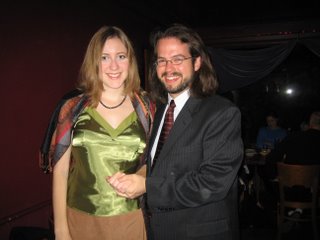
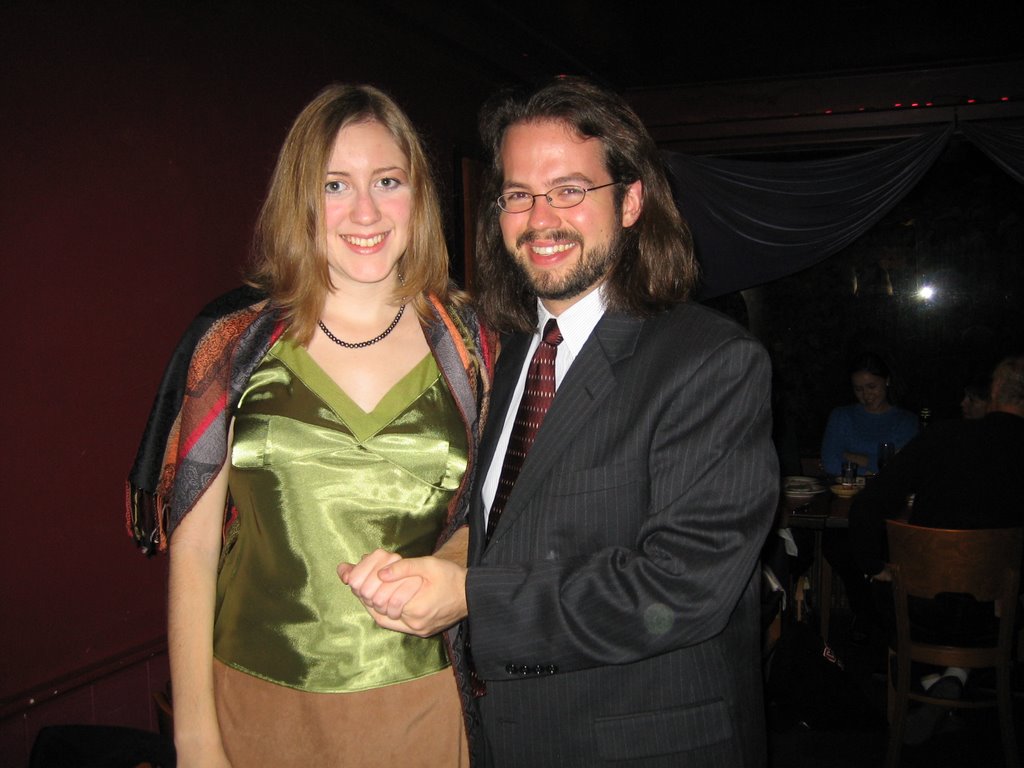
Actually, I wanted to write this anyway to share with you two pictures I really like.
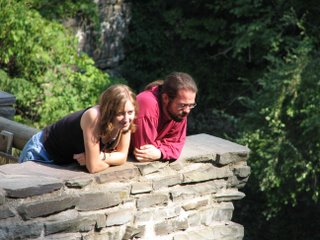
The first is from the gorge at Treman Park outside of Ithaca. It was taken (by Hannah’s mom) the week Hannah was moving back into Cornell at the end of the summer. We were at the time (at the very moment of the picture, I think) discussing how we didn’t think we were going to start dating. So much for that conclusion. I remember distinctly Hannah’s reaction to the falls at the park: coming from a suburban background, she didn’t believe one could actually live so close to such natural beauty.
The second photo was taken at Pangea, one of the nicer restaurants in Ithaca, while I was back visiting Hannah this fall. It is now one of about four pictures taken of the two of us since we’ve been a couple. It’s also currently the background for my computer screen.
(In an attempt to echo the title of a previous entry and to tie this title with the above photos, I considered naming this entry “she and he, hanging out at Tre–man…” or “she and he, eating at Pange–a…” Because, y’know, it’s cute and it uses the “e” sound in each of those words. But it turns out that’s not just cute, it’s far too cutesy for my tastes, and besides I could only have used one. In fact, forget I came up with those names.)
One of the wonderful things about our relationship is that we have lots of overlapping interests, but different specializations. I majored in mathematics and music; she’s studying mathematics and English. She adores poetry, which I like but haven’t taken much time to read on my own, and I like 20th century music, some of which she’s begun appreciating. (It’s essentially entirely due to her that I have any interest in learning more about opera, however. That’s one genre that fell outside of my tastes for a long time. But last spring, after we had discussed Der Ring des Nibelungen for several weeks, she basically handed me the disks and said, “Here. Listen to these at home.” I enjoyed them a great deal, much to my surprise. Let this be a lesson that brief selections of four hours works can’t in general give you a notion of what experiencing the whole thing is like.) We’ve filled up substantial portions of our Gmail accounts with poems and mp3s. (Thank goodness for modern communication.) And, of course, we talk about math. I’m a geometer; she’s leaning towards becoming a topologist, which makes for overlapping but not quite identical interests there, too. It’s marvelous to share things you love with people you love.
Hannah was a student in a class for which I was the teaching assistant last fall. So she developed the habit early on of challenging me to explain mathematical ideas well and to her satisfaction. She’s not easily satisfied: she has very high demands on her level of understanding before she’ll admit that she’s mastered a topic. I, naturally, being a teacher (I’ll always be a teacher, even if it doesn’t stay my profession), am happy to explain, to search for new explanations, to examine an idea from several perspectives until we fall on one that she approves of. In the process, of course, she pushes me like no one else to seriously engage with every single detail, and in the end my understanding has grown nearly as much as hers has. I know she’ll be a stupendous researcher.
Hannah is a dancer. She’s been dancing her whole life, mostly folk dances and almost always with her mom. I like to dance. I aspire to learn all that she’s learned. I was never good at sports growing up, but this sort of coordination I have. This sort of movement makes sense to me. And it’s another way to participate in art. Have I mentioned I’m a liberal arts student at heart?
I’ve said before that’s it’s hard to be so far from her for so long. Of course it is. Who would think it should be otherwise? That, indeed, was one of the frustrations I mentioned a couple of weeks ago. Though it hasn’t gotten easier to be apart, recent days have granted us an easier time going about our lives and studies. We look forward to our reunion with great hope and joy. I would never recommend this kind of separation, nor deciding you’re going to start dating someone five days before one of you is about to leave for a long, long time. But I wish this kind of love for everyone. I am completely and totally (and apparently pleonastically, as well) in love with this woman. That’s why we talk for at least an hour per day, and send messages back and forth as often as we can. The above description I’ve given doesn’t begin to explain why I love her, or how wonderful it truly is to have her in my life. These are just the things I imagine you would like to know about her, and special treats we get to enjoy from being together.
And that, I think, is the sappiest essay you’ll get for a while. Unless, of course, Hannah insists I write another one. In any case, I am exceedingly happy.
When that girl starts tellin’ youIn that spirit, I fulfill Hannah’s suggestion.
The things that she wants you to do,
Buddy, you've got it made.
Actually, I wanted to write this anyway to share with you two pictures I really like.
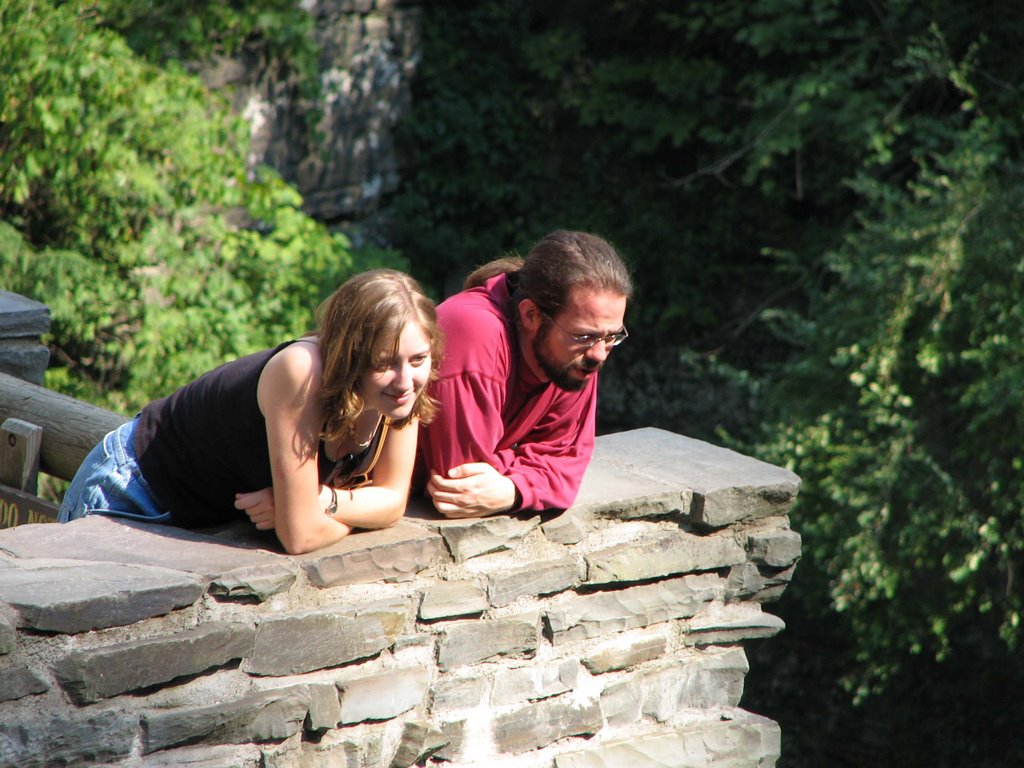
The first is from the gorge at Treman Park outside of Ithaca. It was taken (by Hannah’s mom) the week Hannah was moving back into Cornell at the end of the summer. We were at the time (at the very moment of the picture, I think) discussing how we didn’t think we were going to start dating. So much for that conclusion. I remember distinctly Hannah’s reaction to the falls at the park: coming from a suburban background, she didn’t believe one could actually live so close to such natural beauty.
The second photo was taken at Pangea, one of the nicer restaurants in Ithaca, while I was back visiting Hannah this fall. It is now one of about four pictures taken of the two of us since we’ve been a couple. It’s also currently the background for my computer screen.
(In an attempt to echo the title of a previous entry and to tie this title with the above photos, I considered naming this entry “she and he, hanging out at Tre–man…” or “she and he, eating at Pange–a…” Because, y’know, it’s cute and it uses the “e” sound in each of those words. But it turns out that’s not just cute, it’s far too cutesy for my tastes, and besides I could only have used one. In fact, forget I came up with those names.)
One of the wonderful things about our relationship is that we have lots of overlapping interests, but different specializations. I majored in mathematics and music; she’s studying mathematics and English. She adores poetry, which I like but haven’t taken much time to read on my own, and I like 20th century music, some of which she’s begun appreciating. (It’s essentially entirely due to her that I have any interest in learning more about opera, however. That’s one genre that fell outside of my tastes for a long time. But last spring, after we had discussed Der Ring des Nibelungen for several weeks, she basically handed me the disks and said, “Here. Listen to these at home.” I enjoyed them a great deal, much to my surprise. Let this be a lesson that brief selections of four hours works can’t in general give you a notion of what experiencing the whole thing is like.) We’ve filled up substantial portions of our Gmail accounts with poems and mp3s. (Thank goodness for modern communication.) And, of course, we talk about math. I’m a geometer; she’s leaning towards becoming a topologist, which makes for overlapping but not quite identical interests there, too. It’s marvelous to share things you love with people you love.
Hannah was a student in a class for which I was the teaching assistant last fall. So she developed the habit early on of challenging me to explain mathematical ideas well and to her satisfaction. She’s not easily satisfied: she has very high demands on her level of understanding before she’ll admit that she’s mastered a topic. I, naturally, being a teacher (I’ll always be a teacher, even if it doesn’t stay my profession), am happy to explain, to search for new explanations, to examine an idea from several perspectives until we fall on one that she approves of. In the process, of course, she pushes me like no one else to seriously engage with every single detail, and in the end my understanding has grown nearly as much as hers has. I know she’ll be a stupendous researcher.
Hannah is a dancer. She’s been dancing her whole life, mostly folk dances and almost always with her mom. I like to dance. I aspire to learn all that she’s learned. I was never good at sports growing up, but this sort of coordination I have. This sort of movement makes sense to me. And it’s another way to participate in art. Have I mentioned I’m a liberal arts student at heart?
I’ve said before that’s it’s hard to be so far from her for so long. Of course it is. Who would think it should be otherwise? That, indeed, was one of the frustrations I mentioned a couple of weeks ago. Though it hasn’t gotten easier to be apart, recent days have granted us an easier time going about our lives and studies. We look forward to our reunion with great hope and joy. I would never recommend this kind of separation, nor deciding you’re going to start dating someone five days before one of you is about to leave for a long, long time. But I wish this kind of love for everyone. I am completely and totally (and apparently pleonastically, as well) in love with this woman. That’s why we talk for at least an hour per day, and send messages back and forth as often as we can. The above description I’ve given doesn’t begin to explain why I love her, or how wonderful it truly is to have her in my life. These are just the things I imagine you would like to know about her, and special treats we get to enjoy from being together.
And that, I think, is the sappiest essay you’ll get for a while. Unless, of course, Hannah insists I write another one. In any case, I am exceedingly happy.
Sunday, October 15, 2006
context
So, it’s important to know for a while that I’m back in Ithaca for the week. I was going to post something about it earlier, but the entry got a bit long and unwieldy. I may give a summary of it at some point. But this trip to Ithaca is the context for the next few posts.
Wednesday, August 09, 2006
a short story
I went to the Lost Dog Café last night, across from the Ithaca Commons. I was by myself. I brought Waiting for Godot, because I’ve been wanting to read it for a while and it came up in a conversation recently.
After I ordered, I got up to wash my hands. When I returned, the lady from the couple sitting next to me leaned over and said, “I was beginning to wonder if you were doing performance art. You know, just leaving and never coming back, with Waiting for Godot and a solitary glass of wine sitting there at your place.”
Things to love about Ithaca: people will talk to you in restaurants. And they’ll find it entirely plausible that you might be a performance artist. Because who isn’t, in Ithaca?
After I ordered, I got up to wash my hands. When I returned, the lady from the couple sitting next to me leaned over and said, “I was beginning to wonder if you were doing performance art. You know, just leaving and never coming back, with Waiting for Godot and a solitary glass of wine sitting there at your place.”
Things to love about Ithaca: people will talk to you in restaurants. And they’ll find it entirely plausible that you might be a performance artist. Because who isn’t, in Ithaca?
Saturday, August 05, 2006
politics on my daily commute
At the corner of Warren and Hanshaw in Ithaca, Robert Rich posts signs on the fence outside his house. Many of them pose questions: “Can a secretive government be an honest one?” “Is ‘Stay the course’ a plan or a prayer?” “Is it even conceivable that we oppose a ceasefire?” Rich bills himself as The Sine Man, and recently began adding the address of his blog to the signs.
The bus route I take to school each day passes by this intersection. I have seen that the signs have been subjected to various kinds of vandalism. Very occasionally they are broken; more often terse, dogmatic replies are spraypainted over the original messages. I have wanted to take pictures of these vandalised signs, perhaps title the photos “Dialogue”, which of course is very rarely what they evoke.
If you check out Rich’s blog, you’ll see that he also has a link to an opposing viewpoint: The Anti-Sine Man. Both of these websites present their perspectives carefully, and I think they provide fruitful occasions for discussion.
I am not a political person, by which I mean I do not find politics inherently interesting. More often, frankly, I find the behavior of those embroiled in politics appalling. But I have previously acknowledged the importance of politics, when well carried-out, so I provide these links for those who may know better than I how to work to improve the situations under discussion, and for myself so that I may continue to stay aware.
Two more blogs on Middle East politics I’d like to mention. The first is Informed Comment, by Juan Cole. This blog is of particular interest in academe, because Cole is a professor of history and one of the (apparently growing) number of academics who use blogging to have direct influence outside of their own fields, perhaps even a bit of fame in the culture at large. The Chronicle of Higher Education recently (in the July 28 issue) had an article on this general trend and Cole’s case in particular. He was recently turned down for a faculty position at Yale, despite the recommendations of two departments, and speculation ensued as to whether his blog was part of the reason for the rejection. In any case, I have not had time to examine much of his writing, but from a cursory reading the title of the blog seems well-chosen. Lots of references, lots of well-reasoned commentary.
If you prefer more spleen in your political discourse, you may want to check out the satirical Olive Ream. Again, I have not had time to read much of this, but it is a forum for those who would like to use wit to comment on world events. The author also appears well-informed on the relevant news and issues. Don’t expect the same kind of clean language as the other blogs have, if that sort of thing concerns you. I am intrigued by how political humor (e.g., Doonesbury) can treat topics both substantial and trivial in a way that resonates with those “in the know”, educates those who are more ignorant (that’s usually where I fall), and generally amuses both camps.
The bus route I take to school each day passes by this intersection. I have seen that the signs have been subjected to various kinds of vandalism. Very occasionally they are broken; more often terse, dogmatic replies are spraypainted over the original messages. I have wanted to take pictures of these vandalised signs, perhaps title the photos “Dialogue”, which of course is very rarely what they evoke.
If you check out Rich’s blog, you’ll see that he also has a link to an opposing viewpoint: The Anti-Sine Man. Both of these websites present their perspectives carefully, and I think they provide fruitful occasions for discussion.
I am not a political person, by which I mean I do not find politics inherently interesting. More often, frankly, I find the behavior of those embroiled in politics appalling. But I have previously acknowledged the importance of politics, when well carried-out, so I provide these links for those who may know better than I how to work to improve the situations under discussion, and for myself so that I may continue to stay aware.
Two more blogs on Middle East politics I’d like to mention. The first is Informed Comment, by Juan Cole. This blog is of particular interest in academe, because Cole is a professor of history and one of the (apparently growing) number of academics who use blogging to have direct influence outside of their own fields, perhaps even a bit of fame in the culture at large. The Chronicle of Higher Education recently (in the July 28 issue) had an article on this general trend and Cole’s case in particular. He was recently turned down for a faculty position at Yale, despite the recommendations of two departments, and speculation ensued as to whether his blog was part of the reason for the rejection. In any case, I have not had time to examine much of his writing, but from a cursory reading the title of the blog seems well-chosen. Lots of references, lots of well-reasoned commentary.
If you prefer more spleen in your political discourse, you may want to check out the satirical Olive Ream. Again, I have not had time to read much of this, but it is a forum for those who would like to use wit to comment on world events. The author also appears well-informed on the relevant news and issues. Don’t expect the same kind of clean language as the other blogs have, if that sort of thing concerns you. I am intrigued by how political humor (e.g., Doonesbury) can treat topics both substantial and trivial in a way that resonates with those “in the know”, educates those who are more ignorant (that’s usually where I fall), and generally amuses both camps.
Monday, July 31, 2006
Bringer of Jollity
Last night, Kristin, Jim, Melanie, and I gathered at Todd and Mia’s house. The evening’s purposes were threefold: to begin the process of saying good-byes (half of those present will be gone rather permanently from Ithaca within a week, and the rest will be gone less permanently within a month), to eat dessert (no explanation necessary), and to hold the inaugural game of the recently invented Abstractionary.
Abstractionary, as its name implies, is a kind of Pictionary™ with abstract concepts. It was created by Jim, Melanie, and Kristin as a wedding present for Todd and Mia. The rules are rather loosely written, by intent, so I’ll describe the game as we played it. We split into three teams; on each round one team draws and another team guesses. If the guessers hit exactly on the word, both teams get 5 points; if a variant is guessed, both teams get 3 points; if a synonym is guessed, both teams get 1 point. If the word is not guessed, the remaining team could try to “steal” for 3, 2, or 1 points, according to the same system as before. The first team to 12 points wins the game.
As one might expect, the game quickly turns to a sort of pictorial charades. The first word was “villainous”. It’s not difficult to get plain ol’ “villain”; a stick figure with a handlebar moustache standing next to a railroad track suffices. But there’s that stipulation about exactness in the rules, so we kept going to try to get the last syllable. How does one convey an adjective? I’m sure there are lots of effective ways, but we simply tried to generate the word “us”. I drew a picture of two groups with an arrow between them, to represent “us” and “them”, then marked out the arrow and circled the first group. This picture didn’t make much sense at the time, but it became the standard way to represent the syllable “-ous” over the course of the game. 3 points that round.
Later, we had to draw “effervescent”. A glass of bubbly water accurately represented the concept, but was useless for eliciting guesses. We broke down the word into constituent syllables. “Scent” was not hard, with a nose and a flower. Since we’re all teachers, a piece of paper with lines of text and marks suggested “grading”, and a large X over the page with a sad face adjacent eventually led to “F”. Unfortunately, these clues were not enough to lead to a correct, or even relatively nearby, guess. No points that round.
“Self-referential” was not nearly as difficult as the drawing team initially feared: a stick-figure with a curved arrow leading both away from and back towards the figure finished that off. “Sadistic” led to some interesting pictures of intercontinental ballistic missiles (going for the rhyme, you know), although it was the person in manacles being whipped which succeeded. There was a curious occasion of splitting the single syllable word “hope” into two parts: “hoe” and “pea”, which almost succeeded.
Possibly the most educational round occurred with “jovial”. A cup of coffee (“java”) was intended to compound with a test tube (“vial”) to make the word, but we never got the second half. The coffee led to a happy face, which took us to “joy” and all its variants. (I thought the idea was that coffee brings joy—a sentiment I have often expressed in the office.) At the end of the round, a debate ensued as to how synonymous “joyous” and “jovial” are, and whether they have a common etymological root, given how similar they appear. (We eventually got 1 point for the synonym.) This was a perfect occasion to use one of my new favorite websites: the Online Etymology Dictionary.
You can check out the entries on joy and jovial for yourself if you like, but I’ll summarize the discussion here. “Jovial” comes from “Jove”, that is, Jupiter; “Jupiter” in turn comes from two roots, meaning “god” (related also to the French dieu and the Greek Zeus) and “father” (like pater). That’s right: Jupiter is the Godfather. “Joy” comes from the Latin gaudere, meaning “to rejoice”. The etymologies of the words are completely unrelated. But the meanings are indisputably similiar. After all, Holst subtitled the “Jupiter” movement of The Planets with “Bringer of Jollity” (“jollity” also arising from the root gaudere).
This discovery led into a discussion of favorite etymological coincidences. Jim said he’s seen the similarity of the English day and the Latin dies given as an example of how words with a similar meaning and a similar appearance may not have the same origins: day probably comes from a root meaning “to burn”, whereas dies comes from a root meaning “to shine”, also related to the root of dieu mentioned above. I personally like the fact that Latin has the same word—liber—for both “book” and “free”, even though their origins are completely different.
The game was exceedingly entertaining. A few wrinkles had to be smoothed out: the rules stipulate that which teams play in each round be determined by the digits of some irrational number. We chose π (pi, if the character won’t display properly for you), and since we had three teams, took the digits modulo 3. Unfortunately, it’s not uncommon for adjacent digits in π to be equivalent mod 3 (so that a team would be drawing for itself), nor for one team to be neglected for long stretches if we took the digits in their strict order. We stayed flexible on this point, so that everyone got a fair chance. The tag-team drawing was an on-the-spot innovation, and worked quite well most of the time.
If it weren’t for the game of Math Charades that a group of freshmen started up at a Christmas party last year, Abstractionary would probably also be the nerdiest game ever played in that house.
Abstractionary, as its name implies, is a kind of Pictionary™ with abstract concepts. It was created by Jim, Melanie, and Kristin as a wedding present for Todd and Mia. The rules are rather loosely written, by intent, so I’ll describe the game as we played it. We split into three teams; on each round one team draws and another team guesses. If the guessers hit exactly on the word, both teams get 5 points; if a variant is guessed, both teams get 3 points; if a synonym is guessed, both teams get 1 point. If the word is not guessed, the remaining team could try to “steal” for 3, 2, or 1 points, according to the same system as before. The first team to 12 points wins the game.
As one might expect, the game quickly turns to a sort of pictorial charades. The first word was “villainous”. It’s not difficult to get plain ol’ “villain”; a stick figure with a handlebar moustache standing next to a railroad track suffices. But there’s that stipulation about exactness in the rules, so we kept going to try to get the last syllable. How does one convey an adjective? I’m sure there are lots of effective ways, but we simply tried to generate the word “us”. I drew a picture of two groups with an arrow between them, to represent “us” and “them”, then marked out the arrow and circled the first group. This picture didn’t make much sense at the time, but it became the standard way to represent the syllable “-ous” over the course of the game. 3 points that round.
Later, we had to draw “effervescent”. A glass of bubbly water accurately represented the concept, but was useless for eliciting guesses. We broke down the word into constituent syllables. “Scent” was not hard, with a nose and a flower. Since we’re all teachers, a piece of paper with lines of text and marks suggested “grading”, and a large X over the page with a sad face adjacent eventually led to “F”. Unfortunately, these clues were not enough to lead to a correct, or even relatively nearby, guess. No points that round.
“Self-referential” was not nearly as difficult as the drawing team initially feared: a stick-figure with a curved arrow leading both away from and back towards the figure finished that off. “Sadistic” led to some interesting pictures of intercontinental ballistic missiles (going for the rhyme, you know), although it was the person in manacles being whipped which succeeded. There was a curious occasion of splitting the single syllable word “hope” into two parts: “hoe” and “pea”, which almost succeeded.
Possibly the most educational round occurred with “jovial”. A cup of coffee (“java”) was intended to compound with a test tube (“vial”) to make the word, but we never got the second half. The coffee led to a happy face, which took us to “joy” and all its variants. (I thought the idea was that coffee brings joy—a sentiment I have often expressed in the office.) At the end of the round, a debate ensued as to how synonymous “joyous” and “jovial” are, and whether they have a common etymological root, given how similar they appear. (We eventually got 1 point for the synonym.) This was a perfect occasion to use one of my new favorite websites: the Online Etymology Dictionary.
You can check out the entries on joy and jovial for yourself if you like, but I’ll summarize the discussion here. “Jovial” comes from “Jove”, that is, Jupiter; “Jupiter” in turn comes from two roots, meaning “god” (related also to the French dieu and the Greek Zeus) and “father” (like pater). That’s right: Jupiter is the Godfather. “Joy” comes from the Latin gaudere, meaning “to rejoice”. The etymologies of the words are completely unrelated. But the meanings are indisputably similiar. After all, Holst subtitled the “Jupiter” movement of The Planets with “Bringer of Jollity” (“jollity” also arising from the root gaudere).
This discovery led into a discussion of favorite etymological coincidences. Jim said he’s seen the similarity of the English day and the Latin dies given as an example of how words with a similar meaning and a similar appearance may not have the same origins: day probably comes from a root meaning “to burn”, whereas dies comes from a root meaning “to shine”, also related to the root of dieu mentioned above. I personally like the fact that Latin has the same word—liber—for both “book” and “free”, even though their origins are completely different.
The game was exceedingly entertaining. A few wrinkles had to be smoothed out: the rules stipulate that which teams play in each round be determined by the digits of some irrational number. We chose π (pi, if the character won’t display properly for you), and since we had three teams, took the digits modulo 3. Unfortunately, it’s not uncommon for adjacent digits in π to be equivalent mod 3 (so that a team would be drawing for itself), nor for one team to be neglected for long stretches if we took the digits in their strict order. We stayed flexible on this point, so that everyone got a fair chance. The tag-team drawing was an on-the-spot innovation, and worked quite well most of the time.
If it weren’t for the game of Math Charades that a group of freshmen started up at a Christmas party last year, Abstractionary would probably also be the nerdiest game ever played in that house.
Friday, July 21, 2006
Geistliches Lied
Last night the Cornell University Summer Choir gave its fourth annual concert. I have sung with this group for the last three summers. It has traditionally been composed primarily of members of the Glee Club and Chorus. While I have never belonged to either of those organizations (the Glee Club because I haven’t been able to commit the time, and the Chorus because—well—it’s a women's ensemble), they have been kind enough to permit me to join them in music-making. I think the fact that I sang at St. Olaf was my “in” the first year, and thereafter I had the benefit of a precedent. This year, for various reasons, we ended up with only six singers (hence one member billed the choir to her friends as the “Summer Sextet”). Good musicians all, and we had a great time rehearsing and delivering the performance.
As almost any proper choral concert should, ours included a mix of music reaching back into the Renaissance, up into the 21st century, with both classical “art” songs and folk songs. The second piece we performed was Brahms’ Op. 30, Geistliches Lied, whose title means “spiritual song.” It is a marvelously composed work: slow, peaceful, yet highly contrapuntal. Each section is a double canon—one canon between the soprano and tenor, the other between the alto and bass. The text is by Paul Flemming, and is apparently difficult to translate properly; one choir member described Flemming as a “German John Donne,” with whom he was contemporary. Below is the German text and a decent translation I found online.
The rest of the program:
As almost any proper choral concert should, ours included a mix of music reaching back into the Renaissance, up into the 21st century, with both classical “art” songs and folk songs. The second piece we performed was Brahms’ Op. 30, Geistliches Lied, whose title means “spiritual song.” It is a marvelously composed work: slow, peaceful, yet highly contrapuntal. Each section is a double canon—one canon between the soprano and tenor, the other between the alto and bass. The text is by Paul Flemming, and is apparently difficult to translate properly; one choir member described Flemming as a “German John Donne,” with whom he was contemporary. Below is the German text and a decent translation I found online.
Lass dich nur nichts nicht dauren mit Trauren,We also premiered a piece I wrote, entitled Promised Land. It was the last big number of the concert (not quite the closer, since we sang two lullabies by Charles Ives afterwards), and was well-received. There’s a story to how this song began: early one Saturday morning around March of 2005, I was awoken by the cold wind blowing in through my window. Almost immediately the first line of the second verse below started going through my head. A little while later (still lying in bed), I came up with the first verse and a second tune, which is intended to be a “walking” tune. The words throughout tell of hope, of reaching a final destination. For me, this song captures how I was feeling that morning—a bit chilly, increasingly dealing with life’s struggles, but sure of God’s providence.
sei stille, wie Gott es fügt, so sei vergnügt mein Wille!
Was willst du heute sorgen auf morgen?
Der Eine steht allem für, der gibt auch dir das Deine.
Sei nur in allem Handel ohn’ Wandel,
steh’ feste, was Gott beschleusst, das ist und heisst das Beste.
Amen.
Do not be sorrowful or regretful;
Be calm, as God has ordained, and thus my will shall be content.
What do you want to worry about from day to day?
There is One who stands above all who gives you, too, what is yours.
Only be steadfast in all you do,
stand firm; what God has decided, that is and must be the best.
Amen.
Though the road is harder now, I feel like I can make it,
Feel like I can make it all the way;
Though the road is harder now, I feel like I can make it,
Like I can make it to the promised land.
The wind blows colder now, and I feel like I’ve been walkin’,
Feel like I’ve been walkin’ for so long;
The wind blows colder now, but you know I'll keep on walkin’.
I'm gonna make it to the promised land.
One day my Lord called; He said, “It’s time to make the journey,
Time to make the journey of your life.”
I said to Him, “Oh, Lord, I pray it won’t be too long.”
He said, “My grace is enough for you.”
I'm goin’ stronger now, ’cause His Spirit lives within me
To lead and guide me all the way.
I'm goin’ stronger now, ’cause His Spirit lives within me,
And He will take me to the promised land.
Glory, Hallelujah,
I'm singin’ glory, Hallelujah!
The rest of the program:
- Ave Maria, Jean Mouton
- The Well-Beloved (Armenian folksongs), collected by H. Gudenian, arr. Deems Taylor
- Anthony O’Daly, Samuel Barber
- Locus Iste, Anton Bruckner
- Blessed is the Man that Trusteth in the Lord, Alan Hovhaness
- Poor Pilgrim, collected by R. Nathaniel Dett
- Tryin’ to Get Home, trad.
- City Called Heaven, arr. Josephine Poelinitz
- Berceuse and There is a Lane, Charles Ives, arr. H. Haufrecht
Monday, July 03, 2006
"O for a thousand books to sing..."
I collect hymnals. This is a recently acquired hobby, although it is one I considered taking up for some time. I have determined to make it my habit to seek out used bookstores in each town I visit and find whatever hymnals they have. In the last two weeks, I have more than doubled the number of volumes in my collection. As I was driving into Ithaca today, I stopped by the used bookstores on the Commons to see if I could reach 20. Depending on how you classify some of the volumes, you might claim I made it. Musical treasures abound in these books.
(This may be as far as you want to read in this entry, because from here on out the details get gritty.)
I bought my first hymnal in the spring of 2005 at the Friends of the Library Book Sale. It was the current edition (1989) of the United Methodist Hymnal. For my birthday that year, Becky gave me two Lutheran hymnals and one from the United Church of Christ. In Burlington, Vermont, she pointed me to a collection of American hymns ranging from the 17th century to original commissioned works, and it didn’t take me much deliberation to decide to get it. The real fun started at this spring’s Friends of the Library sale, when I found a book dating from the 1880s and a book of revival-era songs.
Here is the full set as it currently stands, in chronological order:
Each book has its particular value. In Laudes Domini I found a lovely setting of “Worship the Lord in the beauty of holiness”. The St. Olaf College Song Book has many of F. Melius Christiansen’s hymn arrangements, and the supplement holds a ballad about Olav in a setting by Grieg. Junior Praises has a text set to the tune of “Swanee River”. Glorious Gospel Hymns (which has, so far, the worst editing job of my collection) is the only hymnal I have containing a tune I had been singing to myself for some time until I found this book. (To give you an idea of the editing, the tune is attributed twice to Rossini and once to Haydn, but I think the former is correct.)* The United Methodist Hymnal introduced me to Charles Wesley's poem “Come, O Thou Traveler Unknown” and the complete text of “Glory to God, and Praise and Love”, from which “O For a Thousand Tongues to Sing” is taken. Among five hymnals, I have seven different settings of “Come, Ye Sinners, Poor and Needy” (or “poor and wretched,” which I think is the original), three of which have an added refrain. And yes, I did happen upon a Jewish hymnal, with a number of tunes based on traditional (e.g., Sephardic) melodies.
The reactions of my friends upon hearing of this collection have been varied. Becky claims that if I continue this practice, then at the end of my life I’ll have a collection that I’ll have to donate to St. Olaf, and that they’ll love it. Some friends chide me in jest for having an addiction. One remarked that a famous hymnist, Philip Bliss, is from this region (born in Clearfield County, Pennsylvania).
In any case, I’m pleased with what I’ve found so far. Searching through used bookstores means finding a concentration of hymnals from the first half of the 20th century—I suspect this is due in part to dispersing the possessions of people who have passed on, and may have received these books early in their lives. Apart from the United Methodist Hymnal and American Hymns, the more contemporary works I have were gifts.
Now that you’ve read far more than you expected or wanted to about my new hobby, I’ll alert you that this is as much for my own records as it is to enlighten anyone else on it. But perhaps some of you enjoyed the curious diversity of the list. :-)
* Added 9 July: I have now discovered the tune in both of my 1880s hymnals. It is by Rossini, and its name is “Manoah”.
(This may be as far as you want to read in this entry, because from here on out the details get gritty.)
I bought my first hymnal in the spring of 2005 at the Friends of the Library Book Sale. It was the current edition (1989) of the United Methodist Hymnal. For my birthday that year, Becky gave me two Lutheran hymnals and one from the United Church of Christ. In Burlington, Vermont, she pointed me to a collection of American hymns ranging from the 17th century to original commissioned works, and it didn’t take me much deliberation to decide to get it. The real fun started at this spring’s Friends of the Library sale, when I found a book dating from the 1880s and a book of revival-era songs.
Here is the full set as it currently stands, in chronological order:
- Book of Worship with Tunes (1880, Lutheran Publication Society)
- Laudes Domini: A selection of spiritual songs ancient & modern (1887, The Century Co.)
- Junior Praises (1901, Western Methodist Book Concern)
- The Gospel in Song (1926, Review and Herald Publishing Association)
- Glorious Gospel Hymns (1931, Nazarene Publishing House)
- Union Hymnal: Songs and prayers for Jewish worship (1932, The Central Conference of American Rabbis)
- The Concordia Hymnal, bound with a supplementary section as the St. Olaf College Song Book (1934, Augsberg Publishing House)
- The Hymnal of the Protestant Episcopal Church in the United States of America (1940, The Church Pension Fund)
- The Hymnal for Youth (1941, The Westminster Press)
- Tabernacle Hymns Number Four, round note edition (1951, Tabernacle Publishing Company)
- The Methodist Hymnal (1966, The Methodist Publishing House)
- Crusader Hymns and Hymn Stories (1967, The Billy Graham Evangelistic Association)
- The Hymnal of the United Church of Christ (1974, United Church Press, 7th printing 1979)
- The Hymn Book, words only (1975, the Anglican Church of Canada and the United Church of Canada)
- Lutheran Book of Worship, organist edition (1978, Lutheran Church in America, 17th printing 2005)
- The United Methodist Hymnal (1989, The United Methodist Publishing House, 11th printing 1994)
- With One Voice: A Lutheran resource for worship (1995, Augsberg Fortress)
- The Celebration Hymnal: Songs and hymns for worship (1997, Word/Integrity)
- American Hymns Old and New, 2 volumes, including notes on the hymns and biographies of the authors and composers (1980, Columbia University Press)
- A Survey of Christian Hymnody (1987, Hope Publishing Company)
- Biography of Gospel Song and Hymn Writers, by J. H. Hall (1914, Fleming H. Revell Company)
- The Chorale Through Four Hundred Years, by Edwin Liemohn (1953, Muhlenberg Press)
- Liturgies of the Western Church, by Bard Thompson (1961, Fortress Press)
Each book has its particular value. In Laudes Domini I found a lovely setting of “Worship the Lord in the beauty of holiness”. The St. Olaf College Song Book has many of F. Melius Christiansen’s hymn arrangements, and the supplement holds a ballad about Olav in a setting by Grieg. Junior Praises has a text set to the tune of “Swanee River”. Glorious Gospel Hymns (which has, so far, the worst editing job of my collection) is the only hymnal I have containing a tune I had been singing to myself for some time until I found this book. (To give you an idea of the editing, the tune is attributed twice to Rossini and once to Haydn, but I think the former is correct.)* The United Methodist Hymnal introduced me to Charles Wesley's poem “Come, O Thou Traveler Unknown” and the complete text of “Glory to God, and Praise and Love”, from which “O For a Thousand Tongues to Sing” is taken. Among five hymnals, I have seven different settings of “Come, Ye Sinners, Poor and Needy” (or “poor and wretched,” which I think is the original), three of which have an added refrain. And yes, I did happen upon a Jewish hymnal, with a number of tunes based on traditional (e.g., Sephardic) melodies.
The reactions of my friends upon hearing of this collection have been varied. Becky claims that if I continue this practice, then at the end of my life I’ll have a collection that I’ll have to donate to St. Olaf, and that they’ll love it. Some friends chide me in jest for having an addiction. One remarked that a famous hymnist, Philip Bliss, is from this region (born in Clearfield County, Pennsylvania).
In any case, I’m pleased with what I’ve found so far. Searching through used bookstores means finding a concentration of hymnals from the first half of the 20th century—I suspect this is due in part to dispersing the possessions of people who have passed on, and may have received these books early in their lives. Apart from the United Methodist Hymnal and American Hymns, the more contemporary works I have were gifts.
Now that you’ve read far more than you expected or wanted to about my new hobby, I’ll alert you that this is as much for my own records as it is to enlighten anyone else on it. But perhaps some of you enjoyed the curious diversity of the list. :-)
* Added 9 July: I have now discovered the tune in both of my 1880s hymnals. It is by Rossini, and its name is “Manoah”.
Subscribe to:
Posts (Atom)