I’m returning to the States next Thursday, 12 April. That’s a bit earlier than I had planned. It’s been a hard year in many ways, most of which I haven’t written about here: Marseille can be a lonely place, and being away from Hannah has made it many times more difficult. Despite that, this year has been productive in many ways, with lots of new contacts, directions, and information to guide and support my research. At this point, however, I have no ongoing projects that tie me here, and I’m very excited by the prospect of being back in Ithaca, back in the math department at Cornell, and back with Hannah.
For many of you reading, this means I’ll see you sooner than expected, too. So don’t be too surprised. :-)
Showing posts with label Marseille. Show all posts
Showing posts with label Marseille. Show all posts
Tuesday, April 03, 2007

Friday, March 16, 2007
l’arrivée
Hannah arrived safely this morning. Her luggage didn’t, due to a tight connection in the JFK airport, but it should be here soon. We went to the usual Friday events: the Teichmüller seminar and pizza lunch. We’ll be taking the next few days to enjoy Marseille and various cities and towns in Switzerland and Italy. It’s going to be awesome! I should have plenty of stories to post.
I’m also working on an entry about an interesting surface I’ve started studying. I might not finish that entry until after Hannah leaves, but I thought I’d let y’all know I haven’t completely dropped writing things.
I’m also working on an entry about an interesting surface I’ve started studying. I might not finish that entry until after Hannah leaves, but I thought I’d let y’all know I haven’t completely dropped writing things.
Tuesday, March 13, 2007
my suggestion
Never, ever, ever, if at all possible, have anything to do with France Telecom.
I hope they’re not reading this now and decide to cut our internet connection again just to spite us.
I hope they’re not reading this now and decide to cut our internet connection again just to spite us.
Saturday, February 24, 2007
hexamensiversary
Those of you who figured out what enneadecahebdoversary meant, or caught some other clue I’ve given about timing, or know Hannah and me well and have a knack for dates, will realize that today Hannah and I are celebrating six months together. (Yes, I know “hexa” is a Greek prefix which I’ve stuck on a Latin-based neologism. But I decided a while back that the Greek numerical prefixes are almost always cooler and even more natural-sounding than the Latin ones. “Seximensiversary”? Does that work at all? Plus, it has too many overtones in English.) Honestly, I did more for Valentine’s Day than I’m doing for today, partly because I completely lost track of the dates and didn’t realize this was coming up until yesterday when it came up in conversation. (Right now, all time is measured strictly by the number of days remaining until Hannah comes to visit—three weeks from yesterday—rather than by Gregory’s ancient decree of quotidian nomenclature.) If I were in Ithaca, however, it would be different. We would have gone out to dinner on Valentine’s Day, certainly, and I would have brought Hannah flowers. But today, were I there, I would take Hannah on a walk in the snow, perhaps go down to the Carriage House and have a hot drink and a nice brunch. We’d spend the afternoon inside, keeping warm, perhaps working some because we’re students and there’s always work to do, but we’d take time in conversation to remember how lucky we are to have grown so close and to have the promise of so much more. (We had part of this conversation yesterday, as we recalled our histories. We’ve both changed a lot over this time, becoming more and more suited to each other. But in the days before I left Ithaca, before we were dating, we were desperately trying to make sense of our situation. I didn’t think it would be a good idea for us to start dating; I wanted to give her freedom for the year. But as Hannah has pointed out, I still wanted to be the closest man in her life.) I’d sing her a love song…
Moi je t’offrirai
Des perles de pluie
Venues de pays
Où il ne pleut pas
Je creuserai la terre
Jusqu’après ma mort
Pour couvrir ton corps
D’or et de lumière
Je ferai un domaine
Où l’amour sera roi
Où l’amour sera loi
Où tu seras reine
We’d make dinner together. And we’d kiss each other good night, preparing for the morning when we’d go worship together.
Why should this be any different from how we’d spend any other Saturday? I guess in many ways it’s not. Days can be made special by either event or intent. Six months into a relationship is something of a hurdle; a lot has happened by this point, and while things can remain fresh (as they can throughout a lifetime), the relationship isn’t pristine any longer. Many of the complications of depending on another person and having lost some measure of independence have been brought into relief. Six months isn’t a moment to fear, but it is a moment to mark, and maybe marvel. The work has been done, and will continue. The intent of today is to declare that the decision made half a year ago, in such doubt and anxiety and excitement, is now sure. “Happy six months” doesn’t mean that every moment or even every day of those six months has been happy, because that’s simply not true. We have had pain and confusion and sorrow. It means that today I’m happy we’re still together, and I want to remain that way. It means this time has been incredibly wonderful and joyful, despite the hardships. It means, for us, that when I return to the States and a full nine months will have elapsed since the spurt that pushed us into this, the time will not have been lost. It means thank you for being willing to live this experience with me.
Happy six months, Hannah.
Moi je t’offrirai
Des perles de pluie
Venues de pays
Où il ne pleut pas
Je creuserai la terre
Jusqu’après ma mort
Pour couvrir ton corps
D’or et de lumière
Je ferai un domaine
Où l’amour sera roi
Où l’amour sera loi
Où tu seras reine
We’d make dinner together. And we’d kiss each other good night, preparing for the morning when we’d go worship together.
Why should this be any different from how we’d spend any other Saturday? I guess in many ways it’s not. Days can be made special by either event or intent. Six months into a relationship is something of a hurdle; a lot has happened by this point, and while things can remain fresh (as they can throughout a lifetime), the relationship isn’t pristine any longer. Many of the complications of depending on another person and having lost some measure of independence have been brought into relief. Six months isn’t a moment to fear, but it is a moment to mark, and maybe marvel. The work has been done, and will continue. The intent of today is to declare that the decision made half a year ago, in such doubt and anxiety and excitement, is now sure. “Happy six months” doesn’t mean that every moment or even every day of those six months has been happy, because that’s simply not true. We have had pain and confusion and sorrow. It means that today I’m happy we’re still together, and I want to remain that way. It means this time has been incredibly wonderful and joyful, despite the hardships. It means, for us, that when I return to the States and a full nine months will have elapsed since the spurt that pushed us into this, the time will not have been lost. It means thank you for being willing to live this experience with me.
Happy six months, Hannah.
Friday, February 16, 2007
a tale of two spaces
Well, in some ways this week was spent studying three spaces, but two of them made their way into the title of the conference: outer space and Teichmüller space. Teichmüller space has a long history in the study of Riemann surfaces; outer space is much more recent, and the conference was organized in part to celebrate the 20th “birthday” of outer space: in 1986 the definition and fundamental properties of outer space were published by Culler and Vogtmann (the latter of whom is a professor at Cornell). At Thursday night’s bouillabaisse dinner, the two of them blew out the candles on a birthday cake. The third kind of space mentioned this week was symmetric spaces; the study of these goes back even further than Teichmüller space. Several talks described the fruitfulness of thinking of these three kinds of spaces jointly, to see what analogues and differences there are.
Part of the idea in the study of these three spaces is to link geometric and algebraic objects so that each can cast light on the other. Generally, the algebra comes from looking at symmetries in the geometry. Theorems arise which describe the restrictions one side puts on the other: that is, if your geometric object looks the same in a lot of places, then there are a lot of ways to move the points of the object around on itself while keeping the same structure, and vice versa. (Think of how a sphere can be rotated around any axis through its center by any amount to give the same sphere, because it looks exactly the same at every point. A cube, while it has lots of pretty symmetries, is less symmetric than the sphere, which you can see by the severe restrictions on which axes you can rotate around and by how much to leave the cube looking as it did before. A highly irregular object looks different no matter how much you rotate it in any direction; this is called having a trivial symmetry group, which is an algebraic way of describing a geometric property.) The basic geometric objects in Teichmüller theory are surfaces with metrics, i.e., ways of measuring distances on the surfaces. The distances can make little patches on the surface look either flat or curvy (for an explanation of what “curvy” means here, see Tim’s entry about bugs on a hotplate). The symmetries of such a surface can be described roughly (almost always) as ways to cut the surface up and glue it back together so that it looks the same. Outer space looks at graphs, which in this context means not plotting a function or the year’s earnings, but taking points and connecting them with edges of various lengths. (A common example here is a single point with several curves that leave and come back to it; this is called a rose.) The symmetries come from ways of exchanging pieces of the graphs. But whereas Teichmüller space interests itself mainly with the geometry of the surfaces, outer space was created specifically to study the ways of moving the graph around—that is, the focus is on the algebraic aspect. This means the study of outer space falls under “geometric group theory,” using the geometry of an object to glean algebraic information about the associated symmetries. (Indeed, it is called “outer space” because the ways of moving things around form the outer automorphism group, an algebraic object that was studied long before the introduction of outer space.)
This was a fantastic week to be in Marseille (or more properly, in Luminy where the conference center is). For those interested in the conference webpage itself, you can find it (containing a description of the week, a list of participants, and summaries of the talks) here. I could throw around the names of some of the top-notch mathematicians who were here, but everyone who cares probably already knows. I made and strengthened a number of good contacts, and got some good references and discussion for the projects I’m currently working on. Congratulations and thanks to the organizers, and to all the speakers, and to my colleagues with whom I met. I look forward to continuing in this field, at the intersection of so many interesting parts of mathematics and drawing on the skills of so many generous and talented mathematicians, for many years.
Part of the idea in the study of these three spaces is to link geometric and algebraic objects so that each can cast light on the other. Generally, the algebra comes from looking at symmetries in the geometry. Theorems arise which describe the restrictions one side puts on the other: that is, if your geometric object looks the same in a lot of places, then there are a lot of ways to move the points of the object around on itself while keeping the same structure, and vice versa. (Think of how a sphere can be rotated around any axis through its center by any amount to give the same sphere, because it looks exactly the same at every point. A cube, while it has lots of pretty symmetries, is less symmetric than the sphere, which you can see by the severe restrictions on which axes you can rotate around and by how much to leave the cube looking as it did before. A highly irregular object looks different no matter how much you rotate it in any direction; this is called having a trivial symmetry group, which is an algebraic way of describing a geometric property.) The basic geometric objects in Teichmüller theory are surfaces with metrics, i.e., ways of measuring distances on the surfaces. The distances can make little patches on the surface look either flat or curvy (for an explanation of what “curvy” means here, see Tim’s entry about bugs on a hotplate). The symmetries of such a surface can be described roughly (almost always) as ways to cut the surface up and glue it back together so that it looks the same. Outer space looks at graphs, which in this context means not plotting a function or the year’s earnings, but taking points and connecting them with edges of various lengths. (A common example here is a single point with several curves that leave and come back to it; this is called a rose.) The symmetries come from ways of exchanging pieces of the graphs. But whereas Teichmüller space interests itself mainly with the geometry of the surfaces, outer space was created specifically to study the ways of moving the graph around—that is, the focus is on the algebraic aspect. This means the study of outer space falls under “geometric group theory,” using the geometry of an object to glean algebraic information about the associated symmetries. (Indeed, it is called “outer space” because the ways of moving things around form the outer automorphism group, an algebraic object that was studied long before the introduction of outer space.)
This was a fantastic week to be in Marseille (or more properly, in Luminy where the conference center is). For those interested in the conference webpage itself, you can find it (containing a description of the week, a list of participants, and summaries of the talks) here. I could throw around the names of some of the top-notch mathematicians who were here, but everyone who cares probably already knows. I made and strengthened a number of good contacts, and got some good references and discussion for the projects I’m currently working on. Congratulations and thanks to the organizers, and to all the speakers, and to my colleagues with whom I met. I look forward to continuing in this field, at the intersection of so many interesting parts of mathematics and drawing on the skills of so many generous and talented mathematicians, for many years.
Thursday, February 08, 2007
where to go part 3
This isn’t about the strikes in Guinea (which look like they may begin again, incidentally). It’s about the strike happening here in Marseille, with a parade of protesters marching at this moment down the Boulevard d’Athènes and the Cours Julien, starting from the train station, and going presumably all the way to Castellane, if not further. I would have remained entirely oblivious to it had I not gone out to do some errands this morning. On my way back, I noticed the strange traffic flow and the red flags with yellow symbols flying and the early rumblings of a voice on a loudspeaker. So instead of taking a shortcut home, I walked up to the Place des Capucines, where the head of the parade was just about to get underway.
Protest rallies are great places to obtain flyers about all sorts of causes. I got four, and I don’t think I got everything available. The principle one is entitled 8 février : Toutes les raisons d’être dans l’action et la grève (All the reasons to be in action and on strike). The umbrella organization in this activity is the CGT (Confédération générale du travail) of the Bouches-du-Rhône. You can find “Toutes les raisons” as a Word document on their website. Today the call was sent out to all public employees to join in the strike and demonstrations. And, as you can see from the pictures below, many different groups are represented.


If you go to the main CGT page for all of France, you find that this is in fact a nation-wide campaign. The complaints are both that salaries are insufficient (the demand is that the minimum be raised to 1500€, presumably per month) and that jobs are being destroyed, not created, while the population (especially here in Marseille) is growing. The unions are addressing the European Commission, seeking increased security, increased salary, and increased availability of public services.
You might also notice what is marked on those red flags that caught my attention. The Jeunes Communistes took the occasion to make an appearance, which is where my second flyer came from. The header on one side declares “Avec les communistes : unir, lutter, vaincre!” (“With the communists: unite, fight, vanquish!”) I was particularly interested by their discussion, in a single sentence, of contemporary French politics: “By imposing, with incessant propaganda, the rivalry between Nicolas Sarkozy de Naguis-Bosca and Marie Ségolène Royale as the political issue, they leave us to believe that we will have no other solutions except to choose between a dangerous reactionary and a pale conservative. LIE!!!” And they present their candidate, Marie-George Buffet, along with their demands: the sharing of wealth, power, and information. Not a bad presentation, overall. Sufficiently and simultaneously indignant and informed.
The third flyer came from supporters of Roland Veuillet, a teacher and active union member who has been on a hunger strike for 47 days. From what I can gather, in 2003, during a proctors’ strike in Nimes, he “opposed” the school’s (apparently illegal) practice of placing older students in charge of watching the exams. (I haven’t found exactly by what means he opposed this.) Soon afterwards, he was sanctioned by the minister of education De Robien, and was relocated to Lyon. I’m taking all this information from the materials of Veuillet’s supporters, so I have no idea what the other side of the story is, but the hunger strike is real. Several students and other teachers have joined this strike in solidarity at one point or another.
The remaining flyer was less ambitious. Just half a page, printed on one side only, it declares, “Housing is not just the problem of the homeless!” Then it speaks of drawing on public funds to build “social housing” (“logements sociaux”) and improving rights of tenants. The language of this flyer catches my attention; they use the phrase “Exigeons” rather than “Nous exigeons”—that is, “Let us demand” rather than “We demand”, effectively supporting their claim that solving this problem shouldn’t be left to those we’d like to believe are the only ones it affects.
Strikes are painful. They wouldn’t really be effective if they weren’t. France is well-known for frequently having strikes of one form or another. Somehow, in the States, we’ve avoided most of the pain of these events in recent times. (I’ve heard some opinions on why this is the case, but I don’t think I should bring them up here.) I know I’ve been traveling at times when some part or another of an airline’s necessary workers were striking (I think it was the luggage handlers), and I hardly noticed any difference at all—the main thing was the flyers that appeared. But a well-managed strike can bring everything to a standstill. They’re a method of either asserting power or trying to grasp it. Such power may well be merited, and I suspect the causes are usually just. I doubt I’ll ever be in a situation where I’ll have to go on strike with a union. Before today, I hadn’t thought about it. But I believe if the time came, there are conditions under which I would join in approvingly, either for the sake of ameliorating the state of my fellow workers or in protest of an outrageous policy or action. I wish these times weren’t necessary. But that goes back to how the world doesn’t really change, injustice remains, and we have to keep fighting collectively and individually to stamp it out.
Protest rallies are great places to obtain flyers about all sorts of causes. I got four, and I don’t think I got everything available. The principle one is entitled 8 février : Toutes les raisons d’être dans l’action et la grève (All the reasons to be in action and on strike). The umbrella organization in this activity is the CGT (Confédération générale du travail) of the Bouches-du-Rhône. You can find “Toutes les raisons” as a Word document on their website. Today the call was sent out to all public employees to join in the strike and demonstrations. And, as you can see from the pictures below, many different groups are represented.


If you go to the main CGT page for all of France, you find that this is in fact a nation-wide campaign. The complaints are both that salaries are insufficient (the demand is that the minimum be raised to 1500€, presumably per month) and that jobs are being destroyed, not created, while the population (especially here in Marseille) is growing. The unions are addressing the European Commission, seeking increased security, increased salary, and increased availability of public services.
You might also notice what is marked on those red flags that caught my attention. The Jeunes Communistes took the occasion to make an appearance, which is where my second flyer came from. The header on one side declares “Avec les communistes : unir, lutter, vaincre!” (“With the communists: unite, fight, vanquish!”) I was particularly interested by their discussion, in a single sentence, of contemporary French politics: “By imposing, with incessant propaganda, the rivalry between Nicolas Sarkozy de Naguis-Bosca and Marie Ségolène Royale as the political issue, they leave us to believe that we will have no other solutions except to choose between a dangerous reactionary and a pale conservative. LIE!!!” And they present their candidate, Marie-George Buffet, along with their demands: the sharing of wealth, power, and information. Not a bad presentation, overall. Sufficiently and simultaneously indignant and informed.
The third flyer came from supporters of Roland Veuillet, a teacher and active union member who has been on a hunger strike for 47 days. From what I can gather, in 2003, during a proctors’ strike in Nimes, he “opposed” the school’s (apparently illegal) practice of placing older students in charge of watching the exams. (I haven’t found exactly by what means he opposed this.) Soon afterwards, he was sanctioned by the minister of education De Robien, and was relocated to Lyon. I’m taking all this information from the materials of Veuillet’s supporters, so I have no idea what the other side of the story is, but the hunger strike is real. Several students and other teachers have joined this strike in solidarity at one point or another.
The remaining flyer was less ambitious. Just half a page, printed on one side only, it declares, “Housing is not just the problem of the homeless!” Then it speaks of drawing on public funds to build “social housing” (“logements sociaux”) and improving rights of tenants. The language of this flyer catches my attention; they use the phrase “Exigeons” rather than “Nous exigeons”—that is, “Let us demand” rather than “We demand”, effectively supporting their claim that solving this problem shouldn’t be left to those we’d like to believe are the only ones it affects.
Strikes are painful. They wouldn’t really be effective if they weren’t. France is well-known for frequently having strikes of one form or another. Somehow, in the States, we’ve avoided most of the pain of these events in recent times. (I’ve heard some opinions on why this is the case, but I don’t think I should bring them up here.) I know I’ve been traveling at times when some part or another of an airline’s necessary workers were striking (I think it was the luggage handlers), and I hardly noticed any difference at all—the main thing was the flyers that appeared. But a well-managed strike can bring everything to a standstill. They’re a method of either asserting power or trying to grasp it. Such power may well be merited, and I suspect the causes are usually just. I doubt I’ll ever be in a situation where I’ll have to go on strike with a union. Before today, I hadn’t thought about it. But I believe if the time came, there are conditions under which I would join in approvingly, either for the sake of ameliorating the state of my fellow workers or in protest of an outrageous policy or action. I wish these times weren’t necessary. But that goes back to how the world doesn’t really change, injustice remains, and we have to keep fighting collectively and individually to stamp it out.
Tuesday, February 06, 2007
moving along
I gave my first seminar talk in several months last Friday. It was on work contained in a preprint which isn’t my own, but which is closely related to some of my work, and which I could enlighten relatively well for the seminar attendees. Both Dr. Hubbard and Pascal, who organizes the seminar, seemed quite pleased with the exposition.
I’ve been spending most of my time lately working, not going out much. I’ve started tutoring three daughters of an Egyptian family in math and English. This week, a number of Cornell folk are in town for a conference at the CIRM in Luminy, which is where Dr. Hubbard’s birthday celebration was held in summer 2005 (our first time to come here). Melanie (co-creator of Abstractionary) came early to visit over the weekend, which was nice. Unfortunately, I’ve managed to get sick (from all this excitement? not sure) and am trying to both heal myself and get more work done. Next week CIRM hosts a conference on outer space (not what you think) and Teichmüller theory, which will bring lots of interesting people to talk with.
I have ideas for a couple more long essays, hopefully to come along soon. Hope y’all are well.
I’ve been spending most of my time lately working, not going out much. I’ve started tutoring three daughters of an Egyptian family in math and English. This week, a number of Cornell folk are in town for a conference at the CIRM in Luminy, which is where Dr. Hubbard’s birthday celebration was held in summer 2005 (our first time to come here). Melanie (co-creator of Abstractionary) came early to visit over the weekend, which was nice. Unfortunately, I’ve managed to get sick (from all this excitement? not sure) and am trying to both heal myself and get more work done. Next week CIRM hosts a conference on outer space (not what you think) and Teichmüller theory, which will bring lots of interesting people to talk with.
I have ideas for a couple more long essays, hopefully to come along soon. Hope y’all are well.
Sunday, January 21, 2007
a short story 2
I took another walk at sunset today. As I returned from the plaza I spoke of yesterday, I saw a baby stroller running up the hill at me. Now, I just watched The Illusionist last night at the theater, so I had thoughts of magic tricks in my head. As it got closer, I observed a pair of very short legs behind the wheels. I suppose this child got tired of being in the chair and decided to take over. He stopped right even with me and gave me a big smile. I hope he keeps surprising people with his magic stroller.
Saturday, January 20, 2007
something amazing every day
(This essay is dedicated to Hannah, who encourages me, especially when I feel lonely, to find something amazing every day.)
You might think, as I used to, that among locations near our apartment, the harbor is a good spot for watching the sunset. You’d be mistaken. The harbor is downhill and surrounded by forts, so what you’ll see from there is a not very satisfying vision of the sun vanishing behind buildings some time before it actually settles beneath the horizon. So while I’ve described before how fun it can be to people-watch at the Vieux Port, it’s not where you want to be au moment du coucher du soleil.
Tonight I walked to La Canebière and turned away from the harbor, up towards L’Eglise des Réformés. I believe I’ve already told how La Canebière is under construction all the way from Les Réformés down to the Vieux Port, but the worst section is towards the harbor, where the sidewalks are reduced to tiny passages, and if you stop to try to watch natural events you’re likely to get swept up in the tide of people. However, due to the curious diagonal intersection of La Canebière and the Allée Léon Gambetta (along whose length I photographed Les Réformés while standing in the Place des Capucines), there’s a sizable plaza right at the foot of the church. It’s substantially uphill from the harbor, so the view of the sun in the evening is superior. Presumably it’s even better to climb into one of the towers of Les Réformés and watch from there. (The doors of the church were closed, however.) Most of the construction of the tramway is done here, although the fences remain up, and there are lines of trees through whose branches the sunlight becomes laced as it reddens. The crowd is thinner, particularly in the square, which isn’t on the way to anywhere as it juts out into the intersection.
The amazing thing I found today was a monument in this square. A monument whose original engraving stated that its purpose is to honor those soldiers from the department of the Bouches-du-Rhône who died defending la patrie in the War of 1870–1871. Wait, which war? I had to look this up when I got home. Those were the dates of the Franco–Prussian War. Léon Gambetta, it turns out, was a statesman during that period who organized an army in Tours during the war, and who continued to fight for a brief period even after Paris surrendered to the Germans. The monument was erected in 1894 and is known as the “Monument des mobiles.” Since then, it has acquired plaques commemorating soldiers lost in wars throughout the 20th century, from the World Wars to the Algerian War to the Korean War.
At the base of the monument are twenty names of locales in the Bouches-du-Rhône that contributed soldiers. Four are distinguished at the corners with theirs coats of arms, crested by miniature stylized fortresses: Marseille, Aix, Arles, and Tarascon. The coat of Arles bears a lion carrying a staff whose top is the chi-rho symbol (superimposed X and P, for the first two letters of Christ). The coat of Tarascon has the city’s castle on the top half and a dragon devouring a person on the bottom. Aix’s coat has vertical stripes on the bottom, a crusader’s cross in the top left corner, and various arrangements of fleurs-de-lis in the top center and top right. Marseille, the department capital, simply has a large cross covering its entire shield.
Marseille can be beautiful in the twilight. I expect that in five or ten years, by which point hopefully the larger part of the construction will be done, it will be a marvelous place to visit. For now, since I’m living here, I need to continue to search out these gems. It’s easy to turn the wrong direction when you walk out on the street. Persistence is key.
You might think, as I used to, that among locations near our apartment, the harbor is a good spot for watching the sunset. You’d be mistaken. The harbor is downhill and surrounded by forts, so what you’ll see from there is a not very satisfying vision of the sun vanishing behind buildings some time before it actually settles beneath the horizon. So while I’ve described before how fun it can be to people-watch at the Vieux Port, it’s not where you want to be au moment du coucher du soleil.
Tonight I walked to La Canebière and turned away from the harbor, up towards L’Eglise des Réformés. I believe I’ve already told how La Canebière is under construction all the way from Les Réformés down to the Vieux Port, but the worst section is towards the harbor, where the sidewalks are reduced to tiny passages, and if you stop to try to watch natural events you’re likely to get swept up in the tide of people. However, due to the curious diagonal intersection of La Canebière and the Allée Léon Gambetta (along whose length I photographed Les Réformés while standing in the Place des Capucines), there’s a sizable plaza right at the foot of the church. It’s substantially uphill from the harbor, so the view of the sun in the evening is superior. Presumably it’s even better to climb into one of the towers of Les Réformés and watch from there. (The doors of the church were closed, however.) Most of the construction of the tramway is done here, although the fences remain up, and there are lines of trees through whose branches the sunlight becomes laced as it reddens. The crowd is thinner, particularly in the square, which isn’t on the way to anywhere as it juts out into the intersection.
The amazing thing I found today was a monument in this square. A monument whose original engraving stated that its purpose is to honor those soldiers from the department of the Bouches-du-Rhône who died defending la patrie in the War of 1870–1871. Wait, which war? I had to look this up when I got home. Those were the dates of the Franco–Prussian War. Léon Gambetta, it turns out, was a statesman during that period who organized an army in Tours during the war, and who continued to fight for a brief period even after Paris surrendered to the Germans. The monument was erected in 1894 and is known as the “Monument des mobiles.” Since then, it has acquired plaques commemorating soldiers lost in wars throughout the 20th century, from the World Wars to the Algerian War to the Korean War.
At the base of the monument are twenty names of locales in the Bouches-du-Rhône that contributed soldiers. Four are distinguished at the corners with theirs coats of arms, crested by miniature stylized fortresses: Marseille, Aix, Arles, and Tarascon. The coat of Arles bears a lion carrying a staff whose top is the chi-rho symbol (superimposed X and P, for the first two letters of Christ). The coat of Tarascon has the city’s castle on the top half and a dragon devouring a person on the bottom. Aix’s coat has vertical stripes on the bottom, a crusader’s cross in the top left corner, and various arrangements of fleurs-de-lis in the top center and top right. Marseille, the department capital, simply has a large cross covering its entire shield.
Marseille can be beautiful in the twilight. I expect that in five or ten years, by which point hopefully the larger part of the construction will be done, it will be a marvelous place to visit. For now, since I’m living here, I need to continue to search out these gems. It’s easy to turn the wrong direction when you walk out on the street. Persistence is key.
Wednesday, January 17, 2007
marseillais once more
I’ve just returned from my travels to the States for Christmas and New Year’s. I spent the last three weeks with Hannah, which is the longest we’ve seen each other since the end of classes last spring. (Of course, that’s mostly due to the fact that we didn’t start dating until the beginning of classes last fall, which was five days before I left Ithaca.) We shuttled between our two families, danced and talked and kissed a lot. More details later. But now my clock is set back to CET, my verbal communication will be done via Skype rather than cell phone (I was having to use Hannah’s phone anyway, because I suspended my service for the school year while I’m gone), my coffee is espresso from a cafetière italienne rather than brewed in a French press (which, despite its name, I’ve only seen used in the States and the Copenhagen airport), and it’s time to get back to work. I’m not yet sure what I’ll be doing this spring, since a calculation I made before leaving in December reduced our hopes of obtaining the result we were looking for to essentially nothing. I’m preparing a talk for the Teichmüller seminar on other topic, however, and questions abound that require addressing.
Happy New Year to all.
Happy New Year to all.
Tuesday, December 05, 2006
Friday mix
Original post: November 11.
Reposted with photo: December 5. (Cheap way of making it look like I’ve worked on the blog, huh?)
In the academic world, each semester brings its own rhythms, which depend on classes, seminars, who’s around, and numerous other small factors. Sometimes we feel the standard workweek tides, but more often we just get together whenever seems appropriate and settle down to work or socializing. (Contrary to popular stereotypes, most mathematicians really enjoy social activities. It’s possible that in a large fraction of cases they only know how to socialize with other mathematicians, however. It’s difficult to avoid making math jokes through an entire meal or party.)
This fall Friday is the fullest day of the week, normally. It begins at 9:00 in the morning with the course Dr. Hubbard is teaching on Teichmüller theory. This is aimed at a broad graduate student audience. It meets just once a week for two hours. From a review of the definitions of manifolds, differential forms, and cohomology, we have progressed through the proof of the uniformization theorem for Riemann surfaces and are now studying plane hyperbolic geometry (one of my favorite parts of the whole theory), which can be transported to Riemann surfaces (with only a few exceptions) via uniformization (most Riemann surfaces have the unit disk, i.e., the hyperbolic plane, as their universal cover). Most of the students seem to like Hubbard’s teaching overall; he almost certainly teaches in a way they’ve never seen before.
After the class we go to a seminar on Teichmüller theory (loosely speaking; other areas of interest to the participants pop up from time to time). This is where Douady and Roland spoke while visiting Marseille. The audience is quite active. It’s more or less a lecture format, but the peanut gallery is quite happy to interject with questions or points they feel should be clarified. I’ve spoken with some of the organizers, and they claim that they try to encourage an atmosphere where questioning is permitted, because it’s so incredibly frustrating to sit through an entire lecture and have no idea what the speaker said after the first couple of minutes. Apparently at some universities (especially in France, according to their accounts), questioning is actively discouraged. Only the most distinguished attendees may dare to make a remark before the end of the seminar. (In truth, it’s often helpful to younger or less bold audience members if one of the senior members asks a question, because it makes them feel more at ease—you mean there were others for whom that wasn’t totally clear? Oh, that’s a relief.)
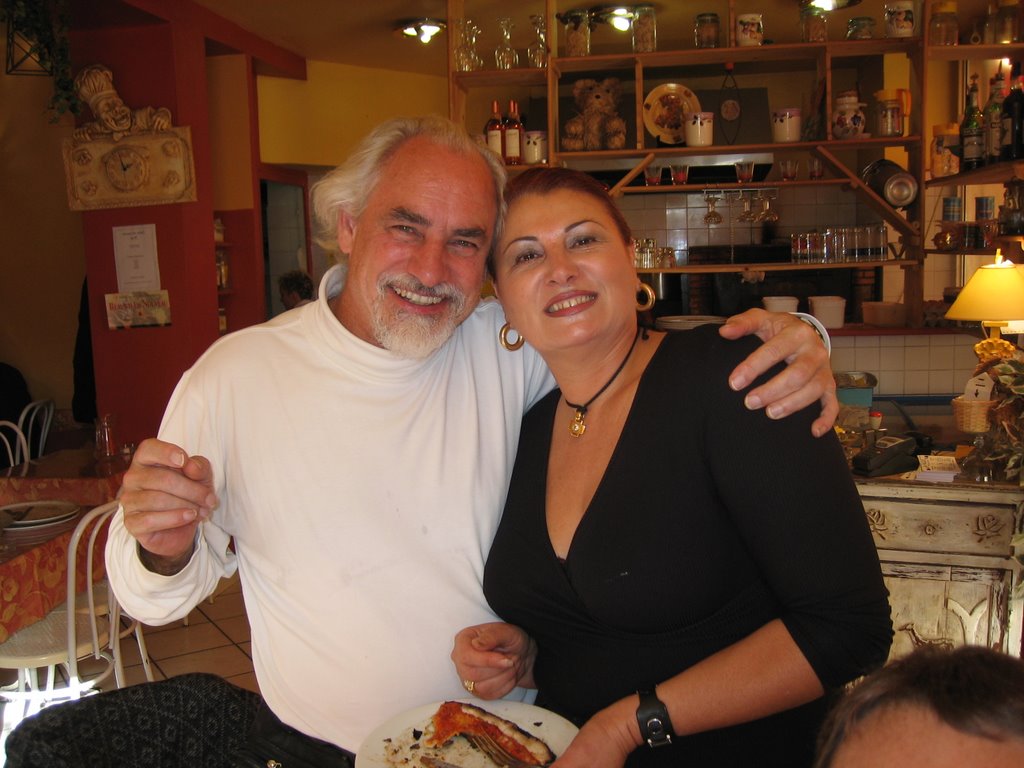
If those morning activities weren’t enough fun, then just wait until lunch. We all hike over to a pizza restaurant called Le Racati. It’s run by a matronly woman who is known simply as “la patronne” (the boss). Various members of the seminar vie for her favor. She takes good care of “les garçons” (as the seminar members are called, since until this year it’s been almost exclusively men). There are usually ten or twelve of us, and we go through four or five pizzas, four or five carafes of wine, a bowl of salad, and whatever other gifts la patronne bestows (sometimes fruit, sometimes desserts). Conversation usually centers around upcoming seminar talks, current mathematical topics of interest, and cultural exchange. This week, following the U.S. elections, politics was a hot subject. Whether any more work gets done by any particular individual the rest of the day depends on how many glasses of wine he or she had. Friday lunch is a highlight of every week. Here’s a photo of la patronne with Prof. Hubbard:

I haven’t quite figured out Friday nights in Marseille. For the first few weeks, we were having dinner with the Hubbards. One week soon after we finally moved into our apartment I took a stroll by myself and treated myself to a nice couscous dinner. There was the party at our place the night before I left for Ithaca a month ago. Twice Sarah and I have gone out to the cinema. There’s nothing consistent, like the choir rehearsal / contradance combination I had in Ithaca. But it hasn’t been bad, for the most part. Movies are relatively inexpensive, fine restaurants are plentiful, and it’s a chance (as always, in any location) to break from the demands of work. I think we should have another party soon. And I should find someplace to dance.
Just to let you know that we do actually work around here, at least for four hours a week on Friday mornings. :-) Now we just need to work on finding folk in the office in the middle of the week, too …
Reposted with photo: December 5. (Cheap way of making it look like I’ve worked on the blog, huh?)
In the academic world, each semester brings its own rhythms, which depend on classes, seminars, who’s around, and numerous other small factors. Sometimes we feel the standard workweek tides, but more often we just get together whenever seems appropriate and settle down to work or socializing. (Contrary to popular stereotypes, most mathematicians really enjoy social activities. It’s possible that in a large fraction of cases they only know how to socialize with other mathematicians, however. It’s difficult to avoid making math jokes through an entire meal or party.)
This fall Friday is the fullest day of the week, normally. It begins at 9:00 in the morning with the course Dr. Hubbard is teaching on Teichmüller theory. This is aimed at a broad graduate student audience. It meets just once a week for two hours. From a review of the definitions of manifolds, differential forms, and cohomology, we have progressed through the proof of the uniformization theorem for Riemann surfaces and are now studying plane hyperbolic geometry (one of my favorite parts of the whole theory), which can be transported to Riemann surfaces (with only a few exceptions) via uniformization (most Riemann surfaces have the unit disk, i.e., the hyperbolic plane, as their universal cover). Most of the students seem to like Hubbard’s teaching overall; he almost certainly teaches in a way they’ve never seen before.
After the class we go to a seminar on Teichmüller theory (loosely speaking; other areas of interest to the participants pop up from time to time). This is where Douady and Roland spoke while visiting Marseille. The audience is quite active. It’s more or less a lecture format, but the peanut gallery is quite happy to interject with questions or points they feel should be clarified. I’ve spoken with some of the organizers, and they claim that they try to encourage an atmosphere where questioning is permitted, because it’s so incredibly frustrating to sit through an entire lecture and have no idea what the speaker said after the first couple of minutes. Apparently at some universities (especially in France, according to their accounts), questioning is actively discouraged. Only the most distinguished attendees may dare to make a remark before the end of the seminar. (In truth, it’s often helpful to younger or less bold audience members if one of the senior members asks a question, because it makes them feel more at ease—you mean there were others for whom that wasn’t totally clear? Oh, that’s a relief.)
If those morning activities weren’t enough fun, then just wait until lunch. We all hike over to a pizza restaurant called Le Racati. It’s run by a matronly woman who is known simply as “la patronne” (the boss). Various members of the seminar vie for her favor. She takes good care of “les garçons” (as the seminar members are called, since until this year it’s been almost exclusively men). There are usually ten or twelve of us, and we go through four or five pizzas, four or five carafes of wine, a bowl of salad, and whatever other gifts la patronne bestows (sometimes fruit, sometimes desserts). Conversation usually centers around upcoming seminar talks, current mathematical topics of interest, and cultural exchange. This week, following the U.S. elections, politics was a hot subject. Whether any more work gets done by any particular individual the rest of the day depends on how many glasses of wine he or she had. Friday lunch is a highlight of every week. Here’s a photo of la patronne with Prof. Hubbard:
I haven’t quite figured out Friday nights in Marseille. For the first few weeks, we were having dinner with the Hubbards. One week soon after we finally moved into our apartment I took a stroll by myself and treated myself to a nice couscous dinner. There was the party at our place the night before I left for Ithaca a month ago. Twice Sarah and I have gone out to the cinema. There’s nothing consistent, like the choir rehearsal / contradance combination I had in Ithaca. But it hasn’t been bad, for the most part. Movies are relatively inexpensive, fine restaurants are plentiful, and it’s a chance (as always, in any location) to break from the demands of work. I think we should have another party soon. And I should find someplace to dance.
Just to let you know that we do actually work around here, at least for four hours a week on Friday mornings. :-) Now we just need to work on finding folk in the office in the middle of the week, too …
Thursday, November 30, 2006
Remember how things kept changing in "Labyrinth"? It's like that, except without the Jim Henson characters.
Time to give a bit more of a description of Marseille, now that I've had a few afternoons and evenings to walk around.
Whether one travels to Marseille by plane or train, one generally arrives at the Gare Saint Charles, since that's also where the navette (shuttle) from the airport drops you off following the half-hour ride into town. ("Gare" means "station". "Garer" is the verb "to park", whence the word "garage". Yep, it's not just geography, it's etymology! I love languages.) The front of the gare is actually quite beautiful, with lovely statues and ironwork. I don't have pictures facing the gare, but here you can see the view from the top of the stairs leading down from the station into the city:

The main road leading straight out from the escalier is the Boulevard d'Athènes. Just to the right of center you can see Notre Dame de la Garde. Brilliant location, yes? The Vieux Port is just outside of the scope of this picture, off to the right. The golden statue atop the tower is supposed to represent Mary (la bonne mère) watching over the ships in the harbor and at sea. You can read more of the basilica's history (including speculations as to that hill's religious and military use in ancient times) on the website linked above.
Behind the gare is one campus of the Université de Provence, the one where we spend our Friday mornings in Dr. Hubbard's class and the Teichmüller seminar. Describing the path to the campus is how I can begin justifying the title of the essay. If I had turned around from where I was at the top of the stairs and taken a picture in that direction, you would have seen a plastic wall zoning off a construction area. All along the western side of the gare (the stairs face south, by the way) is a hefty amount of construction. The plan, I think, is to add stores and a parking area. Somehow this construction is taking over the entire street along that side. What should be wide pedestrian areas have been transformed by metal fences into a maze of twisty little passages, all alike. On the far side of the street, more construction walls abound, and in recent weeks have begun diverting pedestrians farther and farther away from various intersections, thus necessitating the introduction of more crosswalk signals. I'm convinced that eventually the entire area will be construction, with no room for either walking or driving.
If instead of going around the gare to the campus you begin walking down the Boulevard d'Athènes, you'll reach the Place des Capucines:

This is not far from where we live. There's a patisserie we're fond of just a few meters back up the street from the Place des Capucines. Once you're there, turn left and you'll see the Eglise des Réformés:

(I have to take a picture of it at night sometime, when the rose window is lit up from inside.) Despite what its name might suggest, it is a Catholic church, and was named for a Reformed Augustinian monastery which existed on the site previously.
Here is where my pictures end. I'd like to keep walking down the Boulevard d'Athènes just a bit, however, until we get to La Canebière. This is the major road leading down to the Vieux Port (on the right); to the left, it also leads to Les Réformés (the street I showed you isn't parallel to La Canebière). La Canebière is a mess right now, with massive construction again encroaching on pedestrian areas. "Encroaching" is perhaps not the right word -- "engulfing" might be more accurate. Marseille is in the process of installing a new tramway system. This involves a complete redesign of the sidewalks along with the basic work of laying down the rails. Along this road, the effect has mainly been squeezing the traffic. In other places around town, the construction involves frequent changes in the routes and direction of traffic. As one postdoc who's working here said, "I ride my bike around here a lot, and it's like the topology changes every day."
Enough complaining about construction. (Mostly it makes me glad not to be driving.) I want to describe the Vieux Port, because it's a nice place for evening walks. I wish I had pictures of it right now. I've been down there twice by myself (in very different moods), and a couple of times with friends. It's a popular gathering spot; one finds many couples and groups of friends chatting on benches along the waterfront. During the day lots of fishmongers line the waterfront.
At night a few people fish in between the docked ships. Once I saw a couple struggling to get their fishing line to work, and they asked another man to help them out. By working together, they discovered that the casting mechanism just didn't work well. So they just kept the line in close to the shore. I believe they and the other fisherfolk I saw were using bread as bait. A couple small schools of perhaps twenty or thirty fish moved mysteriously about. The man in the couple watched a small fish dart towards and away from his hook, until he pulled the line out and the hook was stripped clean. His wife/ladyfriend chortled, and they began discussing what kind of bait would be better. Crevettes (shrimp), one proposed. Then the man who was helping walked over to a nearby puddle of standing water, and pointed out that it contained a handful of tiny fish, which could be used as bait for the larger fish. He caught one for them, and they gave it a try. While their new bait bobbled in the water, I walked over to the puddle, as well. The man noticed my somewhat bemused air, and explained that when boats come in and dump fish on the quai, these little fish are left in the puddles after the rest are taken away. The woman came over and pleaded for him to catch another piece of bait, because the one they were using had died and stopped wriggling. He did, and the guy in the couple exclaimed, "Putain! Tu es plus rapide que le poisson!" ("Putain" is the mild vulgarity of choice in Marseille.) The new bait secured, he dropped the line back in the water and started saying, "Viens, viens, grand poisson, mange le petit poisson." ("Come, come, big fish, eat the little fish.") That was enough of that story for me. I sort of wished I had stayed to see if they caught anything, but I wanted to move on and see other things.
One of my favorite sights at the Vieux Port is a massive school of silver-scaled fish swimming about just at the top of the harbor. In sunlight or lamplight, their writhing motions occasionally turn each of them so that they reflect light off their sides to the observer. It's like watching aquatic fireflies. Also at night, Notre Dame de la Garde is brilliantly illuminated and stunning from the harbor. (I tried to get a picture of that one night, but the battery in my camera was worn out.)
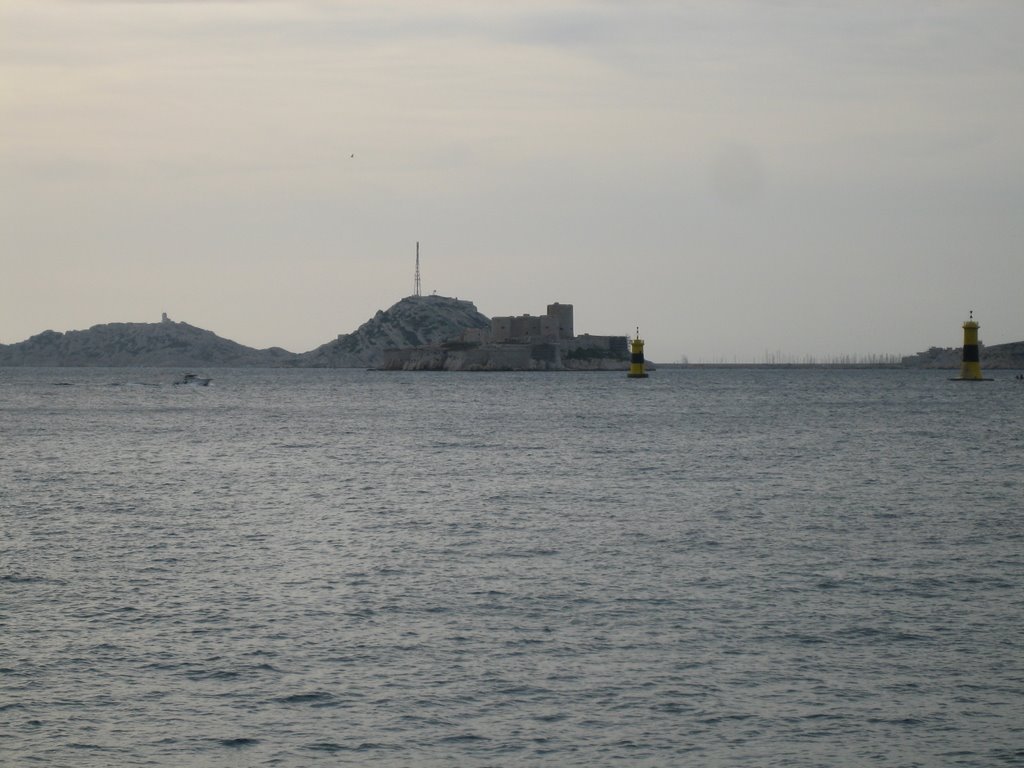
Out past the mouth of the harbor rests the Château d'If, a former island prison made famous by Dumas when he unjustly imprisoned his Count of Monte Cristo there. I do have a picture of this from a distance, taken from a spot where the Hubbards often like to swim:

I certainly plan on making it out to visit the château sometime.
The population of Marseille is dominated, at least in our neighborhood, by North Africans. You're as likely to hear Arabic on the streets as French. Lots of stores had special offers and special hours while Ramadan was happening a couple of months ago. A fortunate side effect of this demographic is the presence of lots of couscous restaurants. In about a four block radius of our house, I've found at least a half-dozen, without really looking hard. The two nicest ones I've been to are Le Femina, on the Rue du Musée, and one down by the Vieux Port whose name I don't know (although inside they have posted a brief story on the 7th century Berber princess Kahena). I've tried a handful of others, and there are two in our neighborhood that I like and are reasonably priced to eat there once a week or so.
The major type of restaurant one encounters on the streets here serves kebab sandwiches. A kebab in this case is an immense amount of lamb skewered, roasted, and left to rotate next to a heating grill in the storefront for who knows how long. It's the sort of thing Americans might find slightly sketchy, but delicious once you try it. My favorite is near the Eglise des Réformés; their sauce and seasonings are the best, and the seating area is spacious and clean.
I've already talked a bit about the open fruits and vegetables market, of which I still highly approve. The metro system is convenient for us (since we live so close to the train station). Lots of little things make this a good place to live. Lots of other little things make it really hard, but I'm not going to share those here right now. This hopefully gives you a picture of what I find fascinating about Marseille.
Whether one travels to Marseille by plane or train, one generally arrives at the Gare Saint Charles, since that's also where the navette (shuttle) from the airport drops you off following the half-hour ride into town. ("Gare" means "station". "Garer" is the verb "to park", whence the word "garage". Yep, it's not just geography, it's etymology! I love languages.) The front of the gare is actually quite beautiful, with lovely statues and ironwork. I don't have pictures facing the gare, but here you can see the view from the top of the stairs leading down from the station into the city:

The main road leading straight out from the escalier is the Boulevard d'Athènes. Just to the right of center you can see Notre Dame de la Garde. Brilliant location, yes? The Vieux Port is just outside of the scope of this picture, off to the right. The golden statue atop the tower is supposed to represent Mary (la bonne mère) watching over the ships in the harbor and at sea. You can read more of the basilica's history (including speculations as to that hill's religious and military use in ancient times) on the website linked above.
Behind the gare is one campus of the Université de Provence, the one where we spend our Friday mornings in Dr. Hubbard's class and the Teichmüller seminar. Describing the path to the campus is how I can begin justifying the title of the essay. If I had turned around from where I was at the top of the stairs and taken a picture in that direction, you would have seen a plastic wall zoning off a construction area. All along the western side of the gare (the stairs face south, by the way) is a hefty amount of construction. The plan, I think, is to add stores and a parking area. Somehow this construction is taking over the entire street along that side. What should be wide pedestrian areas have been transformed by metal fences into a maze of twisty little passages, all alike. On the far side of the street, more construction walls abound, and in recent weeks have begun diverting pedestrians farther and farther away from various intersections, thus necessitating the introduction of more crosswalk signals. I'm convinced that eventually the entire area will be construction, with no room for either walking or driving.
If instead of going around the gare to the campus you begin walking down the Boulevard d'Athènes, you'll reach the Place des Capucines:

This is not far from where we live. There's a patisserie we're fond of just a few meters back up the street from the Place des Capucines. Once you're there, turn left and you'll see the Eglise des Réformés:

(I have to take a picture of it at night sometime, when the rose window is lit up from inside.) Despite what its name might suggest, it is a Catholic church, and was named for a Reformed Augustinian monastery which existed on the site previously.
Here is where my pictures end. I'd like to keep walking down the Boulevard d'Athènes just a bit, however, until we get to La Canebière. This is the major road leading down to the Vieux Port (on the right); to the left, it also leads to Les Réformés (the street I showed you isn't parallel to La Canebière). La Canebière is a mess right now, with massive construction again encroaching on pedestrian areas. "Encroaching" is perhaps not the right word -- "engulfing" might be more accurate. Marseille is in the process of installing a new tramway system. This involves a complete redesign of the sidewalks along with the basic work of laying down the rails. Along this road, the effect has mainly been squeezing the traffic. In other places around town, the construction involves frequent changes in the routes and direction of traffic. As one postdoc who's working here said, "I ride my bike around here a lot, and it's like the topology changes every day."
Enough complaining about construction. (Mostly it makes me glad not to be driving.) I want to describe the Vieux Port, because it's a nice place for evening walks. I wish I had pictures of it right now. I've been down there twice by myself (in very different moods), and a couple of times with friends. It's a popular gathering spot; one finds many couples and groups of friends chatting on benches along the waterfront. During the day lots of fishmongers line the waterfront.
At night a few people fish in between the docked ships. Once I saw a couple struggling to get their fishing line to work, and they asked another man to help them out. By working together, they discovered that the casting mechanism just didn't work well. So they just kept the line in close to the shore. I believe they and the other fisherfolk I saw were using bread as bait. A couple small schools of perhaps twenty or thirty fish moved mysteriously about. The man in the couple watched a small fish dart towards and away from his hook, until he pulled the line out and the hook was stripped clean. His wife/ladyfriend chortled, and they began discussing what kind of bait would be better. Crevettes (shrimp), one proposed. Then the man who was helping walked over to a nearby puddle of standing water, and pointed out that it contained a handful of tiny fish, which could be used as bait for the larger fish. He caught one for them, and they gave it a try. While their new bait bobbled in the water, I walked over to the puddle, as well. The man noticed my somewhat bemused air, and explained that when boats come in and dump fish on the quai, these little fish are left in the puddles after the rest are taken away. The woman came over and pleaded for him to catch another piece of bait, because the one they were using had died and stopped wriggling. He did, and the guy in the couple exclaimed, "Putain! Tu es plus rapide que le poisson!" ("Putain" is the mild vulgarity of choice in Marseille.) The new bait secured, he dropped the line back in the water and started saying, "Viens, viens, grand poisson, mange le petit poisson." ("Come, come, big fish, eat the little fish.") That was enough of that story for me. I sort of wished I had stayed to see if they caught anything, but I wanted to move on and see other things.
One of my favorite sights at the Vieux Port is a massive school of silver-scaled fish swimming about just at the top of the harbor. In sunlight or lamplight, their writhing motions occasionally turn each of them so that they reflect light off their sides to the observer. It's like watching aquatic fireflies. Also at night, Notre Dame de la Garde is brilliantly illuminated and stunning from the harbor. (I tried to get a picture of that one night, but the battery in my camera was worn out.)
Out past the mouth of the harbor rests the Château d'If, a former island prison made famous by Dumas when he unjustly imprisoned his Count of Monte Cristo there. I do have a picture of this from a distance, taken from a spot where the Hubbards often like to swim:
I certainly plan on making it out to visit the château sometime.
The population of Marseille is dominated, at least in our neighborhood, by North Africans. You're as likely to hear Arabic on the streets as French. Lots of stores had special offers and special hours while Ramadan was happening a couple of months ago. A fortunate side effect of this demographic is the presence of lots of couscous restaurants. In about a four block radius of our house, I've found at least a half-dozen, without really looking hard. The two nicest ones I've been to are Le Femina, on the Rue du Musée, and one down by the Vieux Port whose name I don't know (although inside they have posted a brief story on the 7th century Berber princess Kahena). I've tried a handful of others, and there are two in our neighborhood that I like and are reasonably priced to eat there once a week or so.
The major type of restaurant one encounters on the streets here serves kebab sandwiches. A kebab in this case is an immense amount of lamb skewered, roasted, and left to rotate next to a heating grill in the storefront for who knows how long. It's the sort of thing Americans might find slightly sketchy, but delicious once you try it. My favorite is near the Eglise des Réformés; their sauce and seasonings are the best, and the seating area is spacious and clean.
I've already talked a bit about the open fruits and vegetables market, of which I still highly approve. The metro system is convenient for us (since we live so close to the train station). Lots of little things make this a good place to live. Lots of other little things make it really hard, but I'm not going to share those here right now. This hopefully gives you a picture of what I find fascinating about Marseille.
Wednesday, November 29, 2006
le vent souffle
A week ago, Sarah and I were outside the prefecture's Bureau des Etrangers shortly before 7 o'clock in the morning to stand in line for our cartes de séjour, documents that serve as extended-stay visas for several kinds of people, notably students. Our three-month visas with which we entered won't last until Christmas, so this was a necessary trip. It was also surprisingly painless once we got in the office. In that sense, it was rather like our trip to the consulate in New York to get the original visas. (It's still not clear to me why the French government has decided this process of getting a short-term visa in the States, then applying for a different document once in country, is good for either them or the students.) We had been quite nervous that the process would be painful, since the last time we went to the prefecture, in the late morning, we found an incomprehensible mess of lines, signs, and windows inside. We learned then that applicants are called in a very orderly manner from numbers they pick up on arrival, and one must arrive early in order to get a number. Hence our arrival before 7:00 at an office that opens at 8:15. It was another windy day in Marseille; when we arrived, it was still cold and well before dawn. We also weren't the first there; about fifteen or twenty people were ahead of us. (It's hard to tell exactly, even though we went up in order to pick up numbers, because the line was a bit porous for a while--not quite as amorphous as it would have been in Africa, nor as rigid as it would have been in the States.)
The line formed among snaky railings labelled "Séjour" at their entrance. By 7:30, we were at about the halfway point of the line, and by 8:00 sixty or seventy people were there. For a while, people strung themselves out a couple of meters apart, until sufficiently many people (a half-dozen or so) took advantage of the space to pleasantly say "Excusez-moi" to those who had been waiting and to fill in the closest gap to the head that they could. This is an activity I don't think most Americans would even consider; we have been socialized remarkably strongly to have a innate sense of "FIFO" and to place ourselves behind those who arrived earlier--we call it "respect". But from a certain point of view, one understands those who just want to get as close as they can. What advantage is it to them to stand at the end of the "line", especially if that line is essentially ficticious (which it is when people are so scattered), and the people in that line aren't expressing a particularly firm interest in holding their positions? It was actually somewhat amusing to watch as those waiting collapsed into a densely packed formation following a notably egregious application of this principle of self-advancement. Despite this newly-found physical camaraderie, it seemed to get colder as the time went on and the sky got brighter. I didn't quite reach the point of doing jumping-jacks to warm up, but I was bouncing on the balls of my feet for a while.
Wisely, police appeared at the doorway ten or fifteen minutes before it was time to go in. They made sure the stairway of the sortie was clear (it could easily have been a means to forming a new line to merge with ours, the real line) and cleaned up the queue so that everyone had a clear sense of his or her place. Once the doors were open, they acted as valves, permitting eight or ten applicants to proceed at once. We headed upstairs and got the requisite number tickets. We ended up numbers 20 and 21.
From there, things were easy. The numbers went by quickly; so quickly at times that it seemed some people had taken a number and just left. A young man approched Sarah and me, asking if we wanted to take his number 19, which we did. Never figured out why he wanted to move back a couple of places. He just kept hanging out in the waiting room. After only a half-hour or so, we went in to guichet 8. We weren't sure at first if Sarah and I could go up together and get all the information simultaneously, but that worked out. We showed that we had all the necessary papers, and learned that we only had to photocopy them, fill out a couple of brief forms, put all that in an envelope they provided with four identity photos, mail it off, and our cards will be sent to us in a month or so. We don't even have to go back to the bureau. All we need in the meantime really is evidence that we've submitted the applications, for which our receipts from the post office count. Not bad at all.
Our experience with the préfecture is to be completely contrasted with the treatment we got from France Télécom. Whereas the government office gave a stern front initially until we reached the end and received friendly assistance, our dealings with France Télécom started with warm smiles and passed into misinformation and incomprehensible stalling. We were attempting to get internet access at our apartment. This story has a happy ending, too, since we now have said access, but the customer service left much to be desired.
We made no less than five trips in four weeks to the France Télécom store before we had everything worked out. First, a friendly young lady (who apparently had little experience dealing with non-native French speakers, because she was clearly amused by how I didn't understand certain things) explained that we could get internet, telephone, and TV all in a package with a machine called the Livebox. We knew we wanted internet, of course, and unlimited telephone over the 'net sounded like a good deal. Whether or not we get a TV remains to be seen. It would cost more to get just the internet and phone, however, because of a special deal being made, so we opted for Madame la Livebox. We were told we'd have access within ten days. It was suggested we go ahead and set up the Livebox with the enclosed CD and wait until the "error" messages went away.
A week later, we went back. I had tried to set the thing up using the CD, except the CD didn't work on either my or Sarah's computer. Turns out Macs need a different CD format. I'm fairly certain I had said on the first trip that our computers were Macs. So the salesperson called some technical assistance line, and they said they'd mail us a new CD, which should arrive the following Tuesday. We never got the CD.
So the next week I went back again. I explained the problem with the CD again. The man with whom I was speaking went and got me another one, which naturally didn't work either. So he tried to get another. At this point I began to realize that the people in the store were purely salesfolk, with no technical knowledge whatsoever. (I should have realized that on our first trip, when I completely shocked the women behind the counter by knowing what their credit card machine was doing better than they did. First, they didn't know how to handle the magnetic stripe; most cards in France have a chip on one end that is inserted into the machine. Okay, that's just lack of familiarity and I can excuse it. They tried swiping it several times, then watched fervently for the result on their computer screen. I was just reading the display on the machine itself. And so when I suggested they swipe the card in the other direction, and announced immediately that it had registered, they asked in awe, "How did you know it worked?") I also said it had been two weeks since we had applied, and so we should have service, which according to the lights on our box, we still didn't. (Now I have to turn the tables on myself, because even if the service had been established, we couldn't have known from where our box was plugged in. There are three phone line outlets in our apartment. Two of them are non-functional. Those are the two I tried. The third was hidden behind our couch, and we found it eventually. But more troubles would have come anyway...) This was when I discovered that the waiting period was not ten days, but three weeks. Huh? How did that manage to get so completely miscommunicated? The one piece of useful information the man gave that day was that the CD, despite all the warnings on the instruction packet, was not strictly needed to access the Livebox. Later in the day, when I was talking with Dad, he suggested the same thing, so I just plugged in and found they were right.
One major problem was still occurring: the Wi-Fi on the Livebox wasn't functioning. The instructions declared that by pressing a certain button on the back, the wireless would be available. I pressed, and nothing happened. A little light was supposed to start flashing indicating broadcast. It didn't. And I certainly couldn't find the box with my AirPort. This became a big contention point the next week, on my fourth visit.
We finally found a salesperson who at least acted sympathetically towards our situation, even if her answers weren't always consistent. At this point, it had been three weeks, so they couldn't give us that excuse anymore. It was decided that the best thing was for us to come back on Tuesday when she would make a phone call to the technicians who would check our line from a distance. Many times when one chooses a service, one has to decide whether it's worth investing a little more on hope, or if one should just cut out and find a new provider. We decided to stick with it for one more chance.
What about the Wi-Fi? Well, I asked why it wasn't working. The fantastic response I received (this time from another man in the store, who looked remarkably like he should be a techy geek) was that it was because we weren't connected to the internet. The communication between my computer and the Livebox doesn't depend on whether the online connection is working or not, I explained. Oh, this is a completely different kind of technology from a modem, he claimed. The box has to get online to initialize itself before that stuff will work. I pointed in the instruction book to where it said I could connect to the box via wireless in order to give my id and password to start the internet connection. He stared blankly at the page, presumably trying to come up with some other explanation. He took me over to one of the computers in the store and brought up the homepage of the Livebox (what you get at 192.168.1.1) and said that once the box was online, I'd be able to get to that page and adjust everything. I'd already been to that page, I said. That's not online. That's on the box itself. He was looking more and more confused, and decided to stick with his answer that the problem with the wireless was the lack of internet access. Well, it didn't make much difference as long as we didn't have internet anyway, so I left it at that.
Tuesday morning we went back. The lady had already called the technical people, who claimed that everything should be working. She checked several times that on their end they had done everything necessary. For a while, there was a struggle to get them to understand and accept that we had no telephone, because we were waiting for their service. The usual thing to do would have been to call their service line 39 00, but we couldn't. So what should we do? No answers. I asked if no technicians were available, and was told that they are, but that it would be expensive for them to come over. If their service wasn't working, I asked, why should I have to pay for the technician? Once again I was assured that from their end, all was in order and the service should be available. Who knows if it was? We were still plugged into a dead outlet, which again I admit was my fault (gotta make sure the next tenants know about those useless slots). But I pressed them to consider that there might be something wrong with the box. There was, of course; the wireless wasn't working, so at least it was worth asking them to change it. At last she did give us a new box, as an "exceptional case," she said, because normally a technician would have to decide that a new box was necessary.
This new box had wireless that worked as soon as it was turned on. And once we found the real line phone line, we were hooked up. At last.
So this story definitely has points of foolishness on my part. But the representatives of France Télécom were for the most part ill-informed and quite unhelpful. I had the distinct impression throughout that they were making up answers. Our internet access, in the end, was probably only delayed by a few days by the whole mess, because it did take nearly three weeks to get established, according to what we learned from the phone call Tuesday morning. And now, we denizens of this information age feel at last like we have a normal home, because we have internet.
Along with getting registered as students at the university, these were the last of our "settling-in" tasks. The length of time to accomplish all this seems entirely typical, based on what I've heard from others. Next semester we'll not have these distractions. We'll come back from Christmas and New Year's break and have an established location. It'll mean a different and hopefully more productive situation. And we'll know the city already. That's what I'll write about in the next essay: a few things I've learned about Marseille.
The line formed among snaky railings labelled "Séjour" at their entrance. By 7:30, we were at about the halfway point of the line, and by 8:00 sixty or seventy people were there. For a while, people strung themselves out a couple of meters apart, until sufficiently many people (a half-dozen or so) took advantage of the space to pleasantly say "Excusez-moi" to those who had been waiting and to fill in the closest gap to the head that they could. This is an activity I don't think most Americans would even consider; we have been socialized remarkably strongly to have a innate sense of "FIFO" and to place ourselves behind those who arrived earlier--we call it "respect". But from a certain point of view, one understands those who just want to get as close as they can. What advantage is it to them to stand at the end of the "line", especially if that line is essentially ficticious (which it is when people are so scattered), and the people in that line aren't expressing a particularly firm interest in holding their positions? It was actually somewhat amusing to watch as those waiting collapsed into a densely packed formation following a notably egregious application of this principle of self-advancement. Despite this newly-found physical camaraderie, it seemed to get colder as the time went on and the sky got brighter. I didn't quite reach the point of doing jumping-jacks to warm up, but I was bouncing on the balls of my feet for a while.
Wisely, police appeared at the doorway ten or fifteen minutes before it was time to go in. They made sure the stairway of the sortie was clear (it could easily have been a means to forming a new line to merge with ours, the real line) and cleaned up the queue so that everyone had a clear sense of his or her place. Once the doors were open, they acted as valves, permitting eight or ten applicants to proceed at once. We headed upstairs and got the requisite number tickets. We ended up numbers 20 and 21.
From there, things were easy. The numbers went by quickly; so quickly at times that it seemed some people had taken a number and just left. A young man approched Sarah and me, asking if we wanted to take his number 19, which we did. Never figured out why he wanted to move back a couple of places. He just kept hanging out in the waiting room. After only a half-hour or so, we went in to guichet 8. We weren't sure at first if Sarah and I could go up together and get all the information simultaneously, but that worked out. We showed that we had all the necessary papers, and learned that we only had to photocopy them, fill out a couple of brief forms, put all that in an envelope they provided with four identity photos, mail it off, and our cards will be sent to us in a month or so. We don't even have to go back to the bureau. All we need in the meantime really is evidence that we've submitted the applications, for which our receipts from the post office count. Not bad at all.
Our experience with the préfecture is to be completely contrasted with the treatment we got from France Télécom. Whereas the government office gave a stern front initially until we reached the end and received friendly assistance, our dealings with France Télécom started with warm smiles and passed into misinformation and incomprehensible stalling. We were attempting to get internet access at our apartment. This story has a happy ending, too, since we now have said access, but the customer service left much to be desired.
We made no less than five trips in four weeks to the France Télécom store before we had everything worked out. First, a friendly young lady (who apparently had little experience dealing with non-native French speakers, because she was clearly amused by how I didn't understand certain things) explained that we could get internet, telephone, and TV all in a package with a machine called the Livebox. We knew we wanted internet, of course, and unlimited telephone over the 'net sounded like a good deal. Whether or not we get a TV remains to be seen. It would cost more to get just the internet and phone, however, because of a special deal being made, so we opted for Madame la Livebox. We were told we'd have access within ten days. It was suggested we go ahead and set up the Livebox with the enclosed CD and wait until the "error" messages went away.
A week later, we went back. I had tried to set the thing up using the CD, except the CD didn't work on either my or Sarah's computer. Turns out Macs need a different CD format. I'm fairly certain I had said on the first trip that our computers were Macs. So the salesperson called some technical assistance line, and they said they'd mail us a new CD, which should arrive the following Tuesday. We never got the CD.
So the next week I went back again. I explained the problem with the CD again. The man with whom I was speaking went and got me another one, which naturally didn't work either. So he tried to get another. At this point I began to realize that the people in the store were purely salesfolk, with no technical knowledge whatsoever. (I should have realized that on our first trip, when I completely shocked the women behind the counter by knowing what their credit card machine was doing better than they did. First, they didn't know how to handle the magnetic stripe; most cards in France have a chip on one end that is inserted into the machine. Okay, that's just lack of familiarity and I can excuse it. They tried swiping it several times, then watched fervently for the result on their computer screen. I was just reading the display on the machine itself. And so when I suggested they swipe the card in the other direction, and announced immediately that it had registered, they asked in awe, "How did you know it worked?") I also said it had been two weeks since we had applied, and so we should have service, which according to the lights on our box, we still didn't. (Now I have to turn the tables on myself, because even if the service had been established, we couldn't have known from where our box was plugged in. There are three phone line outlets in our apartment. Two of them are non-functional. Those are the two I tried. The third was hidden behind our couch, and we found it eventually. But more troubles would have come anyway...) This was when I discovered that the waiting period was not ten days, but three weeks. Huh? How did that manage to get so completely miscommunicated? The one piece of useful information the man gave that day was that the CD, despite all the warnings on the instruction packet, was not strictly needed to access the Livebox. Later in the day, when I was talking with Dad, he suggested the same thing, so I just plugged in and found they were right.
One major problem was still occurring: the Wi-Fi on the Livebox wasn't functioning. The instructions declared that by pressing a certain button on the back, the wireless would be available. I pressed, and nothing happened. A little light was supposed to start flashing indicating broadcast. It didn't. And I certainly couldn't find the box with my AirPort. This became a big contention point the next week, on my fourth visit.
We finally found a salesperson who at least acted sympathetically towards our situation, even if her answers weren't always consistent. At this point, it had been three weeks, so they couldn't give us that excuse anymore. It was decided that the best thing was for us to come back on Tuesday when she would make a phone call to the technicians who would check our line from a distance. Many times when one chooses a service, one has to decide whether it's worth investing a little more on hope, or if one should just cut out and find a new provider. We decided to stick with it for one more chance.
What about the Wi-Fi? Well, I asked why it wasn't working. The fantastic response I received (this time from another man in the store, who looked remarkably like he should be a techy geek) was that it was because we weren't connected to the internet. The communication between my computer and the Livebox doesn't depend on whether the online connection is working or not, I explained. Oh, this is a completely different kind of technology from a modem, he claimed. The box has to get online to initialize itself before that stuff will work. I pointed in the instruction book to where it said I could connect to the box via wireless in order to give my id and password to start the internet connection. He stared blankly at the page, presumably trying to come up with some other explanation. He took me over to one of the computers in the store and brought up the homepage of the Livebox (what you get at 192.168.1.1) and said that once the box was online, I'd be able to get to that page and adjust everything. I'd already been to that page, I said. That's not online. That's on the box itself. He was looking more and more confused, and decided to stick with his answer that the problem with the wireless was the lack of internet access. Well, it didn't make much difference as long as we didn't have internet anyway, so I left it at that.
Tuesday morning we went back. The lady had already called the technical people, who claimed that everything should be working. She checked several times that on their end they had done everything necessary. For a while, there was a struggle to get them to understand and accept that we had no telephone, because we were waiting for their service. The usual thing to do would have been to call their service line 39 00, but we couldn't. So what should we do? No answers. I asked if no technicians were available, and was told that they are, but that it would be expensive for them to come over. If their service wasn't working, I asked, why should I have to pay for the technician? Once again I was assured that from their end, all was in order and the service should be available. Who knows if it was? We were still plugged into a dead outlet, which again I admit was my fault (gotta make sure the next tenants know about those useless slots). But I pressed them to consider that there might be something wrong with the box. There was, of course; the wireless wasn't working, so at least it was worth asking them to change it. At last she did give us a new box, as an "exceptional case," she said, because normally a technician would have to decide that a new box was necessary.
This new box had wireless that worked as soon as it was turned on. And once we found the real line phone line, we were hooked up. At last.
So this story definitely has points of foolishness on my part. But the representatives of France Télécom were for the most part ill-informed and quite unhelpful. I had the distinct impression throughout that they were making up answers. Our internet access, in the end, was probably only delayed by a few days by the whole mess, because it did take nearly three weeks to get established, according to what we learned from the phone call Tuesday morning. And now, we denizens of this information age feel at last like we have a normal home, because we have internet.
Along with getting registered as students at the university, these were the last of our "settling-in" tasks. The length of time to accomplish all this seems entirely typical, based on what I've heard from others. Next semester we'll not have these distractions. We'll come back from Christmas and New Year's break and have an established location. It'll mean a different and hopefully more productive situation. And we'll know the city already. That's what I'll write about in the next essay: a few things I've learned about Marseille.
Monday, October 30, 2006
patience
Hi,
I wanted to keep updating two or three times a week. But it may be a while before I get back to that schedule. Life's been rather frustrating lately, involving things I don't really want to post here. So I'm having to be patient until it sorts itself out somewhat, and I ask for your patience on updates. I have photos from previous entries still to upload, and events to talk about. I'll get to it. Or if not, find me when I'm back in the States and hit me up for stories and pictures.
Just in brief, from this weekend: we had the Hubbards over to our apartment for dinner Saturday night. Sarah planned out a spaghetti dinner. On Sunday I tried one of the local couscous restaurants. There are plenty, due to the great number of north Africans in Marseille. I've learned how not to get spines in my hands while handling prickly pears. (I guess that's all food-related. For a bit of math---) Dr. Hubbard and I got back to working on odd cohomology and complex structures. Turns out (and I should have realized this earlier), this is a perfect occasion to actually work in the Grassmannian of something to work something out. Maybe I'll give more details on those "somethings" another time.
Take care, y'all. I'll be back soon.
I wanted to keep updating two or three times a week. But it may be a while before I get back to that schedule. Life's been rather frustrating lately, involving things I don't really want to post here. So I'm having to be patient until it sorts itself out somewhat, and I ask for your patience on updates. I have photos from previous entries still to upload, and events to talk about. I'll get to it. Or if not, find me when I'm back in the States and hit me up for stories and pictures.
Just in brief, from this weekend: we had the Hubbards over to our apartment for dinner Saturday night. Sarah planned out a spaghetti dinner. On Sunday I tried one of the local couscous restaurants. There are plenty, due to the great number of north Africans in Marseille. I've learned how not to get spines in my hands while handling prickly pears. (I guess that's all food-related. For a bit of math---) Dr. Hubbard and I got back to working on odd cohomology and complex structures. Turns out (and I should have realized this earlier), this is a perfect occasion to actually work in the Grassmannian of something to work something out. Maybe I'll give more details on those "somethings" another time.
Take care, y'all. I'll be back soon.
Monday, October 16, 2006
chez nous part 3
On Friday night, the night before I left for Ithaca, we hosted our first party in our Marseillais apartment. We invited as many of the the grad students as we currently know. Four showed up, plus the Hubbards, which was about the right number to have in the grande salle for just sitting around chatting. We can have more next time, but this was a nice first number.
True to form, I wasn’t even ready when the first guest arrived (just a titch before 8:00, which was the official starting time); I was still shaving. I had bought a variety of wines earlier in the day (much easier to do affordably in France than in the States, or at least Ithaca; the average price for a good bottle in Marseille is perhaps a third or a fourth that of Ithaca stores), and Sarah got cheeses, bread, and grapes. Two guests—the first arrival, then later the Hubbards—brought more wine, and one brought more grapes. Sarah had purchased a nearly absurd amount of cheese, but a vast amount was consumed. (It reminded me of the snack times before general seminars at Cornell: the cheese is always the first item to go, well before the cookies, perhaps even with the cider.) Once we had two people, we discussed card games. I proposed playing spades (les piques), because I love it; our Marseillais guests described a local game which bears some resemblance. We had gotten about as far as describing the games before another guest arrived, so that shelved the card game idea. We drew maps on the tablecloth of where we’re all from. Most amusing were my attempt to sketch the shape of New York State (it’s much more complicated that the Tennessean parallelogram or Minnesotan rectangle with a wedge removed) and the German’s blocky portrayal of Deutchland (he claimed it was because Germans are always supposed to think in boxes and straight lines). Sarah and I showed off all the work we’d done in the apartment. It really is a nice place to live, even though a few touch-ups remain.
When the Hubbards arrived, the discussion broke into the life of a mathematician, stories of particular mathematicians, how different sectors in France hire different kinds of scientifically-trained folk (apparently there are some industries that should be hiring mathematicians, but neglect to do so; I wasn’t entirely listening to this section of the conversation), and the curriculum of post-doctoral studies in France and the U.S. All four of the students who came are in Dr. Hubbard’s Teichmüller theory course, and I think he’s the sort of professor that it helps to know outside of class in order to feel more comfortable and get more benefit in class.
Later in the evening, after the Hubbards had left, we began discussing Teichmüller theory (since, if we follow order of the textbook, Teichmüller space won’t be defined for another three or four chapters). I explained a bit about flat surfaces, moduli of surfaces, and how differential geometry comes into play via the Gauss–Bonnet theorem. We talked until a little past midnight. Sarah and I cleaned and talked until 2 or so. Then it was time to make sure everything was packed for my travels this morning. A successful evening. It’s good to be getting to know some of our colleagues better. (There are also the Friday lunches for doing that, which I’ll cover another time.)
True to form, I wasn’t even ready when the first guest arrived (just a titch before 8:00, which was the official starting time); I was still shaving. I had bought a variety of wines earlier in the day (much easier to do affordably in France than in the States, or at least Ithaca; the average price for a good bottle in Marseille is perhaps a third or a fourth that of Ithaca stores), and Sarah got cheeses, bread, and grapes. Two guests—the first arrival, then later the Hubbards—brought more wine, and one brought more grapes. Sarah had purchased a nearly absurd amount of cheese, but a vast amount was consumed. (It reminded me of the snack times before general seminars at Cornell: the cheese is always the first item to go, well before the cookies, perhaps even with the cider.) Once we had two people, we discussed card games. I proposed playing spades (les piques), because I love it; our Marseillais guests described a local game which bears some resemblance. We had gotten about as far as describing the games before another guest arrived, so that shelved the card game idea. We drew maps on the tablecloth of where we’re all from. Most amusing were my attempt to sketch the shape of New York State (it’s much more complicated that the Tennessean parallelogram or Minnesotan rectangle with a wedge removed) and the German’s blocky portrayal of Deutchland (he claimed it was because Germans are always supposed to think in boxes and straight lines). Sarah and I showed off all the work we’d done in the apartment. It really is a nice place to live, even though a few touch-ups remain.
When the Hubbards arrived, the discussion broke into the life of a mathematician, stories of particular mathematicians, how different sectors in France hire different kinds of scientifically-trained folk (apparently there are some industries that should be hiring mathematicians, but neglect to do so; I wasn’t entirely listening to this section of the conversation), and the curriculum of post-doctoral studies in France and the U.S. All four of the students who came are in Dr. Hubbard’s Teichmüller theory course, and I think he’s the sort of professor that it helps to know outside of class in order to feel more comfortable and get more benefit in class.
Later in the evening, after the Hubbards had left, we began discussing Teichmüller theory (since, if we follow order of the textbook, Teichmüller space won’t be defined for another three or four chapters). I explained a bit about flat surfaces, moduli of surfaces, and how differential geometry comes into play via the Gauss–Bonnet theorem. We talked until a little past midnight. Sarah and I cleaned and talked until 2 or so. Then it was time to make sure everything was packed for my travels this morning. A successful evening. It’s good to be getting to know some of our colleagues better. (There are also the Friday lunches for doing that, which I’ll cover another time.)
Thursday, October 05, 2006
chez nous part 2
The painting is done. The cleaning is almost done. The unpacking has just begun, but will take hardly any time at all, especially compared to those first two tasks. I’ve just taken my quilt out of my suitcase for the first time since I left Ithaca. It smells rather nice because it’s had soap I bought at the farmers’ market wrapped inside that whole time. We’re actually sleeping in the apartment tonight. This is huge. This is momentous. It finally feels (to me) like we’re not working on someone else’s place. It feels like we have a place to live.
Some of you have heard, via email and other such communication media, about the travails this apartment has entailed. I’ll try to recap.
When last we heard from our intrepid house-hunting students, they had signed a deal with a landlord for a two-bedroom apartment, with kitchen (not equipped at the time), a bathroom, an immense sitting room (grande salle is really the only accurate name for it), and a combination storage closet / WC. The price was right, the location was right. There was only the small matter of preparatory work: simply described, painting.
Some of you may have painted houses before. You know what is involved. Some of you may have painted rooms in houses. You have an idea of how much energy goes into it. We didn’t know, at the outset, how draining this experience would be. Painting six rooms and a hallway seems ideally like a task to complete in 3–4 days. Ha. Don’t forget the cleaning beforehand, the plastering over all the cracks in the walls, the cleanup afterwards, the fact that you’re going to be looking for furniture at the same time, and that once you’ve got the furniture it will get in your way. And once you’ve finished everything but the kitchen—oooooh, the kitchen. Grime caking every surface. Sticky grime, in many cases. This is also the room that’s been storing everything from the old contents of the closets (i.e., all the stuff the previous renters didn’t want) to the paint materials themselves. Fortunately, you’re using oil-based paint in this room so that it’s easier to wipe clean, and that’s sufficiently thick and heavy that you only need to do one coat. (Remember the ceiling of that grande salle and the two coats it absolutely required before it finally looked good? Your neck does.)
Now this experience hasn’t been all hardship. As I mentioned before, many kind people have come together to help us get furnished. In the end, we mainly only had to get stuff for our bedrooms, and a cheap stove and washing machine. (The latter two just arrived this evening. They’re in place, but not quite ready to use yet due to a lack of hoses. But that is easily taken care of.) We also had the trip to Denmark to break up the toil (although we didn’t exactly come back from that trip bubbly and refreshed, despite having some very relaxing periods). And there’s the story of driving around Marseille, which I think I’ll reserve for telling in person. (It may count as hardship, actually. It was certainly an adventure.)
My hands for the last few days have switched by default to scrubbing whenever they’re not doing anything else. I’ve scrubbed the outlet covers for the entire house, the refrigerator, the kitchen sink, the floors of the kitchen and my room, the windows of the doors between the hall and the grande salle, and a few other small things. I think Sarah’s default is painting colors on trim. The door frames, edges of the window bays, and trim are all (except in the kitchen) a bright blue. Most of the window bays are salmon, except in the bathroom, where they are sea-green. I did most of the painting of the walls: white everywhere except the kitchen, which is a bright yellow. Sarah’s trim in the kitchen is framboise (raspberry). It’s all become quite beautiful. The process has been exhausting.
I could also go on a rant about shopping at Ikea, but I think our problems were a special case, and things will go better the next time I go there. The furniture we got there is of good quality, for the price. It’s just been slightly painful trying to get it.
So, we’re moved in, essentially. On Saturday, we’ll go shopping for the small items needed for a house. We already have dishes and silverware. We’re missing things like towels, coffee pot, other miscellany. Oh, and food. We have eggs right now; that’s it.
Some of you have heard, via email and other such communication media, about the travails this apartment has entailed. I’ll try to recap.
When last we heard from our intrepid house-hunting students, they had signed a deal with a landlord for a two-bedroom apartment, with kitchen (not equipped at the time), a bathroom, an immense sitting room (grande salle is really the only accurate name for it), and a combination storage closet / WC. The price was right, the location was right. There was only the small matter of preparatory work: simply described, painting.
Some of you may have painted houses before. You know what is involved. Some of you may have painted rooms in houses. You have an idea of how much energy goes into it. We didn’t know, at the outset, how draining this experience would be. Painting six rooms and a hallway seems ideally like a task to complete in 3–4 days. Ha. Don’t forget the cleaning beforehand, the plastering over all the cracks in the walls, the cleanup afterwards, the fact that you’re going to be looking for furniture at the same time, and that once you’ve got the furniture it will get in your way. And once you’ve finished everything but the kitchen—oooooh, the kitchen. Grime caking every surface. Sticky grime, in many cases. This is also the room that’s been storing everything from the old contents of the closets (i.e., all the stuff the previous renters didn’t want) to the paint materials themselves. Fortunately, you’re using oil-based paint in this room so that it’s easier to wipe clean, and that’s sufficiently thick and heavy that you only need to do one coat. (Remember the ceiling of that grande salle and the two coats it absolutely required before it finally looked good? Your neck does.)
Now this experience hasn’t been all hardship. As I mentioned before, many kind people have come together to help us get furnished. In the end, we mainly only had to get stuff for our bedrooms, and a cheap stove and washing machine. (The latter two just arrived this evening. They’re in place, but not quite ready to use yet due to a lack of hoses. But that is easily taken care of.) We also had the trip to Denmark to break up the toil (although we didn’t exactly come back from that trip bubbly and refreshed, despite having some very relaxing periods). And there’s the story of driving around Marseille, which I think I’ll reserve for telling in person. (It may count as hardship, actually. It was certainly an adventure.)
My hands for the last few days have switched by default to scrubbing whenever they’re not doing anything else. I’ve scrubbed the outlet covers for the entire house, the refrigerator, the kitchen sink, the floors of the kitchen and my room, the windows of the doors between the hall and the grande salle, and a few other small things. I think Sarah’s default is painting colors on trim. The door frames, edges of the window bays, and trim are all (except in the kitchen) a bright blue. Most of the window bays are salmon, except in the bathroom, where they are sea-green. I did most of the painting of the walls: white everywhere except the kitchen, which is a bright yellow. Sarah’s trim in the kitchen is framboise (raspberry). It’s all become quite beautiful. The process has been exhausting.
I could also go on a rant about shopping at Ikea, but I think our problems were a special case, and things will go better the next time I go there. The furniture we got there is of good quality, for the price. It’s just been slightly painful trying to get it.
So, we’re moved in, essentially. On Saturday, we’ll go shopping for the small items needed for a house. We already have dishes and silverware. We’re missing things like towels, coffee pot, other miscellany. Oh, and food. We have eggs right now; that’s it.
Wednesday, September 20, 2006
this morning's experiment
Prickly pears come in different colors. For breakfast, I wanted to learn which color tastes the best. I thought it would be the red ones, so I had bought two reds, one yellow, and one green. I was mildly chagrined that the red ones are not, in fact, the tastiest (they still have the prettiest color, however). Based on this single trial, I would say that the green ones are the best. They taste almost like honeydew, which I adore. Further tests are necessary.
I managed to get only two needles stuck in my hands this time, which is a great improvement. Even better, they were easily found and removed. This may actually be the best-case scenario, but I’m going for zero pricklies from peeling the prickly pears. To the lab! I mean market!
I managed to get only two needles stuck in my hands this time, which is a great improvement. Even better, they were easily found and removed. This may actually be the best-case scenario, but I’m going for zero pricklies from peeling the prickly pears. To the lab! I mean market!
Sunday, September 17, 2006
chez nous
What, exactly, is the first order of business upon arriving in a new place to live? Probably to make some contacts. Because while it seems the first thing to do is find a place to live and move in, knowing people will make those tasks much easier. I’ll get to that.
Indisputably, Dr. Hubbard has been the greatest boon for us here. He’s willing to try just about anything; he follows his nose, and his nose leads him well. We learned of the apartment we’re moving into via a remarkably expensive service that gathers and dispenses information about apartments to rent. It’s something like a highly specialized classified ads section. Some other folk from around here advised against signing up for the service, after we had done so, saying that the information is often misleading or out-of-date, so we count ourselves lucky to have settled on such a marvelous spot out of that investment. It’s still not clear we should have paid as much as we did, but we’ll make up for it in the quality and affordability of our new place. Dr. Hubbard liked the place almost immediately; he quickly developed a rapport with the owner. I was hesitant for a while, mainly because we hadn’t seen any other options. After some reflection and speaking with other property owners, it became clear that it was nearly impossible for a better option to appear.
I’ll describe a bit here about the apartment and where it sits in town. In a later entry I’ll talk more about what the neighborhood’s like. We’re just a few minutes’ walk from the Hubbards’ apartment, which means we’re in the centre-ville, close to a fresh foods market (even better than the Ithaca farmers’ market, in some ways, because it’s every day, the prices are lower than in the supermarket, and almost everyone goes there—these people really care about making food well), the Vieux Port, St. Charles (one of the schools with activities we’ll be attending, such as the Friday seminar on Teichmüller theory), and the operahouse. There’s a newly constructed library nearby, which we haven’t yet had the opportunity to explore. Just up the street from us is the Place des Capucines, from which one can see the façade of the Eglise des Réformés (which, despite its name, is a Catholic church, and a beautiful one at that; we marvelled at the rose window lit from inside this evening as we walked between the apartments).
[Tangential note: I just noticed I can see Notre Dame de la Garde from the Hubbards’ window. It’s atop a hill, from which one can see all of Marseille. We visited there last summer. It’s quite impressive, with a golden statue of Mary placed in watchful benediction on a high tower.]
We have two bedrooms, a large living room with a very high ceiling (for now, while it’s empty, it’s certainly one of those places a chamber choir would love to practice for the acoustics), a bathroom, and a kitchen. All of these were completely empty we we signed the contract for the apartment. And I mean more empty than one might expect, coming from the U.S. The standard in France (or perhaps not quite the standard, but it’s certainly common) is for the kitchen to be unequipped with refrigerator, stove, or oven. Much less were there beds, tables, or any other furniture of the sort. This is where the contacts come in: one of the other professors at the university had some furniture she could donate, and knew that several of her neighbors also had items they were ready to rid themselves of. Just this evening, we picked up a fridge, a sofa, three chairs, a table top, a rug, and some sort of clothes containers from Ikea (they're meant for shoes, but neither Sarah nor I have that many shoes). We would have more still, but getting the sofa and refrigerator up three flights of stairs required so much time and effort that we couldn’t make another trip today. Tomorrow we should have a kitchen table, four more chairs, and an excellent storage unit for kitchen materials. We’re still working on a stove, an oven, and beds. But there’s work to be done first…
Part of the conditions of our contract is that we complete some repairs and a painting job around the apartment. Again, Dr. Hubbard’s expertise has been quite valuable. He bargained with the owner (himself a very kind and capable man; he and his wife loaned us the three chairs currently in our place, and may provide us with a couple more items if we can’t find them elsewhere) for a very nice arrangement, doing so in large part by demonstrating a thorough knowledge of house repairs. A substantial amount of work remains, but we hope to have it completed by the weekend so that we can move in early next week.
I feel a bit strange investing so much in a place I’ll only inhabit for nine months. It’s almost easier for me to think of doing this work for the owner’s sake rather than for Sarah and me. I realize many people feel a need to beautify wherever they live for however long they’ll be there. My life has been sufficiently vagabond (or perhaps just sufficiently bachelor) that I truly can cope with any conditions for a temporary residence (which is what this is). But perhaps that’s part of why I often enjoy spending time outside of my home—it’s not just that I prefer being around people; it’s that I’ve neglected to some extent to make my habitation comfortable and inviting. I don’t lead a slovenly life by any means. I enjoy having my home clean, and I even enjoy arranging furniture, decorations and the like in a pleasing manner. But I don’t typically launch into anything that requires more than a few hours’ purchasing and arranging. I know if I owned a home that would be different—first of all, because there’s hardly a choice but to invest a great deal of time, and second of all, because I would know it as a place of permanance and would want to feel secure in staying there.
So that’s the state of our apartment. I know I’ll have more to say on the subject, particularly as work gets completed and we get familiar with the environs. I wish you could all come see it. It’s going to be a fun place to live.
Indisputably, Dr. Hubbard has been the greatest boon for us here. He’s willing to try just about anything; he follows his nose, and his nose leads him well. We learned of the apartment we’re moving into via a remarkably expensive service that gathers and dispenses information about apartments to rent. It’s something like a highly specialized classified ads section. Some other folk from around here advised against signing up for the service, after we had done so, saying that the information is often misleading or out-of-date, so we count ourselves lucky to have settled on such a marvelous spot out of that investment. It’s still not clear we should have paid as much as we did, but we’ll make up for it in the quality and affordability of our new place. Dr. Hubbard liked the place almost immediately; he quickly developed a rapport with the owner. I was hesitant for a while, mainly because we hadn’t seen any other options. After some reflection and speaking with other property owners, it became clear that it was nearly impossible for a better option to appear.
I’ll describe a bit here about the apartment and where it sits in town. In a later entry I’ll talk more about what the neighborhood’s like. We’re just a few minutes’ walk from the Hubbards’ apartment, which means we’re in the centre-ville, close to a fresh foods market (even better than the Ithaca farmers’ market, in some ways, because it’s every day, the prices are lower than in the supermarket, and almost everyone goes there—these people really care about making food well), the Vieux Port, St. Charles (one of the schools with activities we’ll be attending, such as the Friday seminar on Teichmüller theory), and the operahouse. There’s a newly constructed library nearby, which we haven’t yet had the opportunity to explore. Just up the street from us is the Place des Capucines, from which one can see the façade of the Eglise des Réformés (which, despite its name, is a Catholic church, and a beautiful one at that; we marvelled at the rose window lit from inside this evening as we walked between the apartments).
[Tangential note: I just noticed I can see Notre Dame de la Garde from the Hubbards’ window. It’s atop a hill, from which one can see all of Marseille. We visited there last summer. It’s quite impressive, with a golden statue of Mary placed in watchful benediction on a high tower.]
We have two bedrooms, a large living room with a very high ceiling (for now, while it’s empty, it’s certainly one of those places a chamber choir would love to practice for the acoustics), a bathroom, and a kitchen. All of these were completely empty we we signed the contract for the apartment. And I mean more empty than one might expect, coming from the U.S. The standard in France (or perhaps not quite the standard, but it’s certainly common) is for the kitchen to be unequipped with refrigerator, stove, or oven. Much less were there beds, tables, or any other furniture of the sort. This is where the contacts come in: one of the other professors at the university had some furniture she could donate, and knew that several of her neighbors also had items they were ready to rid themselves of. Just this evening, we picked up a fridge, a sofa, three chairs, a table top, a rug, and some sort of clothes containers from Ikea (they're meant for shoes, but neither Sarah nor I have that many shoes). We would have more still, but getting the sofa and refrigerator up three flights of stairs required so much time and effort that we couldn’t make another trip today. Tomorrow we should have a kitchen table, four more chairs, and an excellent storage unit for kitchen materials. We’re still working on a stove, an oven, and beds. But there’s work to be done first…
Part of the conditions of our contract is that we complete some repairs and a painting job around the apartment. Again, Dr. Hubbard’s expertise has been quite valuable. He bargained with the owner (himself a very kind and capable man; he and his wife loaned us the three chairs currently in our place, and may provide us with a couple more items if we can’t find them elsewhere) for a very nice arrangement, doing so in large part by demonstrating a thorough knowledge of house repairs. A substantial amount of work remains, but we hope to have it completed by the weekend so that we can move in early next week.
I feel a bit strange investing so much in a place I’ll only inhabit for nine months. It’s almost easier for me to think of doing this work for the owner’s sake rather than for Sarah and me. I realize many people feel a need to beautify wherever they live for however long they’ll be there. My life has been sufficiently vagabond (or perhaps just sufficiently bachelor) that I truly can cope with any conditions for a temporary residence (which is what this is). But perhaps that’s part of why I often enjoy spending time outside of my home—it’s not just that I prefer being around people; it’s that I’ve neglected to some extent to make my habitation comfortable and inviting. I don’t lead a slovenly life by any means. I enjoy having my home clean, and I even enjoy arranging furniture, decorations and the like in a pleasing manner. But I don’t typically launch into anything that requires more than a few hours’ purchasing and arranging. I know if I owned a home that would be different—first of all, because there’s hardly a choice but to invest a great deal of time, and second of all, because I would know it as a place of permanance and would want to feel secure in staying there.
So that’s the state of our apartment. I know I’ll have more to say on the subject, particularly as work gets completed and we get familiar with the environs. I wish you could all come see it. It’s going to be a fun place to live.
Friday, September 08, 2006
if you prick a raw paw, next time beware
First post from France!
This may also inaugurate a series of more blow-by-blow event recap entries that pop up from time to time. I’ll try to avoid them for the most part, but sometimes there are just fun stories. Traveling and arrival stories are fun. And I haven’t slept much in the last three days, so this could be especially fun …
The travel times for this trip were not so terrible. That was compensated by the fact that I had to take three planes. Really, the whole process wasn’t bad; it just took a long time, and broke up sleeping times in a peculiar manner. The trip was Memphis–Charlotte–Frankfurt–Marseille. The leg one might be concerned about for length is naturally Charlotte–Frankfurt, but it took less than eight nours. Problem was, it was an overnight flight, so after watching two movies I only had two hours to sleep. Before that flight I had four and a half hours in the Charlotte airport, which is quite friendly. After it I had five hours in the Frankfurt airport, which is less friendly in atmosphere but had lots of nice people in it. I ate breakfast at McDonald’s—the first time I remember eating anything at that restaurant since I can’t remember when, and it was because they were the only ones serving breakfast. It was a pretty good egg sandwich, though. It beat my expectations, much as The Da Vinci Code had on the flight.
The Hubbards’ apartment was quite easy to find from the bus station, after I caught a shuttle from the airport to the Marseille centre-ville. After I arrived and took a shower, Dr. Hubbard, Sarah, and I went out for a walk around town. We passed by the fresh foods market, which in all honesty beats out the Ithaca Farmers’ Market in some aspects. Mostly just because here everyone is interested in fresh, good food, rather than just the hippie-types back in the States.
I was very excited to see prickly pear fruits (a.k.a. barbary figs, les figues de Barbarie). Before this afternoon, I hadn’t seen them, much less tasted them, outside of Morocco. So I bought a few and we brought them back to the apartment for everyone to try. One website I found (while trying to confirm their name) described the taste as “like watered-down watermelon”, which is close enough. The seeds are tightly packed, as in a guava, however, and you just eat the meat with the seeds. (I so hope guavas make an appearance at some point. I enjoyed having them in India again. The fact that I ate them skin and all freaked out those in the group who hadn’t traveled in developing countries, and were convinced I would make myself deathly ill.)
If you ever get a chance to try prickly pears, heed the following: Warning! These fruits got their name for a reason! Yes, they look innocent enough, but this is the fruit of a cactus! They learned from their maker. See, you peel the outside skin and fibrous layer off, then eat the insides, as described above. And you won’t see them, but DOZENS OF TINY NEEDLES WILL EMBED THEMSELVES INTO YOUR HANDS while you’re peeling the fruit. You still won’t see them. You’ll just feel them, and you won’t be able to get them out. Before, when I had prickly pears in Morocco, the vendor kindly peeled each one and handed the edible portion to me to eat in blissful ignorance of the danger involved in handling these succulent treats.
(Now, you see, I’m definitely exaggerating, to an extent I don’t normally. There were a small number of needles stuck in my hand, and they were mildly annoying for a while, but it’s really no big deal. But like I said, I haven’t slept much, and isn’t the story more fun this way? I haven’t got to do any shouting on previous entries, either. Hooray for sleep-deprivation! I’ll be crashing soon.)
For dinner, we joined friends Pascal and Florence. We sat about and with the meal sampled various bottles of wine, pastis, and liquor. (I was introduced to both pear liquor and another drink made from génépy, a kind of mountain flower.) We talked about math, politics, health, wine, graduate studies, biking, apartments, and who can recall what else. In short, it was a very nice opening dinner to greet Sarah and me to Marseille.
I’m excited about the next year. This is going to be a great place to live.
This may also inaugurate a series of more blow-by-blow event recap entries that pop up from time to time. I’ll try to avoid them for the most part, but sometimes there are just fun stories. Traveling and arrival stories are fun. And I haven’t slept much in the last three days, so this could be especially fun …
The travel times for this trip were not so terrible. That was compensated by the fact that I had to take three planes. Really, the whole process wasn’t bad; it just took a long time, and broke up sleeping times in a peculiar manner. The trip was Memphis–Charlotte–Frankfurt–Marseille. The leg one might be concerned about for length is naturally Charlotte–Frankfurt, but it took less than eight nours. Problem was, it was an overnight flight, so after watching two movies I only had two hours to sleep. Before that flight I had four and a half hours in the Charlotte airport, which is quite friendly. After it I had five hours in the Frankfurt airport, which is less friendly in atmosphere but had lots of nice people in it. I ate breakfast at McDonald’s—the first time I remember eating anything at that restaurant since I can’t remember when, and it was because they were the only ones serving breakfast. It was a pretty good egg sandwich, though. It beat my expectations, much as The Da Vinci Code had on the flight.
The Hubbards’ apartment was quite easy to find from the bus station, after I caught a shuttle from the airport to the Marseille centre-ville. After I arrived and took a shower, Dr. Hubbard, Sarah, and I went out for a walk around town. We passed by the fresh foods market, which in all honesty beats out the Ithaca Farmers’ Market in some aspects. Mostly just because here everyone is interested in fresh, good food, rather than just the hippie-types back in the States.
I was very excited to see prickly pear fruits (a.k.a. barbary figs, les figues de Barbarie). Before this afternoon, I hadn’t seen them, much less tasted them, outside of Morocco. So I bought a few and we brought them back to the apartment for everyone to try. One website I found (while trying to confirm their name) described the taste as “like watered-down watermelon”, which is close enough. The seeds are tightly packed, as in a guava, however, and you just eat the meat with the seeds. (I so hope guavas make an appearance at some point. I enjoyed having them in India again. The fact that I ate them skin and all freaked out those in the group who hadn’t traveled in developing countries, and were convinced I would make myself deathly ill.)
If you ever get a chance to try prickly pears, heed the following: Warning! These fruits got their name for a reason! Yes, they look innocent enough, but this is the fruit of a cactus! They learned from their maker. See, you peel the outside skin and fibrous layer off, then eat the insides, as described above. And you won’t see them, but DOZENS OF TINY NEEDLES WILL EMBED THEMSELVES INTO YOUR HANDS while you’re peeling the fruit. You still won’t see them. You’ll just feel them, and you won’t be able to get them out. Before, when I had prickly pears in Morocco, the vendor kindly peeled each one and handed the edible portion to me to eat in blissful ignorance of the danger involved in handling these succulent treats.
(Now, you see, I’m definitely exaggerating, to an extent I don’t normally. There were a small number of needles stuck in my hand, and they were mildly annoying for a while, but it’s really no big deal. But like I said, I haven’t slept much, and isn’t the story more fun this way? I haven’t got to do any shouting on previous entries, either. Hooray for sleep-deprivation! I’ll be crashing soon.)
For dinner, we joined friends Pascal and Florence. We sat about and with the meal sampled various bottles of wine, pastis, and liquor. (I was introduced to both pear liquor and another drink made from génépy, a kind of mountain flower.) We talked about math, politics, health, wine, graduate studies, biking, apartments, and who can recall what else. In short, it was a very nice opening dinner to greet Sarah and me to Marseille.
I’m excited about the next year. This is going to be a great place to live.
Friday, August 18, 2006
vive le visa
Sarah and I went to NYC on Wednesday to get our students visas from the French consulate. I’ll cut to the chase and say that the trip went about as smoothly as possible. However, the events leading up to the trip didn’t quite go that way, and the excursion itself was interesting, so I’ll also fill in the details.
A few weeks ago, Dr. Hubbard was making a trip to the consulate to get visas for himself and his wife. He offered very kindly to take the applications and materials for mine and Sarah’s, as well. So we made the necessary trips to the graduate school office, the health office, Donna Smith (our wonderful graduate field coordinator), our committee members, a couple of photography places, and the French consulate website to gather all the required forms, letters of enrollment and guaranteed support, and identification in the way of passport copies and photos. This part of the process was remarkably painless. So we collected everything and placed in it manila envelopes for Dr. Hubbard to take with him.
He was taking the 4:50 a.m. bus to NYC to get to a late morning appointment. So we did’t see him until the next day. Despite the long day of travel, he still came into work the following day. I saw him walking past as I was eating lunch outside. He came over, and his greeting was the single word: “Failure.”
He had achieved a visa for himself. He had apparently even gotten the officials to look at Sarah’s and my paperwork, because one of each of our photos were stapled in the appropriate place on the form, which we certainly hadn’t done. At some point, however, he was told we would have to come in person to apply for our visas. (This seems particularly peculiar since our trip to India last January only required us to mail in our applications.)
Okay, so we’d hit our first snag. Next snag: navigating the consulate website. They close themselves off quite effectively from outside contact. You cannot speak with anyone over the phone to ask questions or to make a reservation. You cannot even speak to anyone at the consulate in person to make a reservation. All reservations have to be made online. Even the phone information essentially runs you through a choose-your-own-adventure that always leads to instructions to look at the website for the information you want.
Now, to some extent this is understandable. If I were working at a visa application center, I would probably enjoy my job more if I knew every person coming into the office had already been through something of a screening process with the online application. And I imagine such an office would get bombarded by innumerable questions to grate one’s teeth if one accepted casual phone calls. In fact, once we got into the office, the people working there were friendly and courteous.
The website, especially the portion for making an application, was not well-designed or easily understood, however. Sarah and I flipped back and forth from page to back, reading about time-slots and calanders and how to make an appointment for multiple people, and basically crossing our fingers the whole time that we wouldn’t fail this essential step of getting into the consulate. We did all the checking and double-checking we could, and finally convinced ourselves that we had, in fact, made an appointment for two people at 11:45 on the morning of August 16. That was two or three weeks out from the day we made the appointment, so we spent the next fortnight waiting and nervously anticipating our uncertain foray into French bureaucracy.
Then came Wednesday. After a fair amount of discussion whether it would be better to drive, giving ourselves extra flexibility and possible saving some money, or to take the bus, saving ourselves the headaches of driving in Manhattan and at least one of us having to focus for the entire ten hours of the trip, we decided to take the bus. It turned out to be the right choice, as parking on Manhattan was even more expensive than I had thought it would be, and the trip was expensive enough that I at least really couldn’t have afforded a night out on the town before or after the consulate run.
It’s not nearly as interesting to tell when things go smoothly, so I’ll run through the rest of the day quickly. We also took the 4:50 a.m. bus, arrived on time at the Port Authority at 9:50. A couple of subway trains took us within six blocks or so of the consulate, which is just next to Central Park. We made it much more than the requested ten minutes before our appointment. Once in, we did have to stand in line for a while, but not more than 45 minutes or an hour. We had taken enough care in assembling our materials that there were no difficult questions to deal with; it was definitely handy that we brought extra photocopies of everything. We were handed a receipt and told to come back between three and four to get our passports and visas.
We spent most of the next couple of hours sitting on a hill in Central Park, watching kids play and dogs walk around an artificial pond. It was a pleasant afternoon. I particularly enjoyed lying back, looking at the different shades of leaves above varying with the amound of sunlight that reached them. We bought pita sandwiches at a corner stand for lunch. Not the most exciting things to do in New York, but we weren’t really going for excitement. There’s enough of that around Ithaca nowadays.
Once we arrived back at the consulate at 3:00, our names were called almost immediately. So we took our visas, sans problèmes, and headed back to the Port Authority via the subway again. We were back in Ithaca by 9:30 p.m. Not a bad day at all, except for the ten hours of bus ride. We even got to sleep through some of that, and watched both the sunrise and the sunset.
The departure approaches…
A few weeks ago, Dr. Hubbard was making a trip to the consulate to get visas for himself and his wife. He offered very kindly to take the applications and materials for mine and Sarah’s, as well. So we made the necessary trips to the graduate school office, the health office, Donna Smith (our wonderful graduate field coordinator), our committee members, a couple of photography places, and the French consulate website to gather all the required forms, letters of enrollment and guaranteed support, and identification in the way of passport copies and photos. This part of the process was remarkably painless. So we collected everything and placed in it manila envelopes for Dr. Hubbard to take with him.
He was taking the 4:50 a.m. bus to NYC to get to a late morning appointment. So we did’t see him until the next day. Despite the long day of travel, he still came into work the following day. I saw him walking past as I was eating lunch outside. He came over, and his greeting was the single word: “Failure.”
He had achieved a visa for himself. He had apparently even gotten the officials to look at Sarah’s and my paperwork, because one of each of our photos were stapled in the appropriate place on the form, which we certainly hadn’t done. At some point, however, he was told we would have to come in person to apply for our visas. (This seems particularly peculiar since our trip to India last January only required us to mail in our applications.)
Okay, so we’d hit our first snag. Next snag: navigating the consulate website. They close themselves off quite effectively from outside contact. You cannot speak with anyone over the phone to ask questions or to make a reservation. You cannot even speak to anyone at the consulate in person to make a reservation. All reservations have to be made online. Even the phone information essentially runs you through a choose-your-own-adventure that always leads to instructions to look at the website for the information you want.
Now, to some extent this is understandable. If I were working at a visa application center, I would probably enjoy my job more if I knew every person coming into the office had already been through something of a screening process with the online application. And I imagine such an office would get bombarded by innumerable questions to grate one’s teeth if one accepted casual phone calls. In fact, once we got into the office, the people working there were friendly and courteous.
The website, especially the portion for making an application, was not well-designed or easily understood, however. Sarah and I flipped back and forth from page to back, reading about time-slots and calanders and how to make an appointment for multiple people, and basically crossing our fingers the whole time that we wouldn’t fail this essential step of getting into the consulate. We did all the checking and double-checking we could, and finally convinced ourselves that we had, in fact, made an appointment for two people at 11:45 on the morning of August 16. That was two or three weeks out from the day we made the appointment, so we spent the next fortnight waiting and nervously anticipating our uncertain foray into French bureaucracy.
Then came Wednesday. After a fair amount of discussion whether it would be better to drive, giving ourselves extra flexibility and possible saving some money, or to take the bus, saving ourselves the headaches of driving in Manhattan and at least one of us having to focus for the entire ten hours of the trip, we decided to take the bus. It turned out to be the right choice, as parking on Manhattan was even more expensive than I had thought it would be, and the trip was expensive enough that I at least really couldn’t have afforded a night out on the town before or after the consulate run.
It’s not nearly as interesting to tell when things go smoothly, so I’ll run through the rest of the day quickly. We also took the 4:50 a.m. bus, arrived on time at the Port Authority at 9:50. A couple of subway trains took us within six blocks or so of the consulate, which is just next to Central Park. We made it much more than the requested ten minutes before our appointment. Once in, we did have to stand in line for a while, but not more than 45 minutes or an hour. We had taken enough care in assembling our materials that there were no difficult questions to deal with; it was definitely handy that we brought extra photocopies of everything. We were handed a receipt and told to come back between three and four to get our passports and visas.
We spent most of the next couple of hours sitting on a hill in Central Park, watching kids play and dogs walk around an artificial pond. It was a pleasant afternoon. I particularly enjoyed lying back, looking at the different shades of leaves above varying with the amound of sunlight that reached them. We bought pita sandwiches at a corner stand for lunch. Not the most exciting things to do in New York, but we weren’t really going for excitement. There’s enough of that around Ithaca nowadays.
Once we arrived back at the consulate at 3:00, our names were called almost immediately. So we took our visas, sans problèmes, and headed back to the Port Authority via the subway again. We were back in Ithaca by 9:30 p.m. Not a bad day at all, except for the ten hours of bus ride. We even got to sleep through some of that, and watched both the sunrise and the sunset.
The departure approaches…
Subscribe to:
Posts (Atom)