Showing posts with label music. Show all posts

Wednesday, June 29, 2016

why I do math

I spent the past week on retreat with fellow faculty members. During part of this time, we each shared our “vocational journeys,” or the stories of how we have been led to this job and these fields of scholarship. I thought that part of my essay might have broader appeal, so I’m posting it here.

Why do I study and teach mathematics? My research is in the field of pure mathematics, for which it may seem harder to justify an investment of time than for its adjacent field of applied mathematics. Applied math at least tries to tie itself directly to the needs and concerns of our immediate physical world. Pure math is happy to oblige in improving how well we understand the world, but its primary concern is math for math’s sake. (The boundary between these two types of math is highly permeable, and even pure math almost always starts with inspiration from experience.) I’d like to address the question by comparing math with two other areas represented in academia: music and science.

First, math is like music. The aesthetic element in mathematics is essential, not peripheral. I’m not sure, but I think that in the minds of many people mathematics is reduced to a collection of more-or-less arbitrary facts, like the fact that the area of a circle equals pi times the square of its radius. Each of these facts, however, is like the final cadence of a symphony. It may be thrilling by itself, but it’s missing the indispensable context of “where did we start?” and “how did we get here?”

This is why mathematicians insist on proving things: the proof is a whole symphony, not a single chord. Mathematicians are lauded not for stating facts, but for demonstrating their necessity, the way composers and musicians are praised for the whole course of a piece or a performance, not just its ending. When executed well, a proof has rhythm. It has themes that are developed and interwoven. It has counterpoint. It sets up expectations that are satisfied or subverted. Economy of material is valued, but not exclusively; an argument that wanders into neighboring territory, like a modulation to a neighboring key, can provide fuller appreciation of the main theme.

Proofs have a variety of forms, some as common as sonatas and minuets: direct proof, proof by contradiction, proof by induction, proof by picture, proof by exhaustion. We have computer-generated musical compositions and computer-generated mathematical proofs, and in both communities there is healthy debate about whether these artificial creations are beautiful or desirable in such quintessentially human activities. We return over and over to the same pieces and theorems that have inspired us, whether they be simple or grand, and each performer gives her or his own interpretation and inflection to the presentation.

Second, math is like science. Often mathematics is categorized as a science, and that’s not entirely wrong. Science is built on careful observation, winnowing data from the chaff of noise. Science seeks explanation which can be turned into prediction. It invents new tools for collecting information and improves upon those that already exist. It creates models and theories that encompass and relate as many pieces of knowledge as possible.

Where science and math differ is that science deals with the world in which we live, while the world of math is imagined. Imagine that there are such things as points with no volume and perfectly straight lines that connect them. Imagine that numbers have enough solidity that we can move them around en masse by means of undetermined variables, the x, the y, the z. Imagine that once we start counting upwards 1, 2, 3, 4, 5, a thousand, a million, a trillion, a googol,…, we could never reach an end, not in any number of lifetimes in any number of universes. Or imagine that the filigree of a fractal truly exists at every scale, that we can examine it closer and closer and see the ever-increasing detail, that there is no quantum barrier to our exploration, beyond which sight and measurement cease to be meaningful.

When we imagine these things, we create the worlds in which we make our observations. The rules of these worlds are not completely arbitrary, at least not if we want to be able to know anything about them, but they are ours to choose. Each time we choose anew, we enter an undiscovered country. Once in this country, we must return to scientific methods of study. We look for patterns, try to explain them, and check that our explanations make accurate predictions. We must know when to trust the instruments we have—our minds, computer programs, results proved by other mathematicians—and when not to trust them. Like scientists, we have to winnow out the noise.

Mathematical truth persists across ages and cultures, and so it may seem timeless, but our experience of it certainly isn’t. The channels of logic through which a proof flows may be carved out once and for all in eternity or in the human mind (depending on your view of where mathematical truth lies), but like notes on a page they remain inert until they are brought to life by individual or communal study. Like the tree of life in biology or the standard model in physics, mathematical theories are crystallized around our experience and our perception of the world. As Bill Thurston wrote, “mathematics only exists in a living community of mathematicians that spreads understanding and breathes life into ideas both old and new. The real satisfaction from mathematics is in learning from others and sharing with others.”

Sunday, January 16, 2011

Hadestown: a folk opera in three acts

It may seem silly or presumptuous to try to impose a three-act structure on a 57-minute album, but I think doing so is useful for understanding its operatic nature. I spent some time debating whether there is a two-act or three-act structure at work, but there are really far more arguments in favor of the latter, so that’s what I’ll present here.

Act I takes places outside of Hadestown. It opens with the courtship of Orpheus and Eurydice (“Wedding Song”) and ends with Orpheus seeking a way to follow Eurydice to the underground (“Wait For Me”).

Act II begins at the wall of Hadestown (“Why We Build the Wall”), which is known as the River Styx. It ends with an instrumental number (“Papers”), during which Hades discovers both Orpheus’ presence and the speakeasy Persephone has been hiding from him.

Act III opens in the bedroom of Hades and Persephone, as they discuss what is to be done with Orpheus (“How Long?”). The piece ends with Eurydice and Persephone remembering and honoring Orpheus (“I Raise My Cup to Him”).

This subdivision of the work makes evident several pleasing parallels and overarching features.

With regard to setting, Act I takes place in the “world of the living”, away from Hades’ supreme control, while the events of Acts II and III occur in or near Hadestown. This format is almost exactly the same as in the legend recounted by the D’Aulaires, the main difference being that it ends in the underworld rather than following the rest of Orpheus’ life.

Thematically, Act II is institutional and Acts I and III are relational. Act II begins by showing Hades’ power as lord of Hadestown and ends by uncovering the challenges to that power. In between Eurydice and Orpheus struggle (separately) with the isolation imposed by being in Hadestown. Eurydice’s aria “Flowers” in this act is the only number she sings solo, without interaction or commentary from other characters. The two numbers that start this act are not solos, but the only interaction is simple call-and-response, with a single strong personality (Hades or Persephone) speaking to a faceless audience (the workers of Hadestown, who replace the dead of the original myth), who dutifully give the elicited replies.

On the other hand, both Acts I and III open with duets—between Orpheus and Eurydice in the first case, Hades and Persephone in the second. Each of these songs is a conversation, in which a couple tries to sort out how to handle some difficulty presented to them. These duets are both followed by narrative sections (“Epic” parts 1 and 2); here Orpheus is showcased as the master poet and storyteller as he tells the tale of Hades. The crowd responds, either in a discussion of the merits of living in Hadestown (“Way Down Hadestown”) or in support of Orpheus and Eurydice being together (“Lover’s Desire”). (This latter number is again instrumental, and so it’s less clear what is happening. But at the end of the previous song, the workers have joined Orpheus in singing, and in the following Hades complains that they have begun rioting when the lovers kissed. It seems reasonable to infer that the entire town is responding to Orpheus’ plea, as in the legend.) In Act I, the attention then turns to Eurydice’s shifting loyalties, as she is seduced by Hades in another duet. In a twist, Act III instead leaves Hades alone with his thoughts. For the first time, he is forced to reflect on the fragility of his lordly status and to contemplate how to overcome Orpheus’ destabilizing presence. Human weakness impinges on the relationships: Eurydice feels she must escape poverty in Act I, and Orpheus cannot bear the uncertainty that his love might not be following him in Act III. Tragically, the lovers must be separated at the end of both these acts, and each must find aid from another companion. Orpheus calls “Wait for me” to the absent Eurydice as he follows Hermes’ directions to Hadestown. In the end, Eurydice toasts Orpheus “wherever he is now”, and she is joined by Persephone at the table.

Act III also sees another shift in the characters’ relationships. In Acts I and II, both Orpheus and Hades are supreme in their respective crafts. No one can sing so divinely as Orpheus, and no one can challenge Hades’ role as boss. Their conflict, until the end of Act II, is indirect. Orpheus is clearly the hero and Hades is the villain. Starting in Act III, their conflict becomes more direct and ambiguous. Orpheus uncovers Hades’ humanity and threatens to overturn Hadestown’s society. Hades, on the other hand, knows that he must maintain control of the town, at least in part to benefit its residents by providing them with work. He becomes a kind of antihero. As in the myth, the question is raised whether Hades is bad or simply fulfilling a necessary role in life (and death). The battle of wills is begun.

Hades, of course, is victorious. But the opera refuses to admit that Orpheus has utterly failed. Just by presenting his case to Hades in Hades’ own domain he proves his virtue. There is something of the existential here, but that is a topic for another post.

Saturday, January 15, 2011

Hadestown: a folk opera

The album Hadestown astounds me at practically every level. It has stellar performances, poetry, and musicianship. But for me, it bears relistening (at the rate I've been doing so recently) because of its structure and storytelling in addition to those other elements, which one expects from any good album. Not only do I find myself singing the songs over and over, out loud or in my head, I keep thinking about them—how they unfold and how they tie together. I’ve had enough thoughts about this album that I decided to start writing them down, in what I expect will become a series of blog posts. I consider myself more of a music analyst than a music critic, however (an amateur one in either case), and so most of my thoughts are about the construction of the work and the execution of the storytelling. I won’t be trying to assess the quality of the performances or suggest potential improvements (I will point out flourishes I particularly like), even though as I said before they are enough to recommend listening by anyone with even a casual interest in folk rock, blues, or spirituals. (You can get the whole thing streamed via Quicktime here, and hopefully you’ll decide to buy it.) Instead I wish to study what this piece accomplishes in a narrative and poetic sense, and details of the recording will mostly be mentioned only to underscore that focus. Some things I’ll say will be obvious; hopefully some will be less obvious.

The concept of the album is simple: it is a retelling of the legend of Orpheus and Eurydice in the setting of a fictional post-apocalyptic Depression-era America, through the medium of American folk music. Orpheus is an impoverished poet and songster who has found the love of his life in Eurydice. She, rather than being poisoned by snakebite as in the original, is seduced by Hades and the promise of lavish comfort to journey to the underground mine of Hadestown. Orpheus follows her and pleads with Hades to let Eurydice return above ground with him. Hades, struggling to maintain control and order in his domain, is eventually persuaded to let them go, but only on the condition that Orpheus walk alone with Eurydice behind him, and he cannot turn to look at her. As in the original tale, Orpheus is plagued by enough doubt that he cannot help turning near the end, and the lovers are separated permanently by Hades' decree.

(It’s worth mentioning that I learned the story of Orpheus and Eurydice from D’Aulaires’ Book of Greek Myths, which will always be for me the definitive telling of all the stories it covers. Less well-known but just as enjoyable and informative is D’Aulaires’ Book of Norse Myths, which I credit with providing me the only chance I have of understanding the setting of Wagner’s Ring Cycle.)

The “folk” element in the subtitle is evident, but why “opera”? It’s more than just because this piece tells a story set to music over the course of several songs. The tale of Orpheus and Eurydice has appeared again and again in opera and theatre. Monteverdi’s L’Orfeo (1607) was arguably the first true opera, and it was cited in my music history class as an indicator of the beginning of the Baroque era in music. Subsequently, the story was also used as the basis for operas by Gluck, Offenbach (who used the occasion to compose his famous Can-can music), and Glass, in addition to a ballet with music by Stravinsky. By the time Anaïs Mitchell came along to give it a new treatment, it couldn’t be as anything but an opera. The force of musical history is too strong.

Still, I’m not sure anyone had heard anything quite like this album before. It’s an opera in an American musical medium, like Porgy and Bess before it, but it draws on a somewhat different set of elements—Appalachian ballads and traditional call-and-response numbers and folk songs of the 1960s. I personally had not heard of any of the performers (including Mitchell herself), apart from Ani DiFranco (who plays the part of Persephone, Hades’ wife and queen), before receiving this album (it was a gift from my in-laws), although they seem to be well-known and well-respected in the folk music community at large. In any case they come together and tell the story masterfully. It may just as well be described as an oratorio, because the musical setting stands on its own without any staging. The styles of the songs are immediately familiar, but like any great storyteller, Mitchell has imbued every level of the work with layer upon layer of additional meaning. This is what captivates me, and what I want to explore.

Sunday, July 04, 2010

musical reasons to go to church

I have in mind a longer post about all the times we’ve been to church since we got here, and all the different places. But other things (i.e., work, World Cup, sleeping and eating) have gotten in the way of writing. So I just thought I’d share some of the pieces I heard today during the two services I attended.

At St. Cyprian’s (with the Old Catholics): the youth group had a band that was helping lead some of the worship. As a response (after the sermon or communion, I don’t remember which), they sang “Ain’t No Rock”. Been a long time since I heard/sung that one.

At the Münster Cathedral (the centrally-located, largest church in town): today was the “Tag der Kirchenmusik”, and all of the church choirs (the program says there were four, but most were in the organ loft, so I can’t confirm that) joined in to assist the mass. Among the pieces were a lively “Gloria” (I haven’t been able to confirm the composer—maybe Rutter? Except you know how well looking for Rutter’s Gloria online works when it’s not the BIG one), Mendelssohn’s “Denn er hat seinen Engeln befohlen über dir” (“For God commanded angels to watch over you”—I mostly know this one through the St. Olaf Choir, so I was pleased that the choir carried it off admirably at the psalm), Barber’s “Agnus Dei” (quite a bit faster than it’s usually performed, but it worked well for the smaller chorus and for the length of time communion took), and a setting of the Magnificat to end the service, Richard Shephard’s “Song of Mary” with all the choirs participating (hadn’t heard this one before—it was wonderful!).

It’s great when the church functions, at least in part, as a bastion of great music. (Also when parentheses function as a crutch in place of actual structure to an essay.)

Saturday, June 19, 2010

zweiter Samstag in Bonn

The main conference of the summer is done. This week, dozens of mathematicians from all over the world gathered to discuss their interest in flat surfaces (think of polygons from high-school geometry on steroids), foliations (think of layers piled on top of each other to fill up space in different ways), mapping classes (think of “how many different ways can I, or my kid, put clothes on, rightly or wrongly?”), expansion constants (think of how much a balloon stretches as it inflates), moduli spaces (think of how many different shapes a single kind of object—say, a rectangle or a person—can have), and many more topics. Believe it or not, these things are all related. And most of the talks were very good. It was well-paced, with only four lectures a day (I've been to some conferences with seven or eight!), and the organizers deserve a great deal of credit.

I would also count “living in Bonn” as a success so far. Let’s talk food for a moment. I’ve had my spargel (twice, once at home with lemon-butter sauce and once at a restaurant with hollandaise), and schnitzel, and pizza with schinken (ham), and currywurst, and… What’s that? You want to know what currywurst is? Well, I definitely plan to have more. It’s a bratwurst sausage served with curry powder and ketchup sauce. Also French fries (here, called “pommes”, as in “pommes frites”). And beer. Because the thing I’ve had more often than anything else, even strawberries, is beer. (I mention the strawberries because they’re my favorite fruit, they’re even more plenteous than spargel right now, and, ironically, they are called “erdbeeren” in German—“beer”, of course, being German for “berry”, since “bier” means “beer”. Now I want to see if I can find, or invent, beerbier.) My favorite beer to get here is weizen, which invariably comes in the largest (half-liter) size, and which I get to myself because Hannah doesn’t like wheat beer.

Anyway, back to the wurst. We made that lunch today after shopping at the Marktplatz, because there’s a popular currywurst stand right there. According to Wikipedia, it’s been around since the late 1940s, when ketchup and curry powder first arrived in Germany. It’s both amusing and yummy. Another import Germans seem to adore is ice cream. Soooo many gelaterias around. I’ve only indulged in that once. And the moment I really realized I was not in France (I know, you’d think the black-red-gold flags painted on everyone’s faces would give it away, wouldn’t you?) was when I tried to buy bread at 8:00 at night and all of the bakeries were closed. I guess at that time of night you should only being eating meat. Or ice cream. With beer in either case.

(Funny how being around another language will affect you. At the end of that last paragraph, I typed “schould” about three times before I got it right.)

One last food comment before moving on: we of course consumed lots of coffee during the conference. So once this morning arrived, the first thing I wanted to do was get coffee. We went to Einstein Kaffee, a coffeehouse I pass each morning on the way to the institute, which had intrigued me. Turns out to be a very American-style coffeehouse, a couple of steps up from Starbucks, not like a French café at all, with lots of seating inside and out, and hip background music. There are two Starbucks nearby, but we’ll probably go to Einstein while we’re here if we want that ambiance. In the meantime, biergartens it is!

In the middle of the week we went on a hike with several of the conference participants. One of the organizers, who has a bit of a reputation for leading people on far lengthier and more strenuous hikes than they expect, clarified that in his terminology this was just a “walk”. We covered about 10 km in all, and reached the top of Löwenburg in the Siebengebirge. This is very nearly the highest point in the area (one of the other peaks in the Siebengebirge is just a few meters higher), and the view was spectacular. Hannah spent most of the hike talking with other opera buffs, and together on top of the mountain they attempted to trace out the geography of Siegfried’s journey from Wagner’s Ring cycle among the valleys and other peaks below. They had hoped to visit the Drachenfels, where Siegfried was supposed to have slain a dragon, but since we didn't make it there they decided that the ruins of the castle we reached was the home of the dwarf Hagen. We could see the Drachenfels from our location, and there was also much discussion as to which mountaintop had held the sleeping Brünnhilde. (If you’ve heard Anna Russell’s summary of the ring cycle, you are probably fighting to withhold laughter by now. If you haven’t, you should. Or perhaps schould.) By the end of the trip, Hannah was lecturing on the sources and symbols of the Lord of the Rings, and getting quite an audience in the process. Male mathematicians, it appears, enjoy discussing culture with an intelligent, pretty woman.

A few other random things about this week… The country has had an up and a down thanks to the World Cup. On Sunday night, after their team defeated Australia 4-0, the streets were filled with cars and noise. Everyone became much more subdued yesterday when they lost to Serbia 0-1. But all of the restaurants and biergartens have several flat-screen TVs set up, and when any game is occurring, you can hear how it’s going from anywhere in town.

As we wandered around the market this morning, we were surprised by the activity in the Münsterplatz (just a couple hundred meters from the Marktplatz). Whereas last Saturday we found an artisanal fair full of sculpture and fountains, today there was Bonn’s “Energietag”, with all sorts of companies showcasing their products for conserving and preserving energy and water. There were a solar cooking demonstration, a couple of different kinds of solar panels (the first time I’d seen any up close), a system for funneling sunlight inside using something more like a periscope than a skylight, and that’s just the stuff I could figure out without reading German.

We still need to find some concerts to attend. I thought seeing a play might be another option; however, the nearby theatre is showing Der Fremde (L'Étranger) by Camus, in German, and I realized that apart from that sounding incredibly depressing, we’re not yet ready to see a play performed auf Deutsch. Going to be searching for organ and chamber recitals in the area.

So that’s a little about what’s going on here. I may post another, more mathematically focused entry for anyone interested in some of what went on in the lecture hall.

Thursday, January 08, 2009

sonata in the key of calculus

I have been reading The Rest Is Noise, Alex Ross’s chronicle of the 20th century through the lens (or perhaps microphone) of music. I just completed the section about Duke Ellington and the origins of jazz. Much was made of Ellington’s proclivity towards collaboration (so much so that he never finished the opera he undertook, because it was such solitary and large-scale work), and I was reminded of how I’ve been doing math recently. Whenever I've had some time with someone I thought would be interested, I’ve pulled out a pet project and gotten their perspective on it. I have thereby garnered, synthesized, and built upon a variety of useful insights and motivations.

Then I began to reflect on certain analogies that are often drawn between mathematics and music, as well as between their histories. One compares Euler with Mozart and the Bernoulli family with the Bachs. There are notions of what is “classical” and what is “for amusement” in both mathematics and music. More modern comparisons are less frequently made, and so I thought it would be nice to have a notion of a “jazz mathematician”. Someone with a distinctive sound, but capable of improvising on a thousand different themes with hundreds of collaborators. Based on that description, I guess the nearest mathematical equivalent to Duke Ellington would be Paul Erdős, although many mathematicians fit the profile.

Given how many mathematicians are music aficionados, I wonder that more such analogies between contemporaries in these two fields haven’t been drawn. Who would be paired with Messiaen? Or with Grothendieck? Is Cauchy or Gauss more like Beethoven? There is an increasing voice in the Western world for Eastern music and mathematics. Do these two influxes share distinctive aesthetic qualities, or is one or the other merely another source of human labor for doing “more of the same”? Twentieth century music is characterized by experimentalism and division among radically different movements. One can discern echoes of the same in the mathematical world—neo-classicism and minimalism and stark modernism—so, again, are there pairings that indicate shared aesthetics? Or are all such comparisons in the end folly, because the roots of such tendencies lie in unique individuals and historical paths?

Thursday, February 21, 2008

my lord is near me all the time

Inspired by my previous post on the moon, I’m going to use it as the focus of my Lenten meditation this evening, too. It appears pretty early in the Bible, by any reckoning:
And God said, “Let there be lights in the expanse of the heavens to separate the day from the night. And let them be for signs and for seasons, and for days and years, and let them be lights in the expanse of the heavens to give light upon the earth.” And it was so. And God made the two great lights—the greater light to rule the day and the lesser light to rule the night—and the stars. And God set them in the expanse of the heavens to give light on the earth, to rule over the day and over the night, and to separate the light from the darkness. And God saw that it was good. And there was evening and there was morning, the fourth day.
(That passage still reminds me of one of my favorite sections from Copland’s “In the Beginning”, which we sang in the Chorale last spring.) The Israelites were not, I think, very good astronomers. That phrase—“the lesser light to rule the night”—echoes through dozens of conversations I’ve had with people who don’t understand how the solar system works and think the moon is only/always out at night. Even in Guinea, which is the closest situation I’ve been in to ancient Israel, and where people’s schedules depend immensely on the phase of the moon, most people had no idea that when the moon isn’t out at night, it can be visible in the day. I don’t blame Moses, or whoever authored Genesis, for not saying something more precise about the nature of the moon; they had much more important things to discuss, like the fact that God is an amazing creator.

Once you do know something about the moon, though, it becomes a wonderful metaphor. It’s like the mirror Robert Fulghum wrote about in It Was On Fire When I Lay Down On It: not producing any light of its own, it takes the light of the greater light and shares it when the sun is inaccessible. It’s a physical manifestation of grace in the darkness.

This light is also genuinely the most peaceful place I’ve ever found to be. The expanse of stars is terrifying. But the moon is a neighbor, and it feels that way. While the Guineans would dance during the full moon, because it allowed them to stay up all night without fear of darkness, I would stand in awe. Moonlight feels like forgiveness. Debussy’s “Clair de lune” is gorgeous and almost captures it, but walking in moonlight gives an immense feeling of calm and starkness and security.

Tonight I just thank God for the moon, for all the dreams it has inspired and joys it has supported, for its beauty, and for the challenges it poses. May we treat it well, and may it always be a firm stepping stone to the rest of the cosmos.

Wednesday, December 19, 2007

where to go part 6

On Monday night, Hannah’s family and I went to the Lyric Opera in Chicago to see Doctor Atomic, by John Adams. This is a recent opera, premiered in 2005 in San Francisco, about the first test of the atomic bomb; Chicago is presenting a revised version of the work. Major characters include the physicist J. Robert Oppenheimer, his wife Kitty, his colleagues Edward Teller and Robert Wilson, and General Leslie Groves. Both Adams and the librettist/stage director Peter Sellars were present at the performance and took a bow at the curtain call.

The setting is June 1945, a month after V-E day but still a long while before V-J day. The bomb is hoisted onstage towards the end of the first act and remains present throughout the second act. (Compare the images from the article about the test and the article about the opera, linked above; the bomb looks exactly right.) The introduction of the bomb to the stage leads into the emotional (and, in a sense, Shakespearean) climax of the work, Oppenheimer’s soliloquy based on the text of John Donne’s Holy Sonnet XIV. This poem has long held deep import for me, and it’s somewhat surprising that I haven’t mentioned it here before:
Batter my heart, three person’d God; for, you
As yet but knocke, breathe, shine, and seeke to mend;
That I may rise, and stand, o’erthrow mee,’and bend
Your force, to breake, blowe, burn and make me new.
I, like an usurpt towne, to’another due,
Labour to’admit you, but Oh, to no end,
Reason your viceroy in mee, mee should defend,
But is captiv’d, and proves weake or untrue.
Yet dearely’I love you,’and would be loved faine,
But am betroth’d unto your enemie:
Divorce mee,’untie, or breake that knot againe;
Take mee to you, imprison mee, for I
Except you’enthrall mee, never shall be free,
Nor ever chast, except you ravish mee.
It is well-known that Oppenheimer struggled with the consequences of creating an atomic weapon. He later recalled being mindful of a passage from the Bhagavad Gita immediately after the test was completed: “I am become death, the destroyer of worlds.” The whole first act of the opera portrays the moral struggle of the physicists—and the fear they held that all might go awry. In the staging of this aria at the end of the first act, at the phrases “to another due” and “betrothed unto your enemy”, Oppenheimer is kneeling and gestures back to the horrible globe suspended upstage. Whether or not Oppenheimer was religious (I don’t think he was), this shift from the devil to the bomb (by extension, the quest for violent power?) as enslaver was striking. (Some sources indicate that Adams and Sellars intended Oppenheimer to be a Faustian character.) I was reminded of the image from Asimov’s short story “Hell-fire”, where the face of the devil appears in a photo of a nuclear explosion. (The story is more of a position paper than a narrative, and essentially only lasts long enough to present this image.) Oppenheimer writhes under the text “knock, breathe, shine” and again at “break, blow, burn”. He flings his arms over his head in surrender at “o’erthrow me”. These small gestures were just a tiny contribution to a marvelous piece of dramatic music (which is much harder to describe than physical movements, and which I heartily recommend hearing whenever possible). I wish I were a baritone, so that I could sing it sometime.

It was not, however, the opera as a whole nor this musical setting in particular that prompted me to post this. It was the reference to a letter by Leo Szilard, read in the opera by Teller and included with a petition to be sent to President Truman:
Many of us are inclined to say that individual Germans share the guilt for the acts which Germany committed during this war because they did not raise their voices in protest against these acts. Their defense that their protest would have been of no avail hardly seems acceptable even though these Germans could not have protests without running risks to life and liberty. We are in a position to raise our voices without incurring any such risks even though we might incur the displeasure of some of those who are at present in charge of controlling the work on “atomic power”.
I’m not sure I agree with Szilard’s conclusion (or “inclination”) regarding the German people’s guilt. But this kind of situation keeps happening. We are again at a time when governments are acting in ways that are at best incautious and at worst reprehensible (I am concerned most particularly with ours at the moment), and the question of how culpable we are as citizens again arises.

I am appalled at the duplicitousness, arrogance, and incivility of our national behavior. Forget our unflagging support for Israel, which seems determined to uphold unstable and unfriendly relations with its neighbors. Forget the opportunism that accompanied the invasion of Iraq, or whether we should even have gone there. These are matters about which I know little, and which as far as I know could be justified or at least comprehended. Here are the actions to which I object: that we seem to have entered Iraq precipitously, with little idea of what to do afterwards, so that it now is smoldering in unrest and terror; that we cannot bring ourselves to acknowledge the rules of combat and the proper treatment of prisoners, so that we find words to excuse torture and means to obstruct due process (viz. Gitmo); that we frighten and abuse even ourselves with the threat of further terrorism if we fail to comply with arbitrary and superficial ways of addressing the problem. (Another blog last year phrased it well: “It’s easy to defend against what the terrorists planned last time, but it’s shortsighted.”)

In principle, these actions have been in the name of security and self-defense, but in practice they have mainly appeared to be displays of a kind of national Übermenschheit. During a recent gathering at my apartment, we pulled out a collection of Dr. Seuss’s political cartoons from World War II. Many are still relevant. I indicate in particular October 1, 1941, in which “America First” tells a tale of destruction of foreign children, but with the comforting moral that the listeners suffer no loss. We have lost much—I cannot rightly say whether it has just been in the last decade or over the last half-century—even on our own soil, even after 9/11. We have lost dignity and respect. We have lost soldiers. We have betrayed trust. I remember how after the attacks of September 2001 I wanted nothing more than to see and hear my president speak to rally our country. But they did not merit this thrashing about that we have done, like some wounded monster. Even if we had lost nothing material in the last seven years, we must seek the welfare of those “foreign children” and pay heed to their humanity. As Donne has written elsewhere, “[A]ny man’s death diminishes me, because I am involved in mankind.” May we, please, return to the fundamentals of civilized life, and act in such a way that our consciences will be clean and our world will indeed be safer.

Friday, July 28, 2006

Geistliches Lied Part 3b

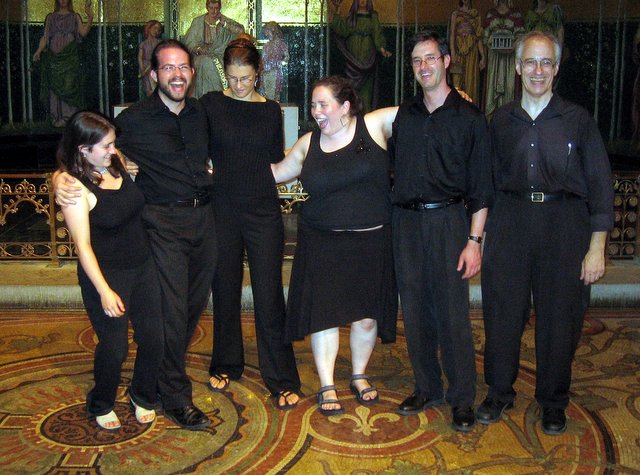
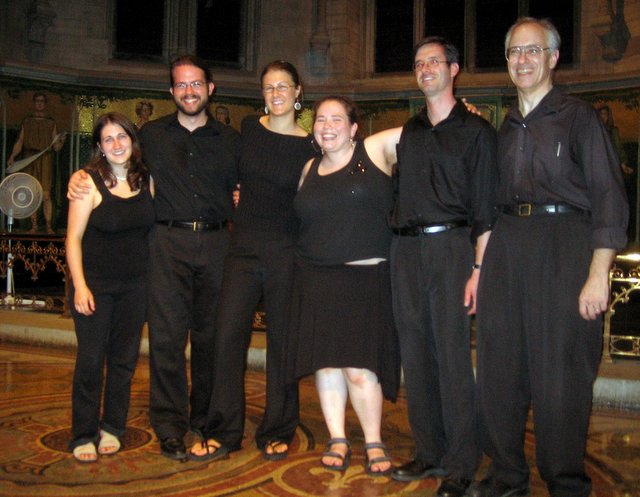
And now for the more traditional pose… What a team of singers! Thanks, everybody, for a great concert and a great summer of rehearsals!

Posted by Picasa

Geistliches Lied Part 3a

Next, the pre-silly picture. (These are getting posted separately because I’m trying to learn Picasa.) This actually looks sillier than the other one, in my opinion, because it totally looks like the women of the choir are checking me out. But I think they’re actually considering whether or not to carry out the suggestion of lifting me up.


Of course, they could be checking me out. One of them said I should tell y’all about how they decided they were tired of women being treated as objects, and started objectifying all the men of the choir. I wasn’t complaining. :-) Posted by Picasa

Geistliches Lied Part 3

I asked the members of the summer choir if I could post pictures, and they all agreed, so here goes…

First, the silly picture. The friend who was taking the pictures suggested the others hoist me up in celebration of the premiere of my song. So that’s me—the one without my feet on the ground.

Posted by Picasa

Sunday, July 23, 2006

Geistliches Lied Part 2

The main reason I chose the title “spiritual song” for this series of essays is not that we sang a beautiful, relatively obscure work by Brahms last Thursday night (although that piece is certainly the source of the title). It is that singing is such a spiritual activity for me, always. My attention is constantly drawn to it, and to music in general. My friends can tell you I am rarely without music in my head, and when out in public I will invariably start asking my companions questions about whatever music is in the “background.” In truth, I do not think I am any longer capable of consigning music to the background—I will relate a brief philosophical story about that later.

I can be enrapt by almost any kind of music, as long as it’s of good quality. I enjoy art music from any era; my own collection reaches from the mediaeval period to the last few years, with a heavy bias towards the 20th century. (The recordings I have of Messiaen outnumber those of Mozart by two or three to one.) My collections of jazz and folk music are growing (the latter being helped by a strong folk community in Ithaca). My collection of so-called “world music”—a catch-all which includes Edith Piaf, Bob Marley, and Värttinä, and could also include a great deal of what I call “folk”—is remaining steady; I would welcome suggestions here. I’m weak on rock music; while I would like to develop a taste for classic rock, whatever that means, I haven’t quite succeeded.

A couple of side notes: I was originally going to say that I thought the art music of the past centuries comprises the bulk of music, and I’m astonished how often I hear someone say they like all kinds of music and omit any mention of anything written before 1960 in the list of genres they listen to. But I suspect that art music has always been outweighed by more popular—dare I say populist—and less sophisticated music. (I don’t mean “less sophisticated” as an insult; being more complex doesn’t inherently make something better.) Hence the current world of commercial music is probably the inheritor of a larger legacy than the symphonic concert hall. Still, our best records of past music lie in the scores of art music, and it seems silly to disregard hundreds of years of extant music while claiming to be a music lover.

The other note: I only recently began to appreciate opera, in the sense of listening to more than a handful of pieces from its vast literature. This is another area I’m seeking to expand in my collection. But that’s a whole other story.

Beyond the pleasure I get from listening to music, I love performing it. Not so much for the sake of the audience, though it’s nice to give them something to enjoy. I love engaging the music. Music, to me, is tactile. I've been singing since I was very young. (Becky may have me beat on this point. Her parents say that in her crib she would sing to herself rather than cry when she woke up. My parents say I would look at the books placed in my crib.) The earliest song I wrote was on the playground in kindergarten—although I’ve kept it in my head since then, and I’m not sure I’ve ever shared it with anyone. It’s called “It’s a Beautiful Day,” and it sounds like something from Sesame Street. The earliest I remember singing in public was a duet version of “Lavender Blue,” in first or second grade. I started playing the tuba in the 7th grade, and that was my main instrument for ten years. The tuba carried me to Norway with the St. Olaf Band and to Eastern Europe with the St. Olaf Orchestra. It immersed me in Rachmaninoff’s Symphony No. 2 and Holst’s suites for military band. Yet the greatest joys I have had in performance have, I believe, been while singing.

I can recall exactly when I realized how important singing is to me. At St. Olaf, the annual Christmas Festival brings together the orchestra and the five main choirs. I was in a choir every year I attended; I was the tubist for the orchestra starting sophomore year. I remember vividly the first dress rehearsal of Christmas Festival my first year; every moment was charged with a musical intensity I had never known. That’s not the story I’m going to tell. This story occurred in my junior year.

Junior year was the year I sang the least in the Christmas Festival. Those of us who belonged both to the orchestra and to a choir would have to change in and out of our robes behind the choral risers, and run up and down ladders to get in and out of our places among the singers. Each choir had two or three feature numbers, and for those of course we had to be with our choir. We could sing as much of the “massed pieces” as we felt like and our orchestral parts would allow. It so happened that, unlike the previous year, most of the pieces with orchestra included a tuba part, often a quite short one. For the sake of playing eight bars with the orchestra in an adjacent piece, I was unable to join the a cappella performance of F. Melius Christiansen’s setting of the hymn O Day Full of Grace.
O day full of grace which we behold,
Now gently to view ascending;
Thou over the earth thy reign unfold,
Good cheer to all mortals lending,
That children of light in ev’ry clime
May prove that the night is ending.

How blest was that gracious midnight hour,
When God in our flesh was given;
Then flushed the dawn with light and pow’r,
That spread o’er the darkened heaven;
Then rose o’er the world that Sun divine
Which gloom from our hearts hath driven.

Yea, were ev’ry tree endowed with speech
And every leaflet singing,
They never with praise God’s worth could reach,
Though earth with their praise be ringing.
Who fully could praise the Light of life
Who light to our souls is bringing?

With joy we depart for the promised land;
And there we shall walk in endless light.

O Day Full of Grace is one of my favorite songs ever to sing. We had performed it at the Christmas Festival my first year. In the weeks leading up to the Christmas Festival, I attended all the choir rehearsals, even those from which orchestra members were excused. Well, that’s not quite true—at times the orchestra rehearsals overlapped with the massed choir rehearsals. One evening I left the orchestra room and passed Urness Recital Hall, where the choirs rehearsed together, on my way to dinner. I stood at a window, and sang O Day Full of Grace with all my heart as Anton Armstrong conducted those who were “supposed” to be there. I knew then that singing and connecting words to music were far more important to me than being an instrumentalist. I miss playing the tuba from time to time, but I am pained when I go too long without singing with friends.

I could very nearly worship music. She has been the source and expression of much of the exultation and sorrow in my life. Yet I sense my unworthiness to serve at her altar. I do not really know how to sing well. I figure I can sing better than about 95% of the population, which is fine for entertainment, but is not what music deserves. Fortunately, music is also a great democratizer, making art and the expression of a vast range of thoughts and feelings accessible to anyone willing to listen or participate.

As for the philosophical story I mentioned earlier: this comes from one of my choral directors. He observed once during a rehearsal that the word “music” derives from “Muse,” referring to those great Greek goddesses who managed the arts. This connection, he noted, is incongruent with music’s contemporary and prevalant role of a-musement, which he took to be a negation of “musing” or thinking. I’m not sure that’s the correct etymology, since a brief search indicates that “amusement” originates from causing someone to think about something, in a distracting sense. But his point is well-posed. Socrates, according to Plato’s account in The Republic, believed that music could be a powerful force for instilling virtue or vice. He thought it would have to be regulated. Many composers have had to cope with actual regulations by their governments, who knew that music, even without words, could be patriotic or subversive; Shostakovich is well-known to have fallen in and out of favor with the Soviet government over his career. Today, however, we are aurally glutted on music, and it is cheapened by being placed where we are only dimly aware of it—in the “background.” (For contrast, check out Satie’s Musique d’ameublement, literally “furniture music,” which was intended to be remain unnoticed.) As with many other areas of modern life, the music we have available to us at any time would in the past have been beyond the reach of kings. We need to treasure it.

(I’ve become intrigued by a certain fact as I write this essay: we have nearly no synonyms for “music” in our language. We can talk about parts of music—melody, harmony, counterpoint, etc.—but there seems to be no other way to express the totality of music than with this one word.)

Lest the reader think I’m slipping into paganism with my adulation of music, let me close with the following poem by George Herbert—a coda, if you will, to the thoughts above. This comes to mind each time I am tempted to idolize such natural things beyond their eternal worth.

“The Pulley”

When God at first made man,
Having a glasse of blessings standing by;
Let us (said he) poure on him all we can:
Let the worlds riches, which dispersed lie,
Contract into a span.

So strength first made a way;
Then beautie flow’d, then wisdome, honour, pleasure:
When almost all was out, God made a stay,
Perceiving that alone of all his treasure
Rest in the bottome lay.

For if I should (said he)
Bestow this jewell also on my creature,
He would adore my gifts in stead of me,
And rest in Nature, not the God of Nature:
So both should losers be.

Yet let him keep the rest,
But keep them with repining restlesnesse:
Let him be rich and wearie, that at least,
If goodnesse leade him not, yet wearinesse
May tosse him to my breast.

Friday, July 21, 2006

Geistliches Lied

Last night the Cornell University Summer Choir gave its fourth annual concert. I have sung with this group for the last three summers. It has traditionally been composed primarily of members of the Glee Club and Chorus. While I have never belonged to either of those organizations (the Glee Club because I haven’t been able to commit the time, and the Chorus because—well—it’s a women's ensemble), they have been kind enough to permit me to join them in music-making. I think the fact that I sang at St. Olaf was my “in” the first year, and thereafter I had the benefit of a precedent. This year, for various reasons, we ended up with only six singers (hence one member billed the choir to her friends as the “Summer Sextet”). Good musicians all, and we had a great time rehearsing and delivering the performance.

As almost any proper choral concert should, ours included a mix of music reaching back into the Renaissance, up into the 21st century, with both classical “art” songs and folk songs. The second piece we performed was Brahms’ Op. 30, Geistliches Lied, whose title means “spiritual song.” It is a marvelously composed work: slow, peaceful, yet highly contrapuntal. Each section is a double canon—one canon between the soprano and tenor, the other between the alto and bass. The text is by Paul Flemming, and is apparently difficult to translate properly; one choir member described Flemming as a “German John Donne,” with whom he was contemporary. Below is the German text and a decent translation I found online.
Lass dich nur nichts nicht dauren mit Trauren,
sei stille, wie Gott es fügt, so sei vergnügt mein Wille!
Was willst du heute sorgen auf morgen?
Der Eine steht allem für, der gibt auch dir das Deine.
Sei nur in allem Handel ohn’ Wandel,
steh’ feste, was Gott beschleusst, das ist und heisst das Beste.
Amen.

Do not be sorrowful or regretful;
Be calm, as God has ordained, and thus my will shall be content.
What do you want to worry about from day to day?
There is One who stands above all who gives you, too, what is yours.
Only be steadfast in all you do,
stand firm; what God has decided, that is and must be the best.
Amen.
We also premiered a piece I wrote, entitled Promised Land. It was the last big number of the concert (not quite the closer, since we sang two lullabies by Charles Ives afterwards), and was well-received. There’s a story to how this song began: early one Saturday morning around March of 2005, I was awoken by the cold wind blowing in through my window. Almost immediately the first line of the second verse below started going through my head. A little while later (still lying in bed), I came up with the first verse and a second tune, which is intended to be a “walking” tune. The words throughout tell of hope, of reaching a final destination. For me, this song captures how I was feeling that morning—a bit chilly, increasingly dealing with life’s struggles, but sure of God’s providence.
Though the road is harder now, I feel like I can make it,
Feel like I can make it all the way;
Though the road is harder now, I feel like I can make it,
Like I can make it to the promised land.

The wind blows colder now, and I feel like I’ve been walkin’,
Feel like I’ve been walkin’ for so long;
The wind blows colder now, but you know I'll keep on walkin’.
I'm gonna make it to the promised land.

One day my Lord called; He said, “It’s time to make the journey,
Time to make the journey of your life.”
I said to Him, “Oh, Lord, I pray it won’t be too long.”
He said, “My grace is enough for you.”

I'm goin’ stronger now, ’cause His Spirit lives within me
To lead and guide me all the way.
I'm goin’ stronger now, ’cause His Spirit lives within me,
And He will take me to the promised land.

Glory, Hallelujah,
I'm singin’ glory, Hallelujah!


The rest of the program:
  • Ave Maria, Jean Mouton
  • The Well-Beloved (Armenian folksongs), collected by H. Gudenian, arr. Deems Taylor
  • Anthony O’Daly, Samuel Barber
  • Locus Iste, Anton Bruckner
  • Blessed is the Man that Trusteth in the Lord, Alan Hovhaness
  • Poor Pilgrim, collected by R. Nathaniel Dett
  • Tryin’ to Get Home, trad.
  • City Called Heaven, arr. Josephine Poelinitz
  • Berceuse and There is a Lane, Charles Ives, arr. H. Haufrecht